

A baseball field is more than just a patch of grass and a few bases. It is a place where athletes compete, families gather, and communities come together after sunset. But behind every well-lit night game is a major operating expense that many facility owners and managers overlook: field lighting.
Traditional baseball field lights can consume a surprising amount of electricity, require frequent maintenance, and create ongoing costs that add up year after year. Upgrading to LED lighting has become a popular choice for schools, municipalities, sports complexes, and private facilities because the benefits go far beyond brighter lights.
LED baseball field lighting can reduce operating expenses, improve the playing experience, and create new revenue opportunities. While the upfront investment may seem significant, the long-term return often makes the upgrade financially attractive.
Understanding the Real Cost of Traditional Baseball Field Lighting
Many baseball fields still rely on older metal halide or high-pressure sodium lighting systems. These technologies have served sports facilities for decades, but they come with several hidden costs.
One of the biggest expenses is electricity usage. Traditional field lights often require high wattage fixtures to provide enough illumination across a large playing area. A typical baseball field may use dozens of fixtures, with each light consuming thousands of watts. When games, practices, and tournaments run several nights a week, energy costs can quickly become a major part of the facility budget.
For example, imagine a baseball field operating 30 traditional fixtures at 1,500 watts each. The total load is approximately 45,000 watts, or 45 kilowatts. If the lights operate for 1,000 hours per year and electricity costs $0.15 per kilowatt-hour, the annual energy expense would be:
45 kW × 1,000 hours × $0.15 = $6,750 per year
That calculation only covers electricity. It does not include maintenance, replacement parts, labor, or equipment rental costs.
Traditional lighting also loses brightness over time. A metal halide lamp may appear to work normally, but its light output gradually decreases as it ages. Facility managers often need to replace lamps regularly to maintain acceptable visibility, which creates additional labor expenses and scheduling headaches.
LED systems approach the problem differently. Instead of constantly replacing aging bulbs, LED fixtures are designed to provide consistent performance for many years with significantly less maintenance.
How to Calculate the ROI of a Baseball Field LED Upgrade
Every baseball facility has its own operating schedule, electricity rates, maintenance costs, and revenue opportunities, so the exact return on investment will vary from one project to another. However, using a simple ROI calculation can help facility owners understand how quickly an LED lighting upgrade can pay for itself.
Rather than looking only at the upfront installation cost, it is better to consider the full financial picture. A modern LED system creates value through multiple channels, including lower energy bills, reduced maintenance expenses, increased field availability, and additional rental opportunities.
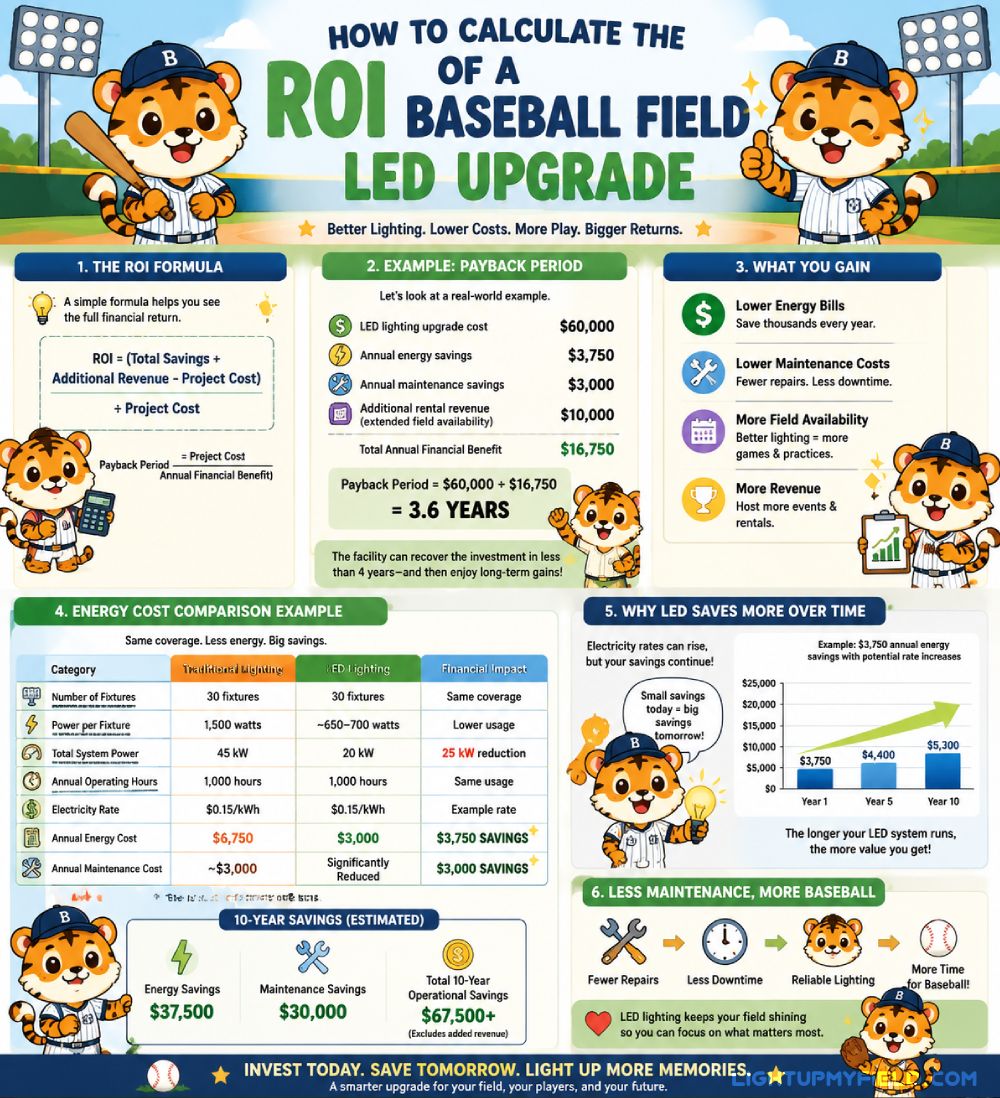
A basic ROI formula is:
ROI = (Total Savings + Additional Revenue – Project Cost) ÷ Project Cost
Another useful way to look at the investment is through the payback period, which shows how long it takes for the savings and added revenue to recover the original cost.
Payback Period = Project Cost ÷ Annual Financial Benefit
Example: Estimating the Payback Period of an LED Upgrade
Consider a baseball facility that invests in a new LED lighting system with the following costs and benefits:
- LED lighting upgrade cost: $60,000
- Annual energy savings: $3,750
- Annual maintenance savings: $3,000
- Additional rental revenue from extended field availability: $10,000
The total annual financial benefit would be:
- $3,750 + $3,000 + $10,000 = $16,750 per year
The estimated payback period would be:
- $60,000 ÷ $16,750 = approximately 3.6 years
This means the facility could potentially recover the original investment in less than four years. After reaching the payback point, the continued energy savings, lower maintenance expenses, and additional income opportunities become long-term financial advantages.
For facilities that operate their fields frequently, the payback period may be even shorter. A stadium hosting tournaments, school competitions, or community events several nights per week has more opportunities to benefit from improved lighting efficiency and increased scheduling flexibility.
Looking Beyond the Initial Cost of LED Lighting
One common mistake is focusing only on the purchase price of a new lighting system. While the upfront cost of LED fixtures and installation may be higher than simply repairing an aging lighting system, the long-term operating costs tell a different story.
Traditional lighting systems often continue creating expenses year after year through higher electricity consumption, replacement lamps, maintenance labor, and equipment rentals. These ongoing costs can quietly drain a facility’s budget.
LED lighting changes the financial equation by shifting the focus from short-term spending to long-term value.
A baseball field that saves several thousand dollars every year can turn its lighting system from an ongoing expense into an asset that contributes to the facility’s financial health.

ROI Examples
Energy Savings That Continue Year After Year
Energy savings are usually the first and most noticeable financial benefit after upgrading to LED.
Traditional sports lighting systems often require large amounts of electricity because older fixtures are less efficient at converting power into usable light. Baseball fields are especially affected because the playing area is large and requires high levels of illumination for nighttime games.
LED technology produces more usable light while consuming significantly less energy. Depending on the age and condition of the existing system, many baseball facilities can reduce lighting energy consumption by 40% to 70%.
| Category | Traditional Lighting System | LED Lighting System | Financial Impact |
|---|---|---|---|
| Number of fixtures | 30 fixtures | 30 fixtures | Same lighting coverage with improved efficiency |
| Fixture power consumption | 1,500 watts each | Approximately 650–700 watts each | Lower electricity usage |
| Total system power | 45 kW | 20 kW | 25 kW reduction |
| Annual operating hours | 1,000 hours | 1,000 hours | Same field usage |
| Electricity rate | $0.15/kWh | $0.15/kWh | Example utility cost |
| Annual energy cost | $6,750 | $3,000 | $3,750 annual energy savings |
| Annual maintenance cost | Approximately $3,000 | Significantly reduced | $3,000 potential annual maintenance savings |
| Additional rental opportunities | Limited by lighting restrictions | More flexible scheduling | Potential extra revenue |
| 10-year energy savings | — | — | $37,500 |
| 10-year maintenance savings | — | — | $30,000 |
| Total 10-year operational savings | — | — | $67,500+ (excluding added revenue) |
Example Energy Cost Comparison
Imagine a baseball field currently using 30 traditional fixtures rated at 1,500 watts each.
The total power usage would be:
- 30 fixtures × 1,500 watts = 45,000 watts
Or:
45 kilowatts (kW)
Assuming the field operates for 1,000 hours per year and electricity costs $0.15 per kilowatt-hour:
- 45 kW × 1,000 hours × $0.15 = $6,750 annual energy cost
Now imagine replacing the system with LED fixtures that provide similar or improved lighting levels while reducing power consumption to approximately 20 kW.
The new energy cost would be:
- 20 kW × 1,000 hours × $0.15 = $3,000 per year
The annual energy savings would be:
- $6,750 – $3,000 = $3,750 saved every year
Over a 10-year period, the energy savings alone could reach:
- $3,750 × 10 = $37,500 in savings
This calculation does not include maintenance reductions, potential utility rebates, or additional revenue created by increased field usage. When those factors are added, the total financial return can become much stronger.
Why Energy Savings Matter More Over Time
Electricity rates have increased in many regions, and operating costs are becoming a bigger concern for sports facilities. A lighting system installed today will continue operating for many years, which means even small annual savings can grow into a significant amount over time.
For example, a facility saving $3,750 per year today may save considerably more in the future if electricity prices rise. The longer the LED system operates, the more value it can provide.
Increasing Revenue Through More Usable Field Time
A baseball field is more than just a place where games take place. For many schools, municipalities, sports complexes, and private organizations, it is also a valuable revenue-generating asset. The more efficiently a field can operate, the more opportunities it has to create income.
One of the biggest advantages of upgrading to LED lighting is the ability to maximize field availability. Older lighting systems can limit scheduling flexibility because many traditional fixtures require a warm-up period before reaching full brightness. In some cases, metal halide lights may take several minutes to reach optimal output, which can create delays when games run late or weather interruptions push schedules behind.
These delays may seem minor, but over an entire season, they can affect how many events a facility can host. A field that loses even 15 to 20 minutes between events may have fewer opportunities to schedule additional rentals, practices, or tournaments.
LED lighting removes many of these limitations with instant-on and instant-off capability. Facility managers can activate the lights shortly before an event begins and turn them off immediately after the final pitch, reducing unnecessary energy use while creating greater scheduling flexibility.
This flexibility allows facilities to maximize their available hours and accommodate more activities, such as:
- Evening league games
- Youth baseball tournaments
- Baseball clinics and camps
- Team training sessions
- Community events
- School competitions
For facilities with high demand, these additional hours can translate directly into new revenue.
How Additional Field Availability Can Improve ROI
Consider a sports complex that gains the ability to add just two additional evening rental slots per week because the LED system allows easier scheduling and more reliable lighting performance.
If each rental generates $250:
- 2 additional rentals × $250 × 50 weeks = $25,000 in additional annual revenue
Over five years, that additional scheduling opportunity could potentially generate:
- $25,000 × 5 = $125,000 in additional revenue
Of course, the actual numbers will vary depending on rental rates, demand, and operating schedules. However, the example shows how improved lighting availability can significantly influence the financial return of an LED upgrade.
For a facility that previously viewed lighting only as an operating expense, LED technology can change the conversation. Instead of simply paying for electricity and maintenance, the lighting system becomes a tool that helps the field generate more value.
Creating More Opportunities for Tournaments and Special Events
Well-lit facilities are often more attractive to tournament organizers and event planners. A baseball complex with high-quality LED lighting can offer more reliable scheduling options, especially for multi-day tournaments where games frequently continue into the evening.
Tournament events can bring additional income through:
- Field rental fees
- Concession sales
- Parking revenue
- Sponsorship opportunities
- Local tourism spending
A lighting upgrade may not only improve the existing game schedule but also help position the facility as a stronger venue for regional competitions.
For example, a youth baseball tournament that requires multiple fields and evening games may prioritize facilities with modern lighting because organizers want to avoid delays and provide a better experience for teams and families.
Improving the Baseball Experience With Better Lighting Quality
Financial benefits are only one part of the value created by LED baseball field lighting. The quality of the playing environment also matters. Baseball is a fast-paced sport where players need to react quickly, and proper visibility can directly affect how comfortably and confidently they perform.
Players need to track pitches traveling at high speeds, follow fly balls against the night sky, and judge the movement of line drives across the field. Poor lighting can create uneven brightness, dark areas, glare, and distracting shadows that make these tasks more difficult.
For athletes, coaches, and umpires, inconsistent lighting can affect concentration and overall game quality. Spectators may also notice when a field feels poorly illuminated, especially during evening games where visibility is a major part of the experience.
LED lighting improves these conditions by providing better control over light distribution. Modern LED fixtures are designed with advanced optics that allow light to be directed precisely where it is needed, rather than spreading excess light into unwanted areas.
This creates several benefits:
- Improved visibility for players, allowing athletes to follow the action more easily and feel more comfortable during nighttime competition.
- A better experience for fans, creating a brighter, more professional atmosphere that makes games more enjoyable for spectators.
- Higher-quality video and photography, which is increasingly valuable for schools, teams, and tournaments that share highlights, livestream games, or promote events online.
- Enhancing the Professional Look of the Facility
The appearance of a baseball field can influence how players, families, and event organizers view the venue. Bright, consistent LED lighting can make a field feel more modern and professionally maintained.
For facilities hoping to attract larger tournaments, higher-level competitions, or community events, lighting quality can become part of the overall venue experience.
A well-lit field sends a message that the facility invests in safety, performance, and user satisfaction. It can help create a more memorable experience for athletes and spectators while supporting the facility’s reputation.
In today’s competitive sports environment, small improvements can make a difference. A field with reliable, high-quality LED lighting is not just easier to operate; it is also better positioned to attract more users, more events, and more long-term value.
A Smarter Investment for the Future of Baseball Facilities
Replacing baseball field lights with LED is not simply a lighting upgrade. It is a long-term investment that can improve financial performance, simplify maintenance, and create a better experience for everyone who uses the field.
The strongest returns usually come from combining multiple benefits: lower energy bills, fewer repairs, increased field availability, and improved game quality. While every facility has different numbers, many LED projects can achieve payback within several years and continue generating savings long after.
If you are considering upgrading your baseball field lighting, our team can help evaluate your current system, estimate potential energy savings, and design an LED solution that fits your facility’s goals and budget. Contact us for a professional consultation and discover how modern LED lighting can help your baseball field become more efficient, cost-effective, and ready for the future.