
Baseball is one of the few sports where the ball can travel well over 150 km/h, soar high into the night sky, and change direction in a split second. That means players, umpires, spectators, and even television cameras all rely on a lighting system that delivers consistent visibility from every angle. A well-designed baseball stadium lighting system isn’t just about making the field brighter. It’s about creating the right balance between illumination, uniformity, glare control, energy efficiency, and long-term operating costs.
Whether you’re planning a community baseball field, a school stadium, or a professional venue, understanding the fundamentals of sports lighting can help you avoid costly mistakes later. From choosing the right LED fixtures to deciding how many light poles are needed, every design decision has a direct impact on performance and maintenance.
Baseball Lighting Standards and Illuminance Requirements
Before choosing LED sports lights, deciding on pole locations, or running a lighting simulation, it’s a good idea to understand the lighting standards that apply to baseball fields. Unlike many other outdoor sports, baseball has very specific lighting requirements because the ball travels at high speed and can remain airborne for several seconds. Players need to track line drives, pop flies, and fast pitches without losing sight of the ball against the night sky, while umpires, spectators, and broadcast cameras also need clear visibility from different viewing angles.
Lighting recommendations vary depending on the level of competition, whether games are played recreationally or professionally, and whether television broadcasting is involved. Organizations such as the Illuminating Engineering Society (IES), local sports associations, and professional leagues all provide recommended lighting practices to help designers achieve consistent playing conditions.
Rather than focusing on brightness alone, a successful baseball stadium lighting design balances illuminance, uniformity, glare control, color quality, and energy efficiency. When these factors work together, the field becomes easier to play on, more comfortable for spectators, and less expensive to operate over the long term.
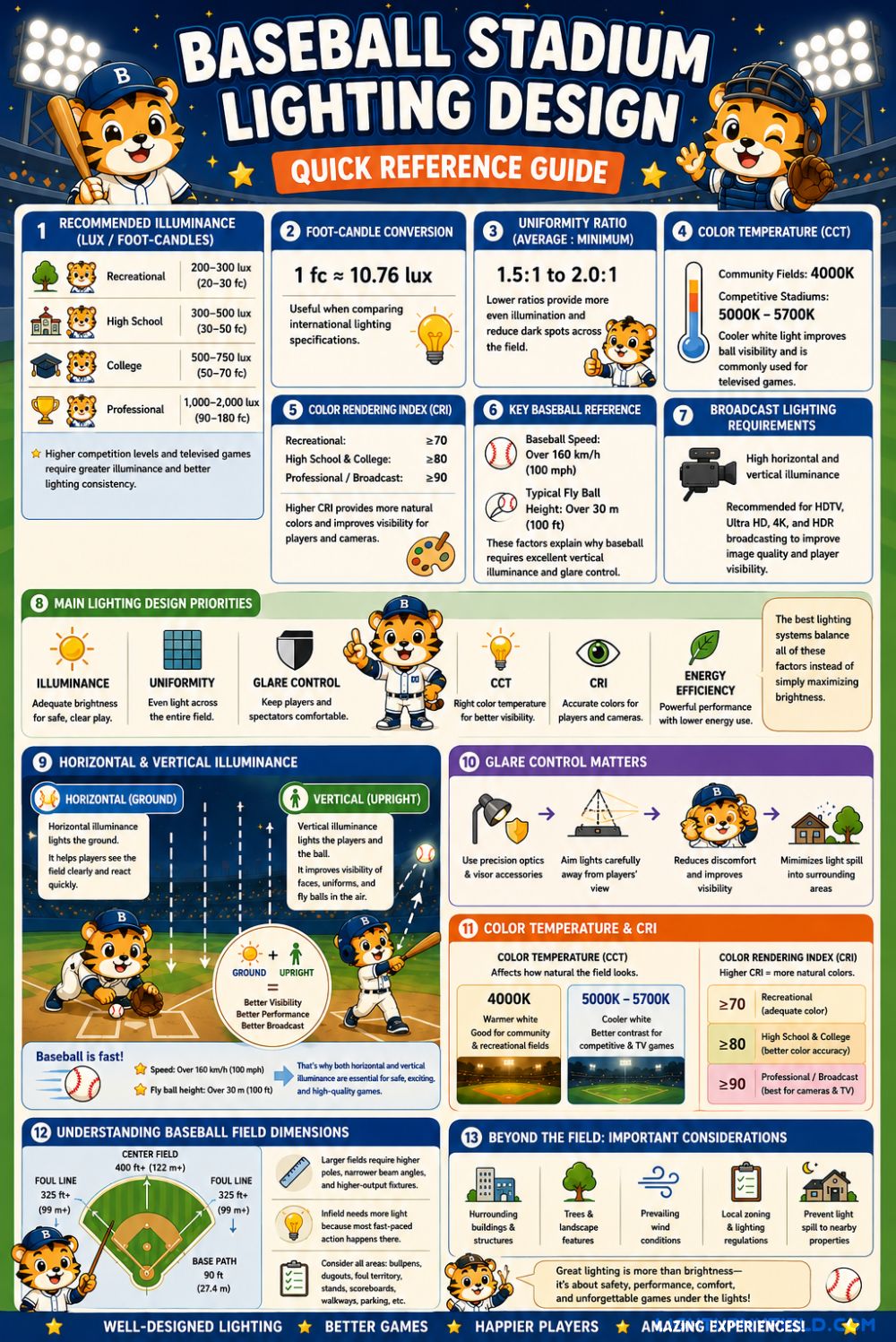
| Category | Recommended Value / Range | Notes |
|---|---|---|
| Recommended Illuminance (Lux / Foot-Candles) | Recreational: 200-300 lux (20-30 fc)High School: 300-500 lux (30-50 fc)College: 500-750 lux (50-70 fc)Professional: 1,000-2,000 lux (90-180 fc) | Higher competition levels and televised games require greater illuminance and better lighting consistency. |
| Foot-Candle Conversion | 1 fc ≈ 10.76 lux | Useful when comparing international lighting specifications. |
| Recommended Uniformity Ratio (Average : Minimum) | 1.5:1 to 2.0:1 | Lower ratios provide more even illumination and reduce dark spots across the field. |
| Recommended Color Temperature (CCT) | Community Fields: 4000KCompetitive Stadiums: 5000K-5700K | Cooler white light improves ball visibility and is commonly used for televised games. |
| Recommended Color Rendering Index (CRI) | Recreational: ≥70High School & College: ≥80Professional/Broadcast: ≥90 | Higher CRI provides more natural colors and improves visibility for players and cameras. |
| Key Baseball Lighting Reference Values | Baseball Speed: Over 160 km/h (100 mph)Typical Fly Ball Height: Over 30 m (100 ft) | These factors explain why baseball requires excellent vertical illuminance and glare control. |
| Broadcast Lighting Requirements | High horizontal and vertical illuminance | Recommended for HDTV, Ultra HD, 4K, and HDR broadcasting to improve image quality and player visibility. |
| Main Lighting Design Priorities | Illuminance, Uniformity, Glare Control, CCT, CRI, Energy Efficiency | The best lighting systems balance all of these factors instead of simply maximizing brightness. |
Recommended Lux and Foot-Candle Levels
Illuminance is typically measured in lux (lx) or foot-candles (fc). Lux measures lumens per square meter, while foot-candles measure lumens per square foot. Since 1 foot-candle equals approximately 10.76 lux, you’ll often see both units listed in sports lighting specifications, especially for international projects.
The recommended illuminance depends on the type of baseball facility. Community and recreational baseball fields generally require around 200 to 300 lux (20 to 30 fc), providing enough brightness for evening practices and local league games.
For high school baseball fields, lighting levels usually increase to around 300 to 500 lux (30 to 50 fc). This additional brightness makes it easier for players to judge fast-moving balls while improving visibility for coaches, officials, and spectators sitting further from the field.
College baseball stadiums often target 500 to 750 lux (50 to 70 fc) across the playing surface. At this level, players can more comfortably follow fly balls, while the lighting also supports photography and basic video production.
Professional baseball stadiums generally require much higher lighting levels, typically between 1,000 and 2,000 lux (90 to 180 fc) depending on league regulations and broadcasting requirements. Major televised events may also specify minimum vertical illuminance, since television cameras capture players from multiple directions rather than directly overhead.
Modern 4K, Ultra HD, and HDR broadcasting has raised lighting expectations even further. Higher-resolution cameras reveal uneven lighting much more easily than older broadcast systems, which is why many newly constructed stadiums are designed with higher average illuminance and tighter uniformity ratios than facilities built 15 or 20 years ago.
It’s also worth remembering that the infield and outfield don’t always require exactly the same lighting levels. The infield typically demands higher illuminance because most fast-paced action happens around the pitcher’s mound, batter’s box, home plate, and bases.
Horizontal and Vertical Illuminance
When discussing baseball lighting, people often focus only on horizontal lux measured across the playing surface. However, vertical illuminance is equally valuable, especially for competitive games and television broadcasting.
Horizontal illuminance measures the amount of light reaching the ground, while vertical illuminance measures the light falling on upright objects such as players, umpires, and the baseball itself during flight. Good vertical lighting makes facial expressions easier to see, improves camera image quality, and helps fielders judge high fly balls against the night sky.
A balanced combination of horizontal and vertical illuminance produces a field that feels naturally lit rather than simply bright.
Uniformity Matters as Much as Brightness
Many people assume installing brighter LED floodlights automatically creates a better baseball field. In reality, lighting uniformity often has a much bigger influence on player performance.
Uniformity describes how evenly light is distributed throughout the playing area. Imagine one section of the outfield measuring 900 lux, while another nearby area drops to only 350 lux. Every time an outfielder moves between those zones, their eyes need a moment to adjust. During a fast game, even a brief adjustment can affect reaction time when chasing a fly ball or judging a catch near the warning track.
For most baseball facilities, designers aim for an average-to-minimum uniformity ratio between 1.5:1 and 2.0:1. Stadiums designed for professional competitions or televised events may require even tighter uniformity to satisfy broadcasting standards.
Good uniformity also reduces harsh shadows around the bases, improves visibility near the pitcher’s mound, and creates a more consistent appearance across the entire field. Spectators may not consciously notice excellent uniformity, but they’ll certainly notice when parts of the field look noticeably darker than others.
Reducing Glare for Players and Spectators
Glare is another factor that should never be overlooked during baseball lighting design.
A baseball can travel well over 160 km/h (100 mph), and fly balls may reach heights exceeding 30 meters (100 feet). If players have to look directly toward high-output LED fixtures while tracking the ball, even a brief moment of discomfort can affect visibility.
Modern sports lighting systems use carefully engineered optics, asymmetric beam distributions, visor accessories, and precision aiming angles to reduce glare without sacrificing brightness. Positioning light poles outside the primary viewing angles also helps prevent fixtures from shining directly into the batter’s or catcher’s line of sight.
Besides improving player comfort, good glare control creates a much more enjoyable viewing experience for spectators and reduces unwanted light spill into nearby residential areas.
Choosing the Right Color Temperature
Color temperature, expressed in Kelvin (K), affects how natural the baseball field appears after sunset.
Most modern baseball stadiums use 5000K or 5700K LED sports lighting, producing a crisp white light that closely resembles natural daylight. This allows players to distinguish the white baseball more easily against grass, dirt, fencing, and the evening sky.
Some recreational fields choose 4000K lighting because it produces a slightly warmer appearance that some communities find more comfortable. While there’s nothing wrong with using a lower color temperature for local facilities, higher-level competitions generally prefer cooler white light because it provides sharper visual contrast and better image quality for cameras.
Using a consistent color temperature across every fixture is equally valuable. Mixing different Kelvin ratings can cause sections of the field to appear different shades of white, which creates an uneven visual appearance during games and broadcasts.
Why High CRI Improves Visibility
Another specification worth paying attention to is the Color Rendering Index (CRI).
CRI measures how accurately a light source reproduces colors compared to natural daylight, using a scale from 0 to 100. Higher values allow players, officials, and cameras to distinguish colors more accurately.
For recreational baseball fields, a CRI of 70 or higher is generally sufficient. High school and college stadiums often select fixtures with CRI 80+, while professional baseball stadiums frequently specify CRI 90 or above, particularly when television production is involved.
Although CRI doesn’t directly increase brightness, it can noticeably improve visual clarity. Grass appears greener, dirt infields show better texture, uniforms look more natural, and the baseball itself becomes easier to track against different backgrounds.
Understanding Baseball Field Dimensions
Every baseball field presents its own lighting challenges because no two layouts are exactly alike. A Little League diamond, a high school field, and a professional stadium all have different dimensions, which directly affect fixture selection, beam angles, pole heights, and lighting calculations.
For example, a professional baseball field features 90-foot (27.4-meter) base paths, while the distance from home plate to the outfield fence typically ranges from 325 feet (99 meters) down the foul lines to over 400 feet (122 meters) in center field. Some Major League parks even exceed 420 feet (128 meters) in the deepest parts of the outfield.
As field size increases, light has to travel much farther. Longer throw distances often require taller poles, narrower beam angles, higher-output LED floodlights, and additional fixtures to maintain consistent illumination across the entire playing surface.
Designers also evaluate much more than just the infield and outfield. Areas such as bullpens, dugouts, foul territory, warning tracks, batting cages, spectator seating, walkways, press boxes, scoreboards, and parking areas may all require lighting as part of the complete stadium design.
Environmental factors can also influence the lighting layout. Nearby buildings, surrounding trees, prevailing wind conditions, local zoning regulations, and potential light spill toward neighboring properties are all considered before finalizing the pole arrangement.
Planning the Pole Layout and Stadium Lighting System
Designing a baseball stadium lighting system involves much more than selecting powerful LED floodlights. The overall lighting performance depends on how the lighting poles, fixtures, beam angles, mounting heights, and aiming directions work together as a complete system. Even premium LED sports lights can produce disappointing results if the poles are positioned incorrectly or if too few fixtures are installed.
Every baseball field has its own layout, dimensions, and performance requirements, so there isn’t a one-size-fits-all solution. Lighting designers normally evaluate factors such as field size, target lux levels, pole setback distance, available installation space, local building regulations, and broadcasting standards before deciding on the final lighting layout.
Rather than relying on rough estimates, most professional projects begin with a detailed sports lighting design and photometric analysis. This approach allows engineers to compare different layouts and optimize the system before construction begins, helping reduce installation costs while achieving better lighting quality.
Baseball Stadium Pole & LED Lighting Design Quick Reference
| Design Item | Typical Recommendation | Notes |
|---|---|---|
| Number of Light Poles | Community: 4 polesHigh School / College: 6 polesProfessional: 8+ poles or roof-mounted lighting | More poles generally improve lighting uniformity and reduce shadows. |
| Pole Height | Community: 18-24 m (60-80 ft)High School / College: 24-30 m (80-100 ft)Professional: 36-45 m (120-148 ft) | Taller poles improve beam overlap, reduce glare, and increase vertical illuminance. |
| Number of LED Fixtures | Community: 24-40 fixturesHigh School: 40-70 fixturesCollege / Professional: 60-150+ fixtures | Actual quantity depends on field size, lux requirements, beam angles, and lighting simulations. |
| LED Fixture Wattage | Community: 500-750WMedium Stadiums: 1,000-1,200WProfessional: 1,500-1,800W | Higher wattage does not always produce better lighting. Fixture optics are equally important. |
| Typical Lumen Output | 1,000-1,200W: 140,000-180,000 lm1,500-1,800W: 200,000+ lm | High-lumen fixtures are commonly used for long throw distances in larger stadiums. |
| Lighting Design Method | Photometric simulation using IES files | Used to verify average lux, minimum lux, uniformity, glare, vertical illuminance, and spill light before installation. |
| Main Design Targets | Uniform beam overlap, low glare, high horizontal & vertical illuminance | Proper pole layout and fixture aiming usually have a greater impact than simply installing higher-wattage lights. |
How Many Light Poles Does a Baseball Stadium Need?
One of the first questions clients usually ask is, “How many light poles do we actually need?” The answer depends on much more than the size of the field.
A lighting designer considers the required average illuminance, uniformity ratio, pole height, fixture output, throw distance, glare control, and whether the venue will host recreational games, league competitions, or televised events. Budget and available space around the stadium also influence the final design.
For smaller community baseball fields, a four-pole configuration is often the most economical option. Two poles are typically installed along each foul line beyond first and third base. This arrangement works reasonably well for youth baseball and recreational games where lighting requirements are relatively modest, generally around 200 to 300 lux.
However, a four-pole layout has its limitations. Since each fixture has to illuminate a larger portion of the field, designers often need wider beam angles. That can create more shadows around the infield and reduce lighting uniformity, especially in deep outfield areas.
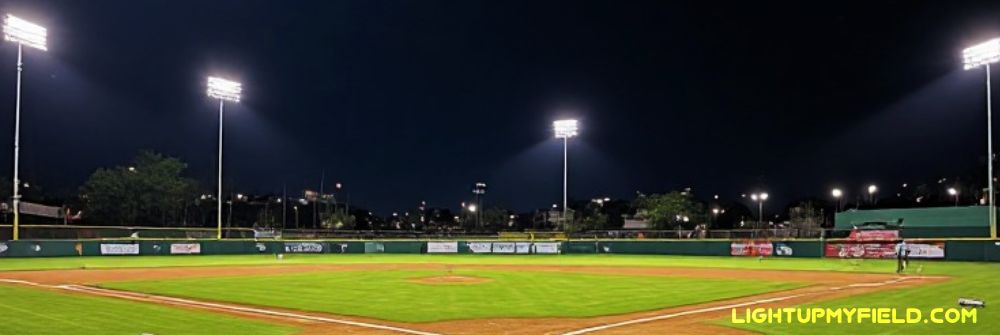
Many high school and college baseball stadiums use a six-pole layout, with three poles positioned along each foul line. This configuration offers a much better balance between installation cost and lighting performance. Because the fixtures are distributed across more locations, each luminaire covers a smaller area, allowing beams to overlap more naturally. The result is smoother illumination, fewer dark spots, and improved visibility for both players and spectators.
Professional baseball stadiums often use eight lighting poles, while some modern venues integrate lighting directly into the roof structure or grandstand canopy. By introducing additional lighting positions around the field, designers can achieve higher illuminance, tighter uniformity ratios, and better vertical lighting for television cameras. This multi-directional lighting approach also reduces harsh shadows around the bases, pitcher’s mound, and home plate.
Instead of choosing a pole quantity based on past projects, experienced lighting engineers almost always verify the design through photometric simulations. It’s quite common for two baseball fields with similar dimensions to require different pole layouts because of surrounding buildings, local regulations, or varying broadcast requirements.
Choosing the Right Pole Height
Pole height has a surprisingly large impact on lighting quality. Many people assume taller poles simply allow lights to shine farther, but the benefits go well beyond that.
As mounting height increases, the angle at which light reaches the playing surface becomes more gradual. This creates smoother beam overlap, improves uniformity, and reduces the harsh contrast between bright and dark areas. Taller poles also allow the baseball to remain illuminated for a longer portion of its flight, making it easier for fielders to track high pop flies and deep fly balls.
For community baseball facilities, poles are commonly installed between 18 and 24 meters (60 to 80 feet) high. These heights provide adequate coverage for youth leagues and recreational games while keeping construction costs manageable.
High school and collegiate baseball fields often increase mounting heights to approximately 24 to 30 meters (80 to 100 feet). The additional elevation allows designers to use narrower beam angles for longer throws, improving both horizontal and vertical illuminance across larger playing areas.
Professional stadiums frequently install lighting poles exceeding 36 meters (120 feet), with some international venues approaching 45 meters (148 feet) depending on stadium design. Higher mounting positions reduce direct glare, create more balanced illumination across the entire field, and provide better lighting for high-definition television production.
That said, taller poles aren’t always the answer. Increasing pole height also increases structural loads caused by wind, requiring larger foundations and stronger steel structures. Designers therefore balance lighting performance with engineering requirements, construction costs, local zoning restrictions, and long-term maintenance considerations.
Pole Placement and Lighting Angles
Pole placement is just as influential as pole height. Even a well-designed lighting system can produce uneven results if the poles are installed in the wrong locations.
In baseball, lighting designers pay particular attention to the pitcher’s mound, batter’s box, home plate, first and third baselines, and the outfield. These are the areas where visibility has the greatest impact on gameplay.
Most lighting poles are positioned outside the field of play, beyond the foul lines, allowing fixtures to illuminate the field from multiple directions without interfering with players or spectators. Designers also avoid placing poles directly behind home plate because that can cause uncomfortable glare for batters looking toward the pitcher.
The goal is to create overlapping beam patterns from different angles. Instead of one fixture trying to illuminate a large section of the field by itself, several fixtures work together to produce consistent lighting across the playing surface. This overlapping approach improves average illuminance, minimum illuminance, vertical illuminance, and overall lighting uniformity while reducing visible shadows around players.
Pole setback distance also plays a role. Installing poles too close to the field can increase glare and reduce beam coverage, while placing them too far away may require higher wattage fixtures or taller structures to achieve the desired lux levels.
Selecting the Right Number of LED Fixtures and Verifying the Design
Once the pole layout has been finalized, the next step is determining how many LED sports lights are required and selecting the most suitable fixture specifications.
How Many LED Fixtures Are Needed?
There isn’t a fixed formula stating that every baseball field should use a certain number of luminaires. The final fixture count depends on several design variables working together.
Engineers calculate fixture quantity based on field dimensions, required lux levels, pole height, beam angle, luminaire lumen output, optical efficiency, lighting uniformity targets, and spill light restrictions. Even small adjustments to one of these factors can noticeably change the number of fixtures required.
For example, a recreational baseball field may only require around 24 to 40 LED floodlights, while a competitive high school stadium could need 40 to 70 fixtures depending on the lighting standard being followed.
Larger collegiate and professional stadiums often install 60 to well over 150 LED sports luminaires, particularly when high-definition television broadcasting is part of the project. These larger installations provide sufficient horizontal and vertical illuminance while maintaining consistent lighting across both the infield and outfield.
Rather than simply increasing the fixture count, lighting designers aim to achieve the required performance using the fewest fixtures possible. This approach helps lower installation costs, reduce power consumption, and simplify long-term maintenance.
Choosing the Appropriate Fixture Wattage
LED sports lighting fixtures are available in a broad range of wattages, typically from 500W to 1800W, although wattage alone doesn’t determine lighting performance.
Smaller recreational baseball facilities commonly use 500W to 750W LED floodlights, while medium-sized stadiums often select 1000W or 1200W fixtures capable of producing approximately 140,000 to 180,000 lumens each.
Professional baseball stadiums frequently use 1500W or 1800W sports luminaires, with premium models delivering more than 200,000 lumens per fixture. These high-output fixtures are designed to illuminate long throw distances while maintaining high uniformity across expansive playing surfaces.
Even so, choosing the highest wattage available isn’t always the smartest approach. A well-designed 1000W LED stadium light with precision optics may outperform a higher-powered fixture that uses a less suitable beam angle or optical distribution. Fixture efficiency, thermal management, driver quality, and optical design all contribute to overall lighting performance.
Why Photometric Simulations Make a Difference
Modern baseball stadium lighting projects rarely rely on estimation or simple lighting calculations alone.
Before construction begins, professional lighting designers import IES photometric files supplied by fixture manufacturers into specialized lighting simulation software. These programs create a virtual model of the baseball field, allowing engineers to evaluate how every luminaire performs before a single pole is installed.
The simulation predicts values such as average lux, minimum lux, maximum lux, horizontal illuminance, vertical illuminance, lighting uniformity, glare, beam overlap, and light spill beyond the stadium boundary. Designers can also identify potential shadowing around the bases, pitcher’s mound, dugouts, or warning track long before installation starts.
This process often saves both time and money. Making adjustments on a computer model may only take a few minutes, whereas relocating a lighting pole or replacing dozens of fixtures after construction can become a very expensive exercise.
For that reason, photometric simulations have become a standard part of professional baseball field lighting design, helping ensure the completed lighting system delivers the performance expected by players, spectators, facility owners, and broadcasters alike.
Common Baseball Stadium Lighting Design Mistakes to Avoid
Even the best LED sports lights can’t compensate for a poor lighting design. Baseball fields require careful planning to achieve the right balance of illuminance, uniformity, glare control, pole placement, and energy efficiency. Overlooking a few key details during the planning stage can lead to uneven lighting, unnecessary operating costs, and expensive upgrades later on.
Fortunately, most of these issues can be avoided by investing time in proper lighting design before construction begins.
Not Having a Professional Lighting Design Can Affect Grant Applications
Many municipalities, schools, universities, and sports organizations apply for government funding, sports facility grants, or capital improvement programs when building or upgrading baseball fields.
While grant requirements vary by country and funding agency, applicants are often expected to submit detailed project documentation, which may include lighting layouts, photometric reports, energy-saving calculations, electrical plans, and equipment specifications. A professionally designed lighting system demonstrates that the project has been properly evaluated and that the proposed installation meets the required performance objectives.
Having a complete lighting design package prepared in advance can also make it easier to estimate project costs, compare different lighting options, and answer technical questions during the funding review process. Even when a photometric report isn’t a mandatory requirement, providing one often helps present the project as more thoroughly planned and technically sound.
Installing Light Poles That Are Too Short
Trying to save money by installing shorter lighting poles is one of the most common mistakes in baseball stadium projects.
Lower mounting heights reduce the distance that light can travel, creating smaller coverage areas and making it more difficult for multiple fixtures to overlap smoothly. The result is often uneven illumination, stronger glare, and more noticeable shadows, particularly around the pitcher’s mound, batter’s box, and deep outfield.
Shorter poles may also require additional fixtures to compensate for the reduced coverage, which can offset any initial savings on pole costs. Choosing the appropriate pole height based on field dimensions and required lux levels usually delivers better lighting quality while reducing future upgrade costs.
Choosing Fixtures Based Only on Wattage
It’s easy to assume that a 1500W LED sports light will always outperform a 1000W model, but that’s not necessarily true.
Wattage simply indicates power consumption. Lighting performance depends on many other factors, including lumen output, beam angle, optical design, luminous efficacy, glare control, and fixture aiming.
For example, a well-designed 1000W LED floodlight with precision optics may place more usable light on the playing surface than a higher-powered fixture with an unsuitable beam distribution. That’s why professional sports lighting projects focus on complete photometric performance rather than wattage alone.
Ignoring Lighting Uniformity
Meeting the target lux level doesn’t automatically guarantee good visibility.
If one section of the field is brightly illuminated while another is noticeably darker, players constantly need to adjust their eyes as they move around the field. This can make it more difficult to judge fly balls, field grounders, or react quickly to fast pitches.
A successful baseball lighting system provides consistent illumination across both the infield and outfield, helping improve player comfort, spectator experience, and television image quality.
Underestimating Long-Term Operating Costs
Looking only at the initial purchase price can sometimes become expensive over the lifespan of the lighting system.
A baseball stadium may operate its lighting for 500 to more than 1,500 hours every year, and over 10 to 20 years, electricity consumption, maintenance, and replacement costs can easily exceed the original equipment cost.
Selecting high-quality LED sports lighting with efficient drivers, durable housings, and a long service life can reduce maintenance while lowering energy consumption over time. Considering the total cost of ownership, rather than just the upfront investment, usually results in a more economical lighting system for the long run.
Building a Lighting System That Performs for Years
A successful baseball stadium lighting system is the result of thoughtful engineering rather than simply adding brighter fixtures. Balanced illuminance, good uniformity, suitable pole heights, properly selected LED luminaires, and accurate photometric simulations all work together to create a field where players can perform confidently and spectators enjoy a better viewing experience.
If you’re planning a new baseball stadium, upgrading an existing field, or comparing LED sports lighting solutions, our experienced team can help evaluate your project requirements, prepare professional lighting simulations, recommend suitable fixture configurations, and develop a solution tailored to your budget and performance goals. Feel free to contact us for expert consultation and discover how the right lighting design can deliver reliable performance for many seasons to come.