

When choosing lighting for a football field, one of the first questions that usually comes up is, “How many lumens do I need?” It sounds like a straightforward question, but the answer is not quite as simple as choosing the floodlight with the biggest lumen number.
A football floodlight needs to provide enough light across the entire playing area, not just produce a large amount of light at the fixture. Field size, mounting height, beam angle, light distribution, required lux level, and the number of floodlights all affect the final result.
For a small training pitch, the lighting requirements can be very different from those of a professional stadium. A well-designed LED system might also produce better results with fewer watts because modern LED technology can deliver a high amount of light from relatively low electrical power.
So, how many lumens does a football floodlight need? The best answer is – it depends on the field and the lighting level you need. Understanding lumens, lux, and watts makes it much easier to choose the right system.

How Many Lumens Does a Football Floodlight Need?
There is no single lumen figure that works for every football field. The number you need depends on several factors, including the size of the pitch, the required lighting level, the number of floodlights, their mounting height and the way their beams are distributed.
For example, a football floodlight might produce 30,000, 50,000, 80,000 or even more lumens. That doesn’t mean the 80,000-lumen option will automatically be the best choice. If the fixture has the wrong beam angle or is installed in an unsuitable position, a large portion of its output may not reach the areas where it is needed.
The number of fixtures also changes the calculation. A field might use several medium-output floodlights positioned around the pitch instead of relying on a few extremely powerful fixtures. Spreading the light sources around the field can make it easier to achieve a more even result and reduce the chance of creating very bright spots directly beneath or in front of individual fixtures.
| Item | Example | What It Shows |
|---|---|---|
| Training pitch | 80 × 50 m = 4,000 m² | Smaller area generally requires less total light |
| Full-size pitch | 100 × 60 m = 6,000 m² | Larger area requires more light for the same lux level |
| Example floodlight output | 30,000–80,000+ lm | Common example range for individual floodlights |
| Illustrative lighting level | 200 lux | Example target used for the calculation |
| Theoretical requirement | 6,000 m² × 200 lux = 1.2 million lm | Ideal amount of light reaching the pitch |
| Example installation | 20 × 60,000 lm = 1.2 million lm | Shows how multiple fixtures can provide the combined output |
Field Size Makes a Big Difference
Consider a full-size football pitch measuring approximately 100 metres by 60 metres. The playing area would be around 6,000 square metres. A smaller training pitch measuring 80 metres by 50 metres, on the other hand, would cover about 4,000 square metres.
That is a difference of 2,000 square metres, or roughly one-third of the larger playing area. Naturally, the amount of light required to achieve the same average illumination will also change.
This is why it can be misleading to compare football floodlights purely by fixture output. A 50,000-lumen floodlight may be perfectly suitable for one application but insufficient for another. The field dimensions and lighting layout need to be considered alongside the fixture specification.
The Required Lighting Level Comes First
In professional lighting design, the process generally starts with the required illuminance in lux, rather than simply picking a lumen number from a product catalogue.
Suppose a hypothetical project has a target average illuminance of 200 lux across a 6,000-square-metre playing area. A basic calculation would be:
6,000 m² × 200 lux = 1,200,000 lumens
This gives us 1.2 million lumens of light reaching the playing surface in an idealized calculation. However, it would be a mistake to interpret that as meaning you should simply install exactly 1.2 million lumens of floodlights.
Real lighting systems experience losses. Some light may fall outside the playing area, while fixture optics, mounting geometry, dirt, ageing and other factors can reduce the amount of useful light reaching the pitch.
The actual fixture requirement therefore needs to be higher than the simple theoretical figure, with the final result checked using photometric calculations.
How to Calculate Football Field Lighting Requirements
A basic lighting calculation starts with the size of the playing area and the target illuminance. The simple relationship is:
Required light reaching the area = Area × Target lux
Let’s use a 100-metre by 60-metre football field as an example.
The playing area is:
100 × 60 = 6,000 m²
Now imagine that the project has an illustrative target of 200 lux.
6,000 × 200 = 1,200,000 lumens
The theoretical requirement would therefore be 1.2 million lumens reaching the playing surface.
However, this is where real-world lighting design becomes more interesting. A floodlight doesn’t send every lumen directly onto the pitch. Some light may fall outside the playing area, while the fixture’s optical system and mounting position affect how efficiently the light reaches the required points.
There can also be a difference between the initial performance of a new fixture and its performance after years of operation. Dirt accumulation, ageing and other maintenance factors can affect light output.
A Practical Example With Multiple Floodlights
Suppose a designer is considering 20 floodlights, each producing 60,000 lumens. The nominal combined output would be:
20 × 60,000 = 1,200,000 lumens
At first glance, that looks like it matches the theoretical 1.2 million lumens from the previous example. But that doesn’t mean the field will actually receive an average of 200 lux.
The 1.2 million lumens is the fixture output, whereas the earlier 1.2 million-lumen figure represented light reaching the surface under ideal conditions. These are two different things.
In a real project, the designer would model the fixtures and calculate the expected lux at multiple points across the field. If the predicted results do not meet the desired performance, the designer might adjust the number of fixtures, fixture output, mounting positions, aiming angles or optics.
That is why a proper lighting simulation is much more reliable than a simple lumens-per-field calculation.
What Is a Lumen in Sports Lighting?
A lumen, written as lm, is a measurement of the total amount of visible light produced by a light source.
For example, if a football floodlight is rated at 50,000 lumens, that figure describes the amount of visible light the fixture produces. A 100,000-lumen floodlight produces roughly twice the total light output of a 50,000-lumen floodlight, assuming the ratings are measured under comparable conditions.
However, there is a catch.
The lumen rating does not tell you exactly how much light will reach the football pitch. A floodlight could have a very high lumen output, but if the beam is too narrow, badly aimed, or poorly distributed, some areas of the field may still be too dark.
That is why professional sports lighting is normally evaluated using lux as well as lumens.
Think of lumens as the amount of light leaving the fixture, while lux tells you how much light actually lands on the surface you are trying to illuminate.
Why Lumens Matter for Football Floodlights
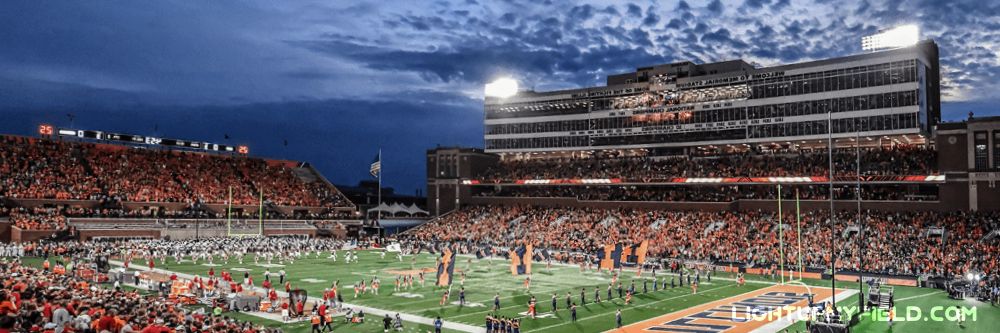
Football is a fast-moving sport, and players need to pick up the ball, teammates, opponents, field markings, and goal areas without constantly dealing with dark or overly bright patches. This becomes even more noticeable when matches and training sessions take place after sunset. A floodlight system that looks bright from the sidelines may still leave parts of the pitch poorly illuminated, which is why simply choosing a fixture with a large lumen number is not enough.
Good football floodlighting is really about putting the right amount of light in the right places. If one section of the pitch is brightly lit while another is noticeably darker, players may find it harder to track a fast-moving ball as it travels across the field. Uneven lighting can also create uncomfortable contrasts, particularly when players move between brighter and darker areas during a game.
The same applies to referees, coaches and spectators. For photographers and video operators, the quality of the lighting becomes even more noticeable because cameras can pick up differences in brightness that are not always obvious to someone watching from the stands. A pitch may look perfectly usable to the naked eye, yet recorded footage can show shadows, uneven exposure, or darker areas around the edges of the field.
This is why a football lighting project should look beyond the headline lumen rating. High lumens are useful, but even light distribution is what turns that output into usable illumination. The fixture’s optics, beam angle, mounting height and position all determine where those lumens actually go.
Another factor is the intended use of the field. A small community pitch used for evening training does not necessarily need the same lighting performance as a stadium hosting competitive matches. A field used for television or high-quality video production may have additional requirements because cameras need consistent lighting across a much wider area.
In other words, the question isn’t simply, “How many lumens does the floodlight produce?” A more useful question is, “How much light needs to reach the pitch, and how evenly can the lighting system deliver it?”
Lumens vs. Lux – What Is the Difference?
Lumens and lux are two terms you will see often when looking at sports lighting, but they measure different things. Lumens measure the total amount of visible light produced by a floodlight, while lux measures how much light actually reaches a surface. One lux equals one lumen per square metre.
A simple way to think about it is with a bucket of water. The amount of water in the bucket represents lumens, while the amount that reaches a particular area is closer to lux. A floodlight may produce plenty of lumens, but if the light isn’t directed properly, much of it may not reach the football pitch.
That is why the lumen rating alone cannot tell you how bright a field will be. The fixture’s optics, mounting height, beam angle and position all affect the final lux level on the playing surface.
Why Lux Is More Useful for the Pitch
When assessing actual football field lighting, lux is generally more useful than the total lumen output because it tells you what is happening on the pitch itself.
For example, imagine two lighting systems that each produce 1,000,000 lumens. If System A spreads the light evenly across the field while System B concentrates much of it in a few areas, they can produce very different results despite having the same total output.
This is why sports lighting designs look at average illuminance and uniformity. The aim isn’t just to make one part of the field bright, but to provide consistent lighting across the playing area.
How Beam Distribution Changes the Result
Beam angle has a direct effect on where the floodlight’s lumens go. A narrow beam concentrates light into a smaller area, while a wider beam spreads it over a larger area.
For example, a floodlight mounted 20 metres above the pitch with a narrow beam may create a bright area without adequately covering the edges. A beam that is too wide, meanwhile, could send unnecessary light beyond the field.
There is no single best beam angle for every football field. The right option depends on the mounting height, pole position, distance from the pitch and required coverage. Professional sports floodlights therefore often come with different optical configurations to suit different installations.
Lumens vs. Watts – Why Wattage Does Not Tell the Whole Story
Watts and lumens are often confused when comparing football floodlights. Watts measure electrical power consumption, while lumens measure light output.
For example, suppose Floodlight A consumes 500 watts and produces 75,000 lumens, while Floodlight B also uses 500 watts but produces 55,000 lumens. Both consume the same amount of power, but Floodlight A produces more light from that electricity.
This is where luminous efficacy comes in. Measured in lumens per watt (lm/W), it shows how efficiently a fixture converts electrical power into visible light.
A 600-watt floodlight producing 60,000 lumens has an efficacy of 100 lm/W. If another 600-watt fixture produces 80,000 lumens, its efficacy is approximately 133 lm/W.
Why LED Efficiency Matters
Football floodlights can operate for hundreds of hours each year, so efficiency can have a noticeable effect on electricity consumption.
For example, a 10 kW lighting system running for four hours uses about 40 kWh per evening. If it operates for 150 evenings a year, that adds up to approximately 6,000 kWh.
If the same lighting performance could be achieved using an 8 kW system, annual consumption would fall to around 4,800 kWh, a difference of roughly 1,200 kWh.
The actual result depends on the lighting design and operating schedule, but the example shows why efficiency should be considered alongside lumen output.
It is also worth checking whether a manufacturer’s lm/W figure refers to the LED chips or the complete fixture. For a more realistic comparison, look at the fixture’s rated lumen output, power consumption and photometric data rather than relying on one headline number.
How Do You Measure Lighting on a Football Field?
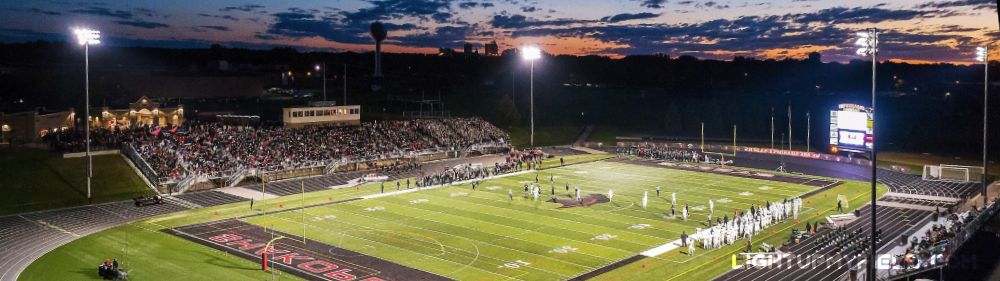
A lux meter is commonly used to measure illuminance on a football pitch. Unlike a lumen rating, which tells you how much light a floodlight produces, a lux reading tells you how much light is actually reaching the playing surface. This makes it much more useful when checking whether a football lighting system is doing its job properly.
Rather than taking just one reading in the middle of the field, measurements are normally taken at multiple points across the entire playing area. The pitch can be divided into a measurement grid, with readings collected at selected locations. For example, a field may be divided into several rows and columns so that the readings cover the centre, sidelines, penalty areas and corners rather than focusing on one small section.
The number of measurement points can vary depending on the size and purpose of the field and the applicable lighting standard. For a larger professional project, a more detailed grid may be used to provide a clearer picture of the lighting performance. The readings can then be used to calculate the average illuminance and lighting uniformity across the pitch.
This approach can reveal problems that a single measurement would easily miss. Imagine a pitch where one area measures 250 lux while another records only 120 lux. A measurement taken only at the brighter location could make the lighting appear perfectly adequate, while the wider set of readings would show that there is a noticeable difference across the playing surface.
Why Multiple Measurement Points Matter
Uniformity is especially useful for football because players are constantly moving around the field. They don’t stay under the brightest part of the floodlights. If the lighting changes significantly from one area to another, the ball and other players can become harder to see as they move through different lighting zones.
For example, imagine a pitch with an average reading of 200 lux. That number sounds straightforward, but it doesn’t tell you whether most areas are close to 200 lux or whether some areas are much brighter and others considerably darker. Two fields could have the same average lux level but provide very different lighting experiences.
This is why average lux should be considered together with uniformity. A well-designed system aims to provide a reasonably consistent level of illumination across the playing surface instead of creating a few very bright spots surrounded by darker areas.
Measuring a New Football Lighting Installation
For a new installation, lux measurements can be used to check whether the completed system performs close to the original lighting design. Before installation, lighting software can predict the expected lux levels at different points on the pitch. After the floodlights are installed and aimed, measurements can provide a useful real-world check.
If the measured results are lower than expected, there can be several reasons. Fixtures may not have been aimed at the intended angles, poles may differ slightly from the original design, or the installed products may not produce the same output used in the calculation. Even relatively small changes in positioning can affect the distribution of light.
Taking measurements after installation therefore gives the project team useful information rather than relying entirely on theoretical calculations.
Checking an Existing Football Field
Lux measurements can also be helpful when evaluating an older football lighting system. LED floodlights can maintain good performance for many years, but their output can gradually change over time. Dirt, dust, ageing components, damaged optics or changes in aiming position can also affect the amount of light reaching the pitch.
If an existing field feels darker than it used to, taking readings across the pitch can help identify whether the problem is related to overall light levels or uneven distribution. This can make it easier to decide whether the fixtures need cleaning, adjustment, repair or replacement.
Other Factors to Consider When Choosing Football Floodlights
Choosing a football floodlight involves more than checking its lumen output. The fixture needs to work with the field, pole arrangement and intended use. A floodlight that performs well on one pitch may not be the right choice for another because the installation conditions can be completely different.
Field Size and Layout
A full-size football field covers a substantial area, so the lighting system needs to reach the entire playing surface. The dimensions of the pitch provide the starting point, but the surrounding layout also matters.
Nearby buildings, spectator stands, trees, fencing and other structures can affect where poles and floodlights can be positioned. If a pole cannot be installed in the ideal location, the floodlight optics and aiming angle may need to be adjusted to compensate.
The same applies when replacing an existing system. You may already have four, six or another number of lighting poles in fixed positions, so the new LED floodlights need to be selected around that existing layout rather than assuming the poles can simply be moved.
Mounting Height
Mounting height affects both the coverage area and the aiming angle of a floodlight. A fixture installed higher above the ground generally has to throw its light over a greater distance before it reaches the playing surface.
For example, a floodlight mounted at 12 metres and another mounted at 25 metres may have identical lumen ratings, but they will not necessarily produce the same lighting pattern on the field. The beam angle, optical distribution and aiming direction need to match the mounting conditions.
Higher mounting positions can sometimes help with light distribution and glare control, but they also require appropriate fixture performance. This is why mounting height, beam angle and lumen output should be considered as a package, rather than selected independently.
Glare Control
Football floodlights can be extremely powerful, so glare deserves attention during the design stage. A fixture that is aimed directly toward players or spectators can create uncomfortable brightness, even if the overall field lighting level is suitable.
Glare can also become an issue outside the football field. Nearby houses, roads, car parks and other properties may be affected if the light is allowed to spill beyond the intended area.
Modern sports floodlights can use specialised optics, shielding and careful aiming to control unwanted light. Instead of simply increasing brightness, a good lighting design tries to put the light where it is needed and reduce unnecessary spill.
This can improve the experience for players and spectators while also making the installation more considerate of the surrounding area.
Color Quality
Lumens don’t tell you everything about how a floodlight looks.
Color temperature describes whether the light appears warmer or cooler, while color rendering relates to how naturally colors appear under the light. These characteristics don’t determine the lumen output, but they can affect the visual experience on the pitch.
For football, good color rendering can help players and officials distinguish uniforms, field markings, the ball and surrounding objects. It can become even more relevant when matches are photographed or recorded because cameras respond differently to lighting than the human eye.
For facilities that regularly produce video content, it is worth considering color quality alongside brightness and uniformity rather than treating the lumen figure as the only specification that matters.
Energy Efficiency
A football field that operates several evenings a week can use a significant amount of electricity, particularly when multiple high-output floodlights are running for several hours at a time.
For example, suppose a lighting system has a combined electrical load of 10 kW and operates for four hours during an evening training session. Its energy consumption would be approximately:
10 kW × 4 hours = 40 kWh
If the field operates under a similar schedule for 150 evenings per year, the annual consumption would be around:
40 kWh × 150 = 6,000 kWh
The actual figure will depend on the operating schedule, dimming, maintenance and control system, but the example shows how quickly operating hours can add up.
LED technology can provide a useful combination of high light output and electrical efficiency. A well-designed LED system can also support dimming or different lighting settings, allowing a facility to use a lower lighting level for training rather than operating the system at full output every time.
When comparing fixtures, look at lumens per watt (lm/W) as well as the total lumen output. A fixture that produces more useful light for each watt of electricity can provide better long-term value, especially for a football facility with frequent evening use.
Frequently Asked Questions About Football Floodlight Lumens
Is a Higher Lumen Rating Always Better?
No. A higher lumen output does not automatically mean better football field lighting. The light still needs to be distributed effectively across the playing surface, and factors such as beam angle, mounting height, optical design, glare and fixture efficiency all affect the final result.
For example, a 100,000-lumen floodlight with a poorly matched beam angle could perform worse for a particular installation than a lower-output fixture with optics designed for the mounting position. The best floodlight is the one that delivers the required lighting performance, not simply the one with the biggest number on the box.
How Many Lumens Are Needed for a Football Field?
There is no universal lumen number for every football field. The required output depends on the pitch dimensions, desired illuminance, number and position of floodlights, mounting height, beam distribution and expected light losses.
A better approach is to establish the required lux level first and then work out how much fixture output and how many floodlights are needed to achieve it evenly. A professional lighting calculation can provide a much more reliable result than choosing a lumen figure based solely on the size of the field.
Is 100,000 Lumens Enough for a Football Field?
It depends on the application and how those 100,000 lumens are distributed. A single 100,000-lumen floodlight may be useful as part of a larger lighting system, but its output alone does not tell you whether the entire football pitch will have adequate illumination.
The position of the fixture, mounting height, beam angle and distance from the field all affect how much of that light actually reaches the playing surface. If the field needs several lighting positions, the total system output may be much higher than 100,000 lumens.
Are Watts or Lumens More Useful When Buying a Floodlight?
Both are useful, but they answer different questions. Watts tell you how much electrical power the floodlight consumes, while lumens indicate how much visible light it produces.
For a proper comparison, it is worth looking at lumens, watts and lm/W together. Then consider the fixture’s optical distribution and photometric performance. Two fixtures with the same wattage can have noticeably different lumen outputs, while two fixtures with similar lumen ratings can distribute their light very differently.
How Can Football Field Lighting Be Tested?
A calibrated lux meter can be used to measure illuminance at multiple points across the football pitch. The readings can then be used to calculate the average lux level and assess how evenly the light is distributed.
For a new installation, these measurements can be compared with the predicted results from the lighting design. For an existing field, they can help identify whether the lighting has become weaker or less uniform over time.
For more demanding projects, professional lighting measurements and documentation can provide a clearer record of whether the completed installation meets the specified performance requirements.
Choosing the Right Lighting Starts With the Field
There is no magic lumen figure that works for every football pitch. The right solution comes from looking at the complete picture – field size, target lux, uniformity, mounting height, beam angle, fixture efficiency, glare control, and how the field will actually be used.
For a basic recreational pitch, the lighting design may be relatively straightforward. Larger competition fields and facilities used for filming or broadcasting require a more carefully engineered approach.
If you’re planning a new football field lighting project, upgrading existing floodlights, or simply unsure how many lumens your pitch needs, feel free to approach us for a lighting consultation. We can help assess your field dimensions, existing pole arrangement, desired lighting level, and fixture requirements, then work toward a practical lighting solution rather than simply recommending the biggest floodlight on the shelf.