

Lighting can make or break a softball game, especially when the sun goes down. The right amount of brightness doesn’t just help players see the ball — it also improves safety, fairness, and even the overall vibe of the field. Too dim, and you’ll get dangerous blind spots. Too bright, and you’ll have glare issues that throw off both players and spectators.
So what’s the right balance? That’s where lux and footcandles (fc) come in. These are the two main ways lighting engineers and field managers measure how bright a softball field should be. But if you’ve ever wondered how much light is “enough,” or how those numbers change for different competition levels, you’re in the right place.
Let’s break it down in a way that’s clear and practical — from what lux and fc actually mean, to how much lighting different types of fields really need.
Understanding Lux for Softball Field and Its Importance
Before diving into the numbers, it helps to understand what lux and footcandles actually measure — and why they matter so much in softball lighting.
Lux (symbol: lx) measures how much light falls on a surface. In simpler terms, it tells you how bright the field actually is, not just how powerful the light fixture might be. One lux equals one lumen per square meter. It’s the metric standard used around the world.
Footcandles, on the other hand, are used mainly in the U.S. and follow the imperial system. One footcandle equals one lumen per square foot. The two units are easy to convert:
1 footcandle ≈ 10.76 lux.
For example, if a softball field needs 500 lux, that’s about 46–47 footcandles.
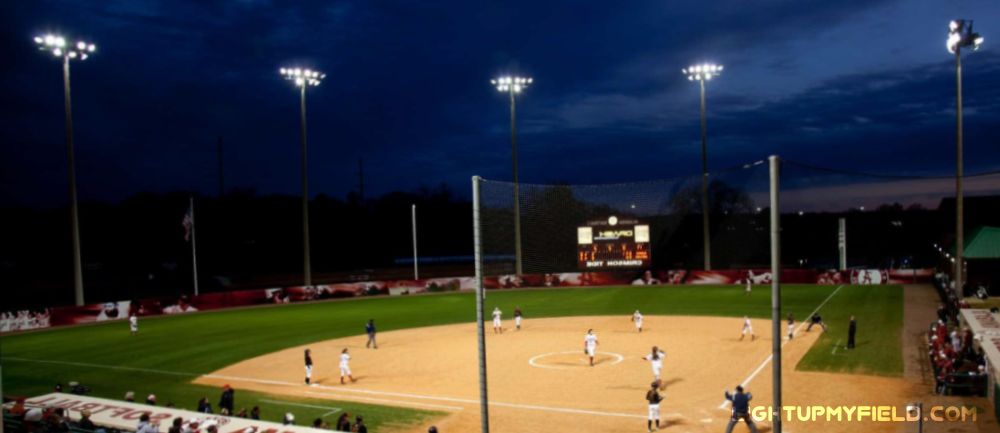
Why Lux and Fc Levels Matter in Softball
Softball is a fast-paced sport with small, high-speed objects — that ball travels fast, and players have milliseconds to react. Proper lighting allows players to see not only the ball but also each other, the field markings, and even subtle movements like a pitch release or a runner’s jump.
A well-lit field also helps umpires make fair calls and keeps spectators engaged, since the action stays visible no matter where the ball goes. For broadcasters or streaming setups, consistent lux levels are key for clear, high-quality video.
It’s not just about visibility — lighting balance matters too. The field needs uniform light distribution so there aren’t patches that are too dark or too harshly lit. Poor uniformity can throw off depth perception and make it harder to judge distances, especially on pop flies or line drives.
To put it simply: getting the lux and fc levels right makes the game smoother, safer, and way more enjoyable for everyone involved.
Suggested Lux and Fc Levels for Softball Fields
Not every softball field is built or used the same way — and neither should its lighting be. A small park where kids play on weekends doesn’t need the same intensity or precision as a college or international field packed with spectators and cameras. The ideal lighting level depends on several things: how competitive the games are, the size and layout of the field, the height and type of poles, and even whether the field will be used for broadcasting or training.
Lighting designers and organizations like the Illuminating Engineering Society (IES) have developed general standards to guide these setups, but every project still needs to adapt based on its own conditions. Below are the most commonly used lux (lx) and footcandle (fc) ranges for different levels of softball play, along with a closer look at what makes each lighting category work best.
Recreational and Community Fields
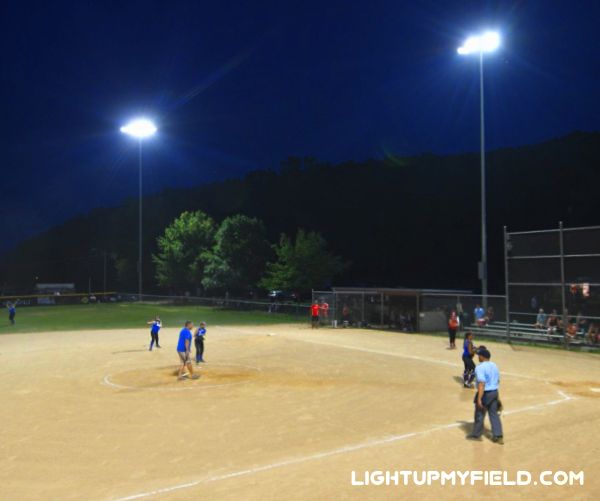 For local parks, youth leagues, and casual recreational games, lighting levels between 200 and 300 lux — or roughly 20 to 30 footcandles — are typically just right. At this range, players have clear visibility to track the ball, run bases, and react to plays, without the lighting feeling blinding or expensive to operate.
Fields at this level often rely on LED floodlights between 400W and 600W, installed on poles around 40 to 50 feet high. That height provides a broad coverage area while keeping installation costs manageable. With about 4 to 6 poles around the field, you can usually achieve uniform lighting that stays consistent across both the infield and outfield.
At recreational intensity, the goal isn’t to mimic a stadium atmosphere but to maintain a safe and enjoyable environment for all players. A good uniformity ratio — ideally around 0.5 to 0.6 — keeps shadows soft and visibility consistent. And since most community fields aren’t lit every night, energy-efficient LEDs with smart timers or motion sensors can help reduce operating hours and save on electricity bills.
As a rough estimate, lighting a 200-foot softball field for recreational play might require about 18,000 to 25,000 total watts of LED power to maintain a steady 250 lux average, depending on the fixture efficiency and aiming angles.
High School and Amateur Fields
Once you move up to competitive high school or amateur leagues, lighting performance becomes a bigger deal. The recommended illumination jumps to around 500 lux, or 50 footcandles, across the playing surface. That’s about twice the brightness of a recreational field.
At this level, players are faster, the ball moves quicker, and visibility has to be clear enough for quick reactions — especially infield plays. In these games, even a split-second delay in spotting the ball can change the outcome of a play. The uniformity ratio should stay above 0.6, which keeps the lighting balanced from the batter’s box to the far corners of the outfield.
A typical high school setup might use 6 light poles, each equipped with 8 to 12 LED floodlights rated between 600W and 1000W, mounted at 50 to 60 feet high. Together, that can produce an average brightness of 500–550 lux, enough for serious competition and small crowd viewing.
Some high schools also integrate color temperatures around 5000K–5700K, which gives off a clean, daylight-like tone. This helps players read the ball better and makes uniforms and field markings stand out under night conditions. Coaches and athletic directors often choose LEDs with optical lensing systems to minimize glare and light spill, especially when fields are close to residential areas.
College and Semi-Pro Fields
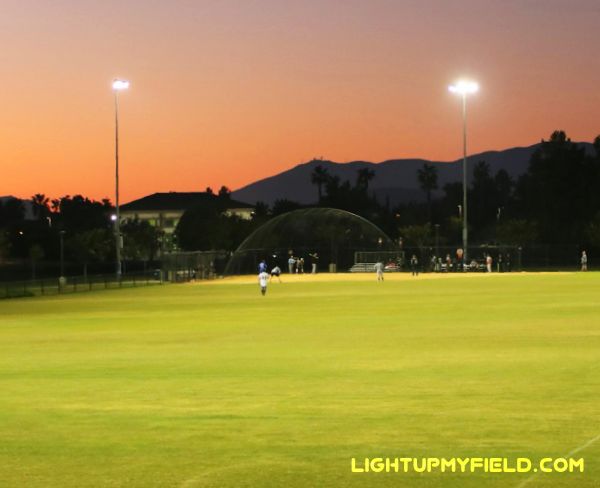 College and semi-professional softball push lighting requirements even further — both for playability and aesthetics. These fields generally target 700 to 800 lux (about 65 to 75 footcandles). That’s bright enough for televised games, detailed video analysis, and photography, while still maintaining a comfortable viewing experience for players and spectators.
At this level, lighting uniformity and vertical illuminance (the light hitting players’ faces and upper bodies) become just as important as horizontal brightness. Good vertical lighting — around 500 lux at eye level — helps players track high fly balls against dark skies and makes it easier for cameras to capture facial expressions and gameplay clearly.
Designers usually go for LED lights with a Color Rendering Index (CRI) of 80 or higher, and a color temperature between 5000K and 6000K. This creates that crisp, daylight look often seen on professional sports broadcasts. To achieve these levels, setups often use 6 to 8 poles, with fixtures ranging from 800W to 1200W, depending on the beam spread and pole placement.
For reference, an average college softball field covering around 220 to 250 feet to the outfield fence might need roughly 30 to 40 LED fixtures, delivering a combined total lumen output of about 4 to 5 million lumens. That’s the sweet spot for balancing power, performance, and player comfort.
Professional and Televised Games
When you reach professional and nationally televised games, the expectations for lighting quality get serious. Here, the target brightness levels are typically 1000 lux (90–100 fc) in the infield and around 700 to 800 lux (65–75 fc) in the outfield.
This setup ensures high-speed cameras capture every pitch, swing, and slide with clarity. Lighting uniformity becomes very precise — designers often aim for 0.7 or better — and the vertical lighting for broadcast angles needs to be consistent across all camera views.
Poles for pro fields are often 60 to 70 feet tall, fitted with precision-aimed LED floodlights that use advanced optics and anti-glare visors. The fixtures typically range from 1000W to 1500W, depending on the beam focus and field geometry. Some top-tier systems can produce over 150,000 lumens per light, ensuring even the farthest corners of the outfield are properly illuminated.
The total system power might reach 60,000 to 80,000 watts for a full-size stadium, but thanks to efficient LED technology, these setups still consume 50–60% less energy than older metal halide systems. Beyond just brightness, pro-level lighting also focuses on color consistency (Δu’v’ < 0.003) and flicker-free performance — both vital for slow-motion replays and HDTV broadcasting.
International or Tournament-Level Fields
At the very top of the spectrum are international and tournament-level softball fields, like those used in World Softball Championships or Olympic qualifiers. These venues need to meet not only gameplay standards but also international broadcast specifications, which demand extreme lighting precision.
Here, brightness levels often reach 1200 to 1500 lux (around 110 to 140 fc) across the entire field, sometimes even higher in the infield areas. The goal is to maintain crystal-clear visibility for live TV, ultra-HD recording, and professional photography from multiple angles.
Such systems often combine smart lighting controls, DMX or DALI-based dimming, and adaptive zoning — allowing operators to adjust brightness for different games, events, or weather conditions. For instance, practice sessions might run at 800 lux, while championship finals switch up to full brightness.
An international-standard field may use 8 to 10 poles up to 75 feet tall, with around 60 to 80 high-output LED fixtures in total. Each light can deliver up to 160,000 lumens, giving a total field output exceeding 10 million lumens. Despite the sheer power, modern LED optics keep glare under control and focus illumination tightly within the playing area to comply with light spill regulations (ULR < 5%).
In these advanced setups, lighting uniformity can hit 0.75 or higher, and vertical illumination stays above 600 lux for all camera zones — ensuring flawless visual clarity no matter where the viewer is watching from.
| Field Type | Lux (lx) | Footcandles (fc) |
|---|---|---|
| Recreational/Community | 200–300 | 20–30 |
| High School/Amateur | 500 | 50 |
| College/Semi-Pro | 700–800 | 65–75 |
| Professional/Televised | 1000 (infield), 700–800 (outfield) | 90–100 (infield), 65–75 (outfield) |
| International/Tournament | 1200–1500 | 110–140 |
Finding the Right Balance
Even with these standards, the “ideal” lux or fc level isn’t just about raw brightness. It’s about how evenly and efficiently that light is distributed. Recreational fields focus on affordability and safety, while pro-level and broadcast fields aim for visual perfection and precision control.
A well-designed lighting system — tuned to the right lux range — enhances not only visibility but also the mood of the game. Whether it’s a quiet community park or a packed stadium under the lights, the perfect brightness gives softball that unmistakable energy and magic that keeps everyone watching, playing, and cheering long after sunset.
Factors Affecting the Lux and Fc Levels
Getting the right lux or footcandle (fc) levels on a softball field isn’t just about buying powerful lights and flipping a switch. Even with the best LED fixtures, the actual brightness that players and spectators experience depends on dozens of smaller design and environmental details working together. From how high your poles stand to the type of turf underfoot, each piece can subtly shift how the lighting performs.
Let’s break down the main factors that really influence how bright and balanced your field feels once the lights come on.
Pole Height and Placement
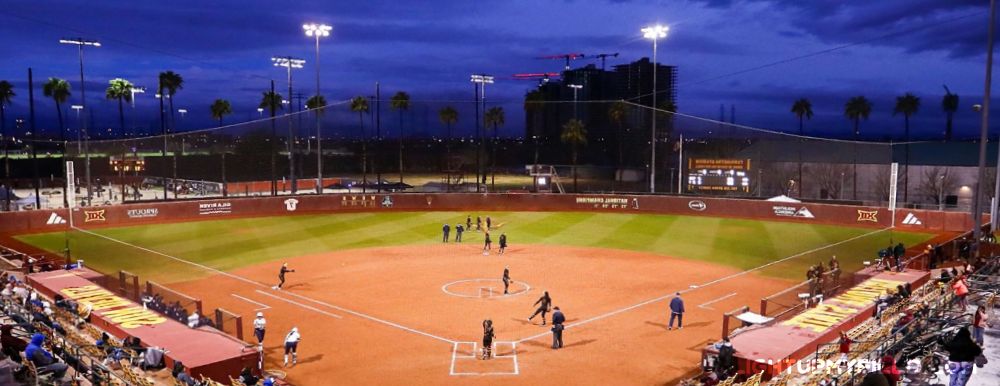
Pole height and positioning are easily two of the biggest game-changers in lighting design. If your poles are too short, the lights cast steep angles, which creates harsh shadows and uneven brightness across the infield and outfield. On the other hand, poles that are 50 to 70 feet tall tend to distribute light more evenly and reduce glare for both players and spectators.
Think of it like holding a flashlight — the higher you raise it, the more evenly the light spreads. Most well-designed softball fields use four to six poles, strategically placed just beyond the foul lines and behind the outfield fence. A common layout might include two poles near each foul line and two more centered behind the outfield, which gives balanced coverage and minimizes those annoying dark corners.
For a regulation field that stretches around 200 to 250 feet to the outfield fence, keeping poles spaced between 90 and 120 feet apart helps achieve a uniformity ratio of around 0.6 to 0.7 — meaning the dimmest areas are at least 60–70% as bright as the brightest. That might sound like a small technical detail, but players definitely notice the difference when chasing high pop flies under consistent light instead of patchy glare.
Fixture Type and Beam Angle
The type of lighting fixture you choose — and how it directs its beam — can completely change the character of your field’s lighting. Not all LED floodlights are created equal. Some have narrow beam angles (20°–30°) that throw intense light onto a small area, while others use wide beams (45°–60°) for broader coverage but less concentrated brightness.
A professional lighting setup usually blends both. Narrow beams highlight critical zones like the pitcher’s mound and infield, while wide beams smooth out coverage in the outfield and spectator areas. Using only one type often leads to bright hot spots near the bases and dark gaps in the corners.
Another big difference comes from optical quality. High-end sports LEDs come with precision-engineered lenses and reflectors that control exactly where light goes — keeping more of it on the field and reducing spill or glare. Poor-quality fixtures can waste up to 25–30% of their total output, meaning you’d have to install more lights (and pay more in energy costs) just to hit the same lux level.
If you’re aiming for about 700 lux for competitive play, using efficient fixtures with light utilization rates above 80% can help you reach that goal with fewer luminaires and lower long-term costs.
Field Surface and Color
Here’s something people often overlook — the field itself plays a big role in how bright everything looks. The way light reflects off the surface can make two fields with the same lux readings appear totally different to the eye.
A field with fresh green grass or light-colored synthetic turf reflects more light upward, giving a brighter, more vibrant look. In contrast, darker, older, or wet turf absorbs more light, making the field seem dimmer even though the measured lux level hasn’t changed.
For instance, a brand-new artificial turf surface can reflect up to 25% more light than natural grass, while worn or muddy areas might reflect 10–15% less. That means a field with identical lighting setups could look noticeably brighter just because of surface color and condition.
Lighting designers sometimes adjust for this by slightly increasing target lux levels — say, bumping a 500 lux design up to 550 lux — to compensate for darker surfaces or poor reflectivity.
Ambient Lighting and Surroundings
The world around the field matters, too. If your softball field sits in a bright urban area surrounded by streetlights, parking lot lamps, or nearby buildings, that extra background glow can wash out contrast and make the field seem dimmer. To the human eye, brightness is relative — so if the surroundings are already bright, you may need more lux on the field to make it stand out.
In rural or suburban settings with darker skies, on the other hand, a field might look perfectly bright at the same lux level because there’s less competing light. That’s why lighting designers often measure ambient illuminance during planning — even a difference of 30–50 lux in surrounding light levels can shift how the field’s lighting feels in real play.
Obstructions like trees, fences, or bleachers can also block parts of the light or cause weird shadowing patterns if poles aren’t positioned carefully. When designing around these obstacles, it’s common to adjust aiming angles or use higher poles to maintain uniform coverage.
Maintenance and Fixture Aging
Even the best LED lighting system needs a little love to stay consistent over time. While LEDs are far more durable than old metal halide lamps, they still experience lumen depreciation — a gradual reduction in light output as the fixtures age.
On average, good-quality sports LEDs lose about 2–3% of brightness each year. After five years, that’s roughly a 10–15% drop in total output, which can noticeably affect lux readings if no adjustments are made. Add a layer of dust, dirt, or bird droppings on the lenses, and the drop can hit 20% or more in neglected systems.
Regular maintenance — cleaning lenses, checking for corrosion, tightening mounts, and recalibrating aiming — can help keep the field performing like new. Many modern systems even include tilt indicators and laser aiming tools to make re-alignment easier after storms or seasonal shifts.
For fields that operate several nights per week, it’s a good idea to plan an annual photometric checkup to measure current lux and uniformity levels. That way, small losses in brightness can be corrected early, either by re-aiming fixtures or slightly increasing power to maintain the desired illumination.
Environmental and Weather Conditions
Lastly, weather plays its part. Humidity, temperature, and air clarity all influence how light behaves outdoors. For example, in humid or dusty environments, airborne particles scatter light and slightly reduce visibility — which can make the field appear less bright, even if the measured lux stays the same.
Temperature also affects LED performance. While modern sports LEDs are designed to handle extremes, very high ambient temperatures (above 40°C / 104°F) can lower luminous efficiency by around 5–8%. Conversely, cold air can slightly boost performance since LEDs produce light more efficiently at lower temperatures.
These environmental realities are why professional lighting simulations use real-world climate data to predict how the field will look not just in ideal conditions but across the seasons.
| Factor | Influence on Lighting |
|---|---|
| Pole Height & Placement | Higher poles (50-70 ft) create even light distribution, reduce shadows, and improve uniformity (0.6–0.7). |
| Fixture Type & Beam Angle | Narrow beams focus light on key areas (e.g., infield), wide beams cover outfield; efficient optics reduce glare. |
| Field Surface & Color | Lighter surfaces (e.g., synthetic turf) reflect more light, making the field appear brighter; darker surfaces absorb light. |
| Ambient Lighting | Extra light from surrounding areas (streetlights, etc.) can make the field seem dimmer, requiring more lux. |
| Obstructions | Trees, bleachers, and fences can block light and cause shadows, impacting uniformity. |
| Maintenance & Fixture Aging | LEDs lose brightness over time (2-3% per year); regular cleaning and recalibration are needed for consistency. |
| Environmental Conditions | Humidity, temperature, and air clarity affect light behavior (e.g., high heat reduces efficiency, cold boosts it). |
Keeping Everything in Balance
At the end of the day, getting the right lux or fc levels isn’t about blasting the field with as much light as possible — it’s about balancing coverage, efficiency, and real-world visibility. The perfect softball lighting setup blends smart design choices (like pole height and beam control) with ongoing care and awareness of local conditions.
When everything aligns — the poles, fixtures, surfaces, and environment — players can see clearly, fans can enjoy the game, and the field itself gets that warm, even glow that makes night softball feel truly special.
Issues About Brightness Levels in Softball Fields
Finding the sweet spot for softball field lighting can be a bit of a balancing act. Too little light and players are squinting through shadows; too much, and the field turns into a blinding spotlight that’s uncomfortable for everyone. It’s a surprisingly delicate balance, since the human eye can easily detect even small differences in brightness — a 10–15% shift can already change how a field feels to both players and spectators.
Lighting designers spend a lot of time fine-tuning brightness because both extremes — under-lighting and over-lighting — come with their own set of problems.
When It’s Too Dim
Under-lighting is probably the most common issue, especially on older fields that still rely on metal halide or halogen lamps. These traditional fixtures not only use more energy, but they also lose brightness over time — sometimes dropping to 70% of their original output after just 2–3 years.
When the average illumination falls below 200 lux (about 20 footcandles) for adult recreational games, visibility starts to go downhill fast. Players begin losing track of high pop-ups, and infielders have a tougher time reacting to fast grounders. Even a small dip in brightness can slow down reaction times by a fraction of a second, which is enough to change the outcome of a play — or worse, increase the chance of injuries.
Spectators feel it too. Without adequate lighting, it’s hard to follow the ball once it leaves the bat, especially in deeper outfield zones. On unevenly lit fields, you’ll often see fans shifting their eyes or leaning forward just to keep track of the play. And for umpires, poor lighting can cause misjudgments on strikes, fouls, or catches, since shadowed zones distort depth perception.
You’ll also see color distortion in dim fields — white balls and bright uniforms may appear dull or slightly tinted, which further reduces clarity. That’s one reason why newer LED systems, which can maintain consistent brightness and color temperature (around 5000K–6000K) over time, have become the go-to upgrade for most softball facilities.
When It’s Too Bright
It might sound like a nice problem to have, but too much brightness can be just as frustrating. Over-lighting can lead to glare, discomfort, and visual fatigue — things that subtly throw off a player’s coordination and timing.
When lights are too intense, especially if fixtures are aimed incorrectly, they can cause direct or reflected glare that blinds fielders momentarily when tracking a fly ball. For pitchers and batters, overexposure makes it hard to judge the ball’s speed and spin, because the contrast between bright and dark areas becomes exaggerated. You might have a dazzlingly bright infield while the outfield looks relatively dim, forcing players’ eyes to constantly readjust.
Studies show that glare can reduce visual performance by 15–30%, even if the measured lux levels are technically “within range.” That’s why well-designed systems focus on balanced illumination, not just raw brightness. Fixtures should be tilted at precise angles — often between 20° and 35° downward — so they light up the field evenly without spilling directly into players’ lines of sight.
There’s also the issue of light pollution. Overly bright fields waste a significant amount of light that spills into the sky or nearby homes. A field that runs at 1000 lux when only 700 is needed doesn’t just waste energy — it creates a visual nuisance that can upset neighbors and even violate local lighting ordinances. Many municipalities now limit upward light output (known as ULR, or Upward Light Ratio) to just a few percent, so keeping brightness under control isn’t just practical — it’s required.
The Cost and Efficiency Side
Brightness levels don’t just affect how the game looks — they also show up on your utility bill. For every 100 extra lux, the total power demand increases noticeably, especially on large fields that use dozens of fixtures. If each light is running at 800 to 1000 watts, that adds up fast.
For example, boosting a field from 500 lux to 700 lux might seem minor, but it can increase total energy use by 20–30%, depending on the fixture efficiency and aiming design. That’s why it’s so valuable to use LED lighting with smart controls. Modern LED systems can cut energy use by 60–70% compared to traditional metal halide lamps while maintaining — or even improving — brightness consistency.
Some fields take it a step further by using adaptive lighting controls that automatically adjust brightness based on the event. For example, the lights can dim down to 300 lux for practice sessions, ramp up to 700 lux for league games, or even reach 1000 lux for tournaments. This not only extends the lifespan of the lights but also keeps power consumption in check.
Another benefit of right-sizing your brightness is heat management. Overly bright setups push fixtures to their limits, which can shorten LED lifespan and increase maintenance costs. Running lights at 80–90% of maximum output instead of full blast can make them last years longer and keep brightness levels stable over time.
Finding That “Just Right” Zone
The goal of any good lighting design isn’t to make the field the brightest in town — it’s to make it consistently bright where it matters most. In practice, that means ensuring the infield, bases, and outfield all stay within an appropriate range for the level of play, with minimal glare and smooth transitions between zones.
For recreational games, that might mean holding around 250 lux. For professional or televised games, around 900–1000 lux across the infield (and 700–800 in the outfield) does the trick. Anything more tends to waste energy without adding visibility benefits.
A well-balanced lighting design creates a natural, daylight-like feel — bright enough to see every play clearly, but soft enough that it’s comfortable for everyone on the field. When that balance is right, players perform better, spectators see more, and the game just feels smoother and more enjoyable under the lights.
Keeping the Balance Right
Lighting a softball field isn’t a one-size-fits-all job. The ideal lux and fc levels depend on the type of play, size of the field, and budget, but what really matters is achieving the right balance between brightness, uniformity, and comfort.
For casual games, a range around 200–300 lux is usually fine. High school and college fields need around 500–800 lux, while pro or international fields go well above 1000 lux. These aren’t just numbers — they represent how well players see, react, and perform.
Good lighting design makes the game feel professional, fair, and exciting, even under the stars. When the field glows evenly and the ball shines clearly mid-flight, that’s when you know you’ve got the lighting just right — bright enough to play hard, but comfortable enough to enjoy every pitch.