

Lighting a softball field might seem simple — just slap some big lights on poles and call it a night game. But the truth is, getting the right wattage involves more than guessing. Too little power, and players struggle to track the ball; too much, and you’re wasting energy, money, and creating glare. Understanding how wattage ties into brightness, field type, and level of play helps you design a lighting setup that’s both efficient and effective.
The Relationship Between Softball Field Lighting Wattage and Lux/Fc Levels
When planning a softball field, one of the first questions people ask is, “How many watts do I actually need?” Wattage is the electrical power a fixture consumes, but what players really experience is brightness on the field, usually measured in lux (lx) or footcandles (fc). While it might seem like more watts automatically mean a brighter field, the reality is a bit more nuanced. Factors like fixture efficiency, optics, pole height, aiming angles, and uniformity all play a role in how much usable light actually reaches the playing surface.
Wattage Isn’t the Whole Story
Take a 1000W metal halide (MH) fixture for example. It might produce around 120,000 lumens, which translates to roughly 500–600 lux on a medium-sized high school softball field. That sounds decent, but MH lamps are not very efficient — they typically produce 1–1.2 lumens per watt. Over time, they also lose brightness faster and need warm-up periods to reach full output.
Now compare that to a modern 600W LED fixture. With a luminous efficiency of roughly 2 lumens per watt, it can deliver the same 120,000 lumens while using nearly half the electrical power. Not only does this reduce energy consumption, but LEDs also maintain consistent output, don’t flicker, and can achieve full brightness instantly. In practical terms, that means 600W of LED lighting can give the same on-field brightness as 1000W of MH, making wattage alone a misleading measure if you don’t account for efficiency.
Target Lux Levels Drive Wattage Needs
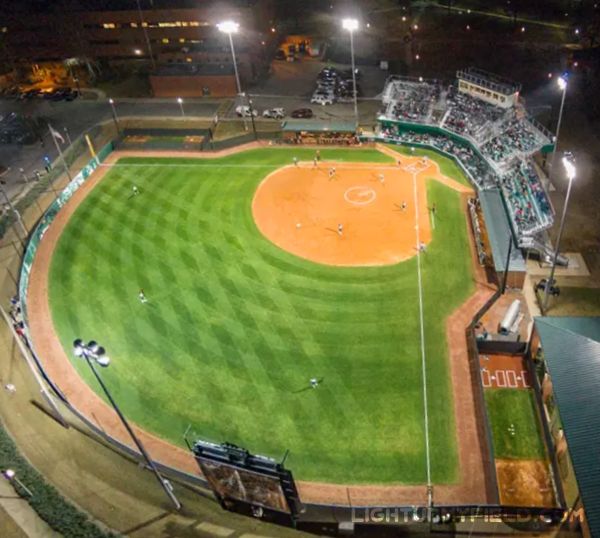 Wattage requirements are directly tied to the desired lux or fc level on the field. Recreational or community fields typically need 200–300 lux (20–30 fc), which is sufficient for casual evening games. At this level, a field might use 400–600W LED floodlights mounted on 40–50 ft poles, totaling around 10,000–12,000 watts for a four-pole setup.
High school or amateur-level fields aiming for 500 lux (50 fc) will require more total wattage. This might mean 6 poles with 600–1000W LEDs, totaling 25,000–35,000 watts, depending on the field size and aiming design. College or regional competition fields, which often need 700–800 lux (65–75 fc), might push total system wattage to 40,000–60,000 watts, with 8–10 LED fixtures per pole, especially if the field is over 220 feet to the outfield fence.
For professional or televised games, the numbers jump even higher. Infields often require 1000 lux (90–100 fc) or more, while the outfield may need 700–800 lux. Achieving these numbers usually involves 60–80 LED fixtures, each ranging from 1000W to 1500W, mounted on 60–70 ft poles, which can bring total wattage close to 80,000–100,000 watts. The exact number depends on how well the fixtures are aimed, their beam angles, and whether smart controls or dimming systems are used.
Other Factors That Affect Wattage
Field Size is an obvious one. Larger fields need more lumens to maintain uniformity from infield to outfield. A small 180-foot community field can reach 250 lux with just 16–20 lights, but a 250-foot regional field might need 40–50 lights for the same uniformity.
Fixture optics and beam angles matter as much as raw wattage. Narrow beams focus light in small areas, requiring fewer watts to achieve high lux locally but possibly leaving shadows elsewhere. Wide beams spread light over larger areas but reduce intensity unless wattage is increased. Combining different beam types allows designers to balance brightness, uniformity, and energy efficiency.
Pole height and positioning also influence wattage requirements. Taller poles (50–70 ft) distribute light more evenly, which can reduce the number of fixtures or total watts needed. Lower poles may require higher wattage or additional fixtures to prevent dark spots.
Finally, ambient conditions like turf color, nearby light pollution, and weather can slightly shift wattage requirements. A darker field surface absorbs more light, meaning you may need extra lumens to achieve the same lux, while reflective artificial turf can reduce wattage needs.
Modern LED Technology Reduces Wattage
Switching from MH to LED fixtures can dramatically lower wattage requirements without sacrificing brightness. LEDs convert electricity to light more efficiently, maintain lumen output over time, and can be aimed with precision to minimize waste. A well-designed LED field can cut total wattage by 30–50%, saving thousands of dollars in energy costs annually.
Smart controls, timers, and dimming systems can further optimize wattage. For example, a field might only need 50% power for practice sessions, ramping up to full wattage during competitive games. This reduces overall energy use while keeping brightness where it matters.
Typical Watts of Lighting in Softball Fields
The amount of wattage needed for a softball field really depends on the level of play, field size, and how the space is used. A casual neighborhood park and a televised international stadium operate under completely different lighting demands, so the total power installed can vary dramatically.
Recreational and Community Fields
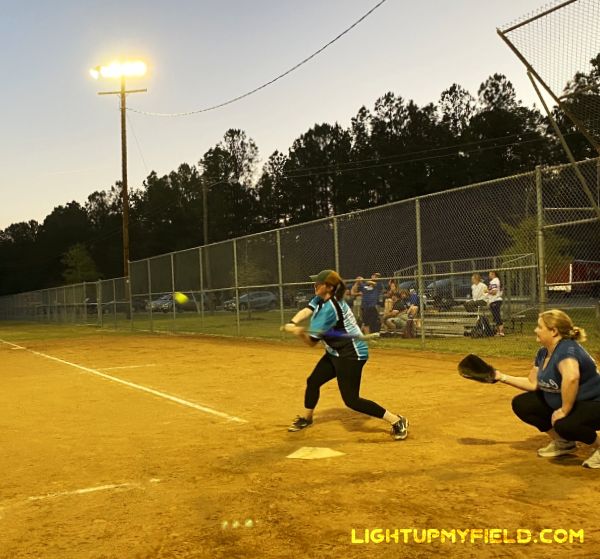 For small parks or community softball fields, lighting doesn’t have to be extreme. Most designers use 400W–600W LED fixtures, usually mounted on 40–50 ft poles. A four-pole setup with 16–20 fixtures total can reach about 250 lux, which is bright enough for evening games and practices without overwhelming the neighborhood.
In terms of power, these setups consume roughly 10,000–12,000 watts for the entire field. That’s plenty for casual play, and using modern LEDs keeps energy use low while still delivering even coverage. At this level, the goal is clear visibility of the ball and players, rather than broadcast-quality brightness.
High School and Amateur Fields
High school and amateur-level fields require more uniform and powerful lighting. Here, you’re often looking at 600W–1000W LEDs on six poles, with 30–40 lights total. This setup produces roughly 500 lux, which allows fielders to react faster and batters to track the ball clearly against the night sky.
Total wattage for these systems generally falls between 25,000–35,000 watts, depending on fixture type and aiming. Uniformity is also more important here — ideally the darkest spots on the field should be at least 60% as bright as the average, which requires careful pole placement and beam overlap.
Regional or College-Level Fields
Regional tournaments or college-level fields demand even higher intensity. Fixtures for these setups usually range from 800W–1200W, mounted on six to eight poles, totaling 40–60 lights. These systems deliver 700–800 lux across the entire field, enough to handle faster pitches, deeper outfields, and larger spectator areas.
At this level, total system wattage might hit 40,000–60,000 watts, but it’s necessary for both player performance and broadcast-quality lighting. Designers also pay close attention to color temperature (often 5000K–6000K) and Color Rendering Index (CRI) — making sure the field looks natural under the lights, which is especially important for televised games.
Professional and International Fields
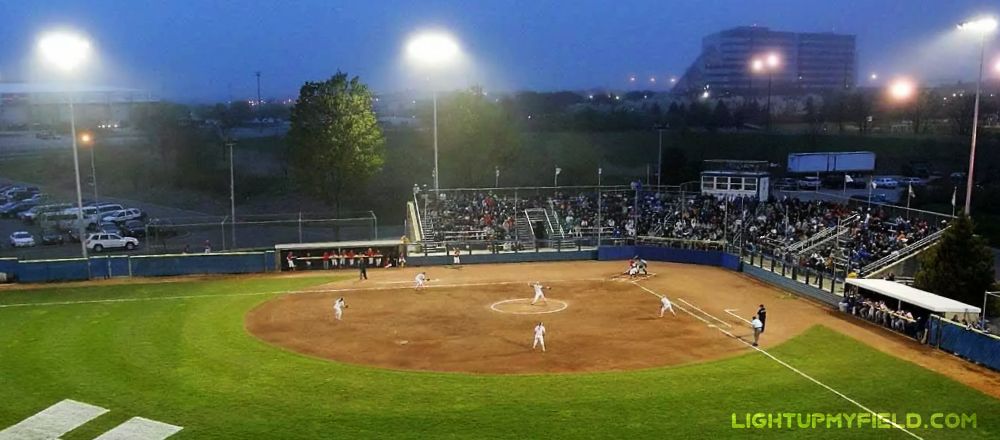
For professional and international tournaments, lighting gets serious. Poles can reach 60–70 ft, and each can hold 1000W–1500W LED fixtures. A complete field may have 60–80 lights, with total system wattage reaching 70,000–100,000 watts.
These setups produce 1000–1500 lux on the infield, with slightly lower but still substantial illumination in the outfield to meet HD camera and broadcast requirements. Smart aiming, precise beam angles, and advanced controls help maintain uniformity and minimize glare, which is crucial when every pitch and swing is being recorded for slow-motion replay.
At this level, wattage isn’t just about brightness — it’s about consistency, coverage, and visual comfort for players, umpires, and spectators. Even small dips or spikes in light can be noticeable in professional play, so total system wattage reflects both the size of the field and the quality of the lighting design.
| Field Type | Pole Height (ft) | Fixture Wattage (W) | Number of Fixtures | Total Wattage (W) | Lux Level (lx) |
|---|---|---|---|---|---|
| Recreational / Community | 40–50 | 400–600 | 16–20 | 10,000–12,000 | 250 |
| High School / Amateur | 40–50 | 600–1000 | 30–40 | 25,000–35,000 | 500 |
| Regional / College | 50–60 | 800–1200 | 40–60 | 40,000–60,000 | 700–800 |
| Professional / International | 60–70 | 1000–1500 | 60–80 | 70,000–100,000 | 1000–1500 |
What Determines the Lighting Wattage
Figuring out exactly how much wattage a softball field needs isn’t as simple as picking a number off a spec sheet. Several factors come into play, from the size of the field to the type of fixtures you use. Understanding these variables helps you avoid overspending on power while still hitting the desired brightness.
Field Size
One of the most obvious factors is field size. A small 200-foot recreational field needs fewer lumens than a full 250-foot regulation field. Bigger fields naturally require more light just to keep the entire playing area bright and evenly lit. For instance, a four-pole setup on a community field may only need 16–20 LED fixtures at 400–600W each, while a college-level field of the same width but longer outfield might need 40–50 fixtures at 800–1000W each to maintain uniformity.
The bigger the playing surface, the more total watts are required to avoid shadowed areas, particularly in the outfield corners or near the foul lines. Designers often calculate wattage by first determining total lumens needed, then selecting fixtures to meet that target efficiently.
Type of Softball Field
The type of surface and structure also affects wattage. Indoor or covered fields reflect light differently than open-air fields, which can lead to hotspots or uneven illumination if the wattage isn’t adjusted.
Synthetic turf fields reflect more light than natural grass, which means you might be able to achieve the same lux levels with slightly lower total wattage. For example, a synthetic field may reach 500 lux with 25,000 watts, while a natural grass field of the same dimensions might need 28,000–30,000 watts due to light absorption. Designers often consider reflection coefficients and surface color when calculating fixture requirements.
Level of Competition
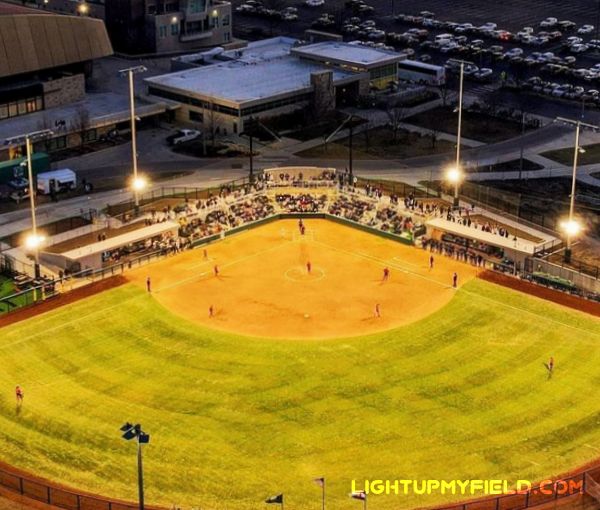 The level of competition dramatically affects how much wattage a field requires.
Recreational or community leagues can get by with 200–300 lux, which translates to lower total wattage — around 10,000–12,000 watts for a small four-pole LED setup. High school games usually aim for 500 lux, with 25,000–35,000 watts spread across six poles. College, semi-pro, and professional tournaments require 700–1000 lux or more, pushing total wattage to 40,000–100,000 watts, especially if the field is also used for televised games or high-definition broadcasts.
Higher-level competitions don’t just demand more brightness; uniformity and color rendering also become key. For televised games, a CRI of 80+ and a color temperature around 5000K–6000K ensures the ball, uniforms, and field markings appear natural on camera.
Playing Time and Usage
How a field is used also affects wattage decisions. Fields primarily used for daytime practice may not need their full lighting capacity, while stadiums hosting night games or tournaments must be designed for peak brightness.
For example, a practice session might only require 50–60% of full wattage, which can save energy and extend fixture lifespan. In contrast, a high-stakes evening game needs maximum output to maintain consistent 500–1000 lux across infield and outfield areas.
Fixture Type and Efficiency
One of the biggest wattage influencers is the type and efficiency of your fixtures. Modern LEDs produce 2–2.5 lumens per watt, while older metal halide (MH) lamps often produce just 1–1.2 lumens per watt. This means you can hit the same lux target at 30–50% lower total wattage if you switch to LEDs.
For example, a high school field that previously needed 30,000 watts of MH lighting could meet the same brightness with roughly 15,000–20,000 watts of LEDs, while also reducing energy costs and maintenance needs.
Pole Height and Layout
Finally, pole height and positioning can significantly impact wattage requirements. Taller poles, typically 50–70 feet for competitive fields, allow light to spread more evenly across the field. Better distribution often means you need fewer fixtures or lower wattage per fixture.
Pole layout also matters. Strategically placing poles along foul lines and behind the outfield ensures overlap of light beams and minimizes dark spots. Poorly placed poles can leave shadowed areas, forcing designers to add extra fixtures or increase wattage unnecessarily.
Can We Reduce the Wattage of Softball Field Lighting?
The short answer is yes — with modern technology and smart design, you can lower total wattage without sacrificing field visibility or player safety. In fact, many fields today achieve the same lux levels with 30–50% less power than older setups, which translates into big energy and cost savings over time.
Replacing Metal Halide With LEDs
One of the biggest changes in recent years has been switching from metal halide (MH) fixtures to LED floodlights. LEDs are far more efficient, producing around 2–2.5 lumens per watt compared to 1–1.2 lumens per watt for traditional MH lamps.
For example, a 1000W MH fixture used on a high school field can often be replaced by a 600W LED fixture to achieve the same 500 lux across the playing surface. Beyond energy savings, LEDs maintain brightness longer, don’t flicker, and reach full output instantly — unlike MH lamps, which may take several minutes to warm up and degrade faster over time.
Optimizing Pole Placement and Beam Angles
Wattage savings aren’t just about swapping bulbs. Good lighting design can dramatically reduce the power you need. Strategically placing poles, adjusting their height, and carefully aiming beams ensures even coverage without over-lighting any one area.
For instance, a six-pole setup on a regulation field might deliver 700 lux using 1000W LEDs per pole. By tweaking the aiming angles and overlapping light patterns, the same field could achieve similar brightness with 800W fixtures, cutting total wattage by 10–20%. Proper optical lenses and anti-glare shields further ensure light goes exactly where it’s needed, minimizing spill onto nearby streets or spectators.
Smart Controls, Timers, and Dimming
Another way to reduce wattage is through smart controls. Many modern fields use timers, dimmers, or motion sensors to adjust brightness based on need. For example, practice sessions may only require 50–60% of full lighting power, while evening tournaments need full intensity.
Over a year, smart controls can reduce total energy consumption by 20–30%, while also extending the lifespan of your LED fixtures. Some stadiums even integrate zoning, allowing infield lights to run at full power while outfield lights operate at reduced intensity for partial-field events.
Designing for Efficiency
Ultimately, reducing wattage isn’t just about saving money — it’s about making light work smarter. By combining LED technology, careful pole layout, optimized beam angles, and smart controls, you can achieve bright, uniform lighting without running unnecessarily high wattage.
For example, a professional-level field that previously consumed 90,000 watts with MH lamps might now reach the same 1200 lux infield using 55,000–60,000 watts of LEDs, all while improving uniformity, reducing glare, and cutting electricity costs by tens of thousands per year.
Common Mistakes to Avoid When Choosing Lighting Power
Choosing the right wattage for a softball field might seem straightforward, but there are a few traps that can easily lead to wasted energy, poor lighting, or unhappy players. Understanding these common mistakes can save both money and headaches.
Overestimating Wattage
One of the most common errors is assuming that more watts automatically means brighter light. While wattage contributes to brightness, it’s only one part of the equation. Fixture efficiency, beam angles, pole height, and aiming all influence how much usable light actually reaches the field.
For example, installing 1000W fixtures without proper aiming or overlapping might create glare in the infield while leaving the outfield under-lit. In contrast, a well-planned 800W LED setup can achieve the same lux levels with less power, lower energy costs, and better coverage.
Ignoring Uniformity
High wattage doesn’t guarantee an even playing surface. Uneven light distribution can leave dark corners, shadowed bases, or inconsistent outfield coverage, which frustrates players and even affects safety. Tracking fly balls in poorly lit areas becomes harder, increasing the risk of mistakes or minor injuries.
Uniformity is measured by the ratio of minimum to average illuminance. Ideally, the darkest parts of the field should be at least 60% as bright as the average lux level. High wattage spread unevenly often fails this standard, making careful pole placement and beam overlap as important as total watts.
Failing to Plan for Future Needs
Another mistake is not considering future upgrades or changes in field usage. A field built for recreational leagues may be fine with 200–300 lux, but hosting tournaments or night games later will require higher brightness and possibly more fixtures. Without planning for scalability, you may end up needing additional poles or more powerful lights, which can be costly and disruptive.
For instance, adding 10 new fixtures at 600W each to meet tournament requirements could have been avoided with proper initial design, like including extra poles or spacing for future expansion.
Overlooking Maintenance and Fixture Aging
Even LEDs, which are highly durable, lose output over time — usually around 2–3% per year. Dust, dirt, and weathering on lenses can further reduce light levels, sometimes by 10–15% if neglected.
If you choose wattage without accounting for this depreciation, your field could be under-lit within a few years, especially in outdoor environments exposed to rain, wind, and dust. Regular cleaning, inspection, and occasional recalibration help maintain consistent lux levels and reduce the need for extra wattage later.
Relying Solely on Wattage for Decisions
Finally, focusing purely on wattage rather than lux targets, fixture type, and field layout is a common misstep. Two fields with the same total wattage can look completely different in terms of brightness and uniformity. Always consider lumens per fixture, aiming angles, pole height, and overlapping light patterns, rather than just adding more watts to “solve” a lighting problem.
Lighting Your Field Wisely
In the end, wattage is a tool, not a target. With good design, efficient fixtures, and consideration of field size and usage, you can get bright, uniform lighting without overspending on power. The goal is a field that’s safe, playable, and visually appealing — a space where softball shines, both literally and figuratively, under the lights.