
Shooting range lighting is one of those facility upgrades that can look straightforward on paper but turn into a much bigger project once equipment, installation, electricity, and maintenance enter the picture. A few new fixtures might be enough for a small facility, while a larger indoor range could require electrical upgrades, specialized equipment, and a carefully planned lighting system.
So, how much should you budget? The answer depends on the size of the range, the type of fixtures you choose, the condition of the existing electrical system, and how many hours the lights operate each day. A project that looks affordable at the purchasing stage can also become expensive over time if the fixtures consume too much electricity or require frequent repairs.
The good news is that a well-planned lighting upgrade can help control long-term expenses while improving visibility, comfort, and day-to-day facility management. From fixture prices and installation labor to electricity bills and potential grants, here’s what range owners and facility managers should consider before starting a project.
How Much Does Shooting Range Lighting Cost?
Shooting range lighting costs vary considerably depending on whether you’re installing a completely new system or upgrading an existing one. Replacing a few outdated fixtures is usually less complicated than installing new circuits, mounting equipment, and controls throughout a large building.
For an early budget, it helps to separate the project into two categories – the initial investment and the ongoing operating expenses. The initial investment covers fixtures, labor, wiring, controls, and other installation work. Operating expenses include electricity, maintenance, repairs, and eventual replacement.
Estimated Shooting Range Lighting Project Costs
The following figures are broad budgeting allowances in US dollars. They are illustrative estimates for preliminary planning, not independently verified national averages. They exclude major building construction, specialized range equipment unrelated to lighting, and substantial structural modifications.
| Project type | Illustrative lighting budget |
|---|---|
| Small lighting replacement or partial upgrade | $2,000–$8,000 |
| Small indoor range lighting retrofit | $5,000–$20,000 |
| Medium-sized indoor range retrofit | $15,000–$50,000 |
| Large indoor range lighting upgrade | $40,000–$120,000+ |
| Outdoor range lighting project | $10,000–$100,000+ |
These ranges are intentionally broad because two facilities with similar floor areas can have very different requirements. A building with usable wiring and accessible mounting points may need relatively little additional work, while another facility may require new circuits, elevated access equipment, weather-resistant enclosures, or extensive electrical improvements.
Outdoor installations can be particularly difficult to estimate without a site assessment. Pole foundations, trenching, underground cables, utility connections, and the distance between electrical equipment and the illuminated areas can account for a substantial share of the budget.
What Makes One Lighting Project More Expensive Than Another?
The number of fixtures is only one part of the calculation. Mounting height, building layout, environmental conditions, operating hours, and the availability of existing infrastructure all affect the final price.
For example, a facility replacing 30 existing fixtures may have a lower installation cost than a smaller facility that needs new wiring and mounting structures. Similarly, an outdoor project with difficult ground conditions can cost more than expected even when the number of luminaires is relatively modest.
It’s also worth allowing room in the budget for design work, inspections, commissioning, and unexpected site conditions. A preliminary contingency of 10% to 15% is a reasonable planning assumption for some straightforward projects, although more complex renovations may need a larger allowance.
Shooting Range Lighting Fixture Costs
Fixtures are usually the most visible part of a lighting budget, and it’s tempting to choose products based on their purchase price alone. However, a fixture’s actual value depends on more than its price tag. Energy consumption, service life, durability, replacement parts, and warranty coverage all affect the cost of owning it.
LED technology is widely used in commercial and industrial lighting because it can deliver substantial energy savings compared with older lighting systems. Still, not every LED fixture is suitable for every environment. Product specifications and installation conditions matter just as much as the technology itself.
How Much Do LED Shooting Range Lighting Fixtures Cost?
For preliminary budgeting, standard commercial LED fixtures might cost around $50 to $250 each, while higher-specification industrial products can fall in the $150 to $500+ range. These are indicative planning bands rather than confirmed prices for specialist shooting range products.
Fixtures designed for demanding environments, specialized mounting arrangements, enhanced protection, or particular electrical and environmental requirements may cost more. Controls, sensors, emergency-lighting functions, and accessories can also increase the equipment budget.
| Fixture category | Illustrative unit price |
|---|---|
| Basic commercial LED fixture | $50–$150 |
| Higher-specification industrial LED fixture | $150–$350 |
| Specialized or higher-output fixture | $250–$500+ |
| Lighting control or compatible sensor | $30–$200+ |
Prices depend on the manufacturer, product specifications, purchase quantity, certification requirements, and supplier. The categories above overlap because a fixture’s output and construction do not always correspond neatly to its price.
When comparing products, check the published light output in lumens, electrical power in watts, expected service life, warranty, and suitability for the intended installation environment. A product with a higher initial price may offer a lower lifetime cost if it consumes less electricity and requires fewer replacements.
LED Lighting vs. Traditional Lighting
Older fluorescent and other conventional lighting systems can have a lower replacement-equipment cost in some cases, especially when compatible products are readily available. However, energy use and maintenance can make them more expensive over several years.
LED upgrades can reduce lighting electricity consumption substantially, although the actual savings depend on the existing system. Replacing inefficient fixtures with properly selected LEDs may reduce lighting energy use by 30% to 60% or more in favorable situations. The savings should be calculated from actual fixture wattages, operating schedules, and utility rates rather than assumed for every project.
LED fixtures also offer long rated service lives. Some commercial products are rated for 50,000 hours or more, but that figure does not mean the fixture will operate indefinitely without maintenance. Drivers, connections, lenses, and other components can still require attention, particularly in demanding environments.
What Should You Check Before Buying Fixtures?
The first consideration is whether the product is suitable for the installation environment. Indoor ranges may have specific requirements involving airborne contaminants, cleaning, corrosion, ventilation, and access for maintenance. Outdoor facilities must also account for rain, temperature changes, moisture, and other weather conditions.
Electrical and product certifications should match the applicable codes and local requirements. Fixtures should also be assessed for appropriate impact protection and their suitability for the proposed mounting location. These characteristics should be confirmed from manufacturer documentation and the project design rather than inferred from appearance or price.
Warranty terms deserve a closer look, too. A five-year warranty may sound attractive, but check what it covers, whether labor is included, and how replacement products are supplied. If a fixture fails after installation, the cost of accessing and replacing it can be greater than the equipment price itself.
Shooting Range Lighting Installation Costs
Installation can account for a significant portion of the overall project budget. Even when fixtures are relatively affordable, electrical labor, wiring, access equipment, mounting hardware, and commissioning can add thousands of dollars to the bill.
The final installation cost depends heavily on the existing site. Replacing compatible fixtures in an accessible building is generally simpler than installing a complete system in a facility with limited electrical capacity or difficult mounting conditions.
Electrical Labor and Contractor Fees
For preliminary budgeting in the United States, general commercial electrical labor might be estimated at approximately $75 to $150 per hour, although local rates can fall outside this range. Specialist contractors, difficult working conditions, after-hours work, and high-cost metropolitan areas may command higher rates.
A straightforward retrofit involving 20 to 30 fixtures might require approximately 20 to 50 labor hours, depending on access, wiring, mounting arrangements, and testing requirements. At an illustrative rate of $100 per hour, that would equal $2,000 to $5,000 in labor alone.
This example is not a universal installation benchmark. A contractor should estimate the actual hours required after reviewing the site, because fixture replacement, new wiring, elevated work, and electrical upgrades involve very different amounts of labor.
Wiring, Mounting, and Electrical Upgrades
Electrical materials can include conductors, conduit, junction boxes, connectors, mounting brackets, circuit protection, and compatible control equipment. A small retrofit may need only limited additional materials, whereas a new installation can require extensive cabling and distribution work.
For a modest project, a preliminary allowance of $500 to $2,500 for additional electrical materials might be reasonable as a budgeting placeholder. Larger projects can run considerably higher, especially if new circuits, distribution equipment, structural supports, or extensive cable routes are required.
Outdoor projects bring further variables. Trenching, conduit installation, pole foundations, and long cable runs can substantially increase costs. Before accepting a quote, confirm whether these items are included or listed separately.
Design, Permits, Testing, and Commissioning
Professional design and verification should be included in the project budget when required by the facility’s complexity or applicable regulations. Depending on the scope, preliminary allowances might range from $500 to $3,000 for modest design and documentation work, with more complex projects costing considerably more.
Permits and inspections vary by jurisdiction, and not every project will have the same requirements. Commissioning may involve checking fixture operation, confirming control settings, documenting the installation, and verifying that the completed system meets the agreed performance criteria.
A detailed contractor proposal should distinguish equipment, labor, materials, design, permit fees, commissioning, and exclusions. That makes it much easier to compare competing bids without accidentally choosing a quote that leaves major expenses out.
New Installation vs. LED Retrofit
A retrofit can be less expensive when existing circuits, mounting points, and other infrastructure remain suitable. However, reusing existing equipment should never be assumed to be the cheapest or most appropriate option without an inspection.
A new installation may have higher upfront costs but allow better integration of controls, easier maintenance access, and a more suitable electrical layout. The right comparison is therefore not simply the cost of installing each fixture. It is the total cost of delivering a compliant, maintainable system over its expected service life.
Shooting Range Lighting Running Costs
Once the lights are installed, electricity becomes one of the main recurring expenses. The amount you pay depends on the total electrical load, the number of operating hours, and the rate charged by your utility provider.
Fortunately, lighting energy costs are relatively easy to estimate. You do not need complicated software to create a useful first calculation, although actual utility bills and verified equipment data will produce a more reliable result.
How to Calculate Annual Lighting Electricity Costs
Use the following formula:
Annual electricity cost = Total lighting power in kW × Operating hours per year × Electricity rate per kWh
To calculate total power in kilowatts, divide the combined fixture wattage by 1,000. For example, 30 fixtures rated at 150 watts each have a combined lighting load of 4,500 watts, or 4.5 kW.
If those fixtures operate for 10 hours per day over 365 days, annual consumption would be:
4.5 kW × 10 hours × 365 days = 16,425 kWh per year.
At an illustrative electricity rate of $0.15 per kWh, the annual lighting energy cost would be $2,463.75. Actual bills can differ because of utility rate structures, demand charges, seasonal tariffs, and other electricity uses within the facility.
Comparing Two Lighting Systems
Suppose an existing system uses 250-watt fixtures and an LED replacement uses 150-watt fixtures. If both systems contain 30 fixtures and operate for 10 hours per day, the difference in connected lighting load is 3 kW.
| Calculation | Existing system | LED system |
|---|---|---|
| Number of fixtures | 30 | 30 |
| Power per fixture | 250 W | 150 W |
| Total lighting load | 7.5 kW | 4.5 kW |
| Annual operating hours | 3,650 | 3,650 |
| Annual energy use | 27,375 kWh | 16,425 kWh |
| Annual cost at $0.15/kWh | $4,106.25 | $2,463.75 |
Under these assumptions, the LED system uses 10,950 fewer kWh each year and reduces annual lighting electricity costs by $1,642.50, a 40% reduction.
This is a simplified comparison that assumes equal operating hours and suitable lighting performance from both systems. A real project should confirm the proposed fixture output and lighting design before treating the projected savings as achievable.
What Affects Monthly and Annual Running Costs?
Operating schedules can make a surprisingly large difference. A system that runs for 12 hours per day consumes 50% more energy than the same system running for eight hours per day, assuming the electrical load remains unchanged.
Electricity prices matter just as much. For example, a system consuming 20,000 kWh annually would cost $2,000 at $0.10 per kWh, $3,000 at $0.15 per kWh, and $4,000 at $0.20 per kWh.
Controls can help reduce unnecessary consumption when compatible with the facility’s operating requirements. Scheduling, appropriate dimming, and separate lighting zones may allow some areas to use less electricity when full output is not needed. Any control strategy should be reviewed by the facility operator and qualified designer to ensure it remains consistent with the facility’s safety, visibility, and operational requirements.
Shooting Range Lighting Maintenance and Replacement Costs
Electricity is only one part of the long-term budget. Fixtures need inspection, cleaning, occasional repairs, and eventual replacement. These expenses can be easy to overlook during the purchasing stage, especially when a project is being evaluated mainly on its initial price.
The maintenance plan should reflect the actual environment and manufacturer recommendations. Facilities with demanding operating conditions may need more frequent inspections than ordinary commercial buildings.
Routine Inspection and Cleaning
A preliminary maintenance allowance of $200 to $1,000 per year may be suitable for budgeting at some small facilities, but the actual amount depends on fixture count, access, labor rates, and the required inspection schedule. Larger sites or facilities with difficult access may spend considerably more.
Routine work can include checking mounting hardware, inspecting visible damage, cleaning lenses where appropriate, and confirming that fixtures and controls operate correctly. Work should follow the manufacturer’s instructions and the facility’s approved maintenance procedures.
Access costs can be substantial. A fixture installed several meters above the floor may take far longer to inspect or replace than one in an accessible location. For that reason, maintenance access should be considered during the original design rather than left until the first repair.
Fixture Replacement and Repair Expenses
A fixture’s rated service life is usually expressed in operating hours, but the rating should be interpreted carefully. A product rated for 50,000 hours would reach that operating duration after approximately 13.7 years at 10 hours per day, or 8.2 years at 16.7 hours per day.
Those calculations describe operating time, not a guaranteed replacement date. Actual performance depends on temperature, electrical conditions, product quality, maintenance, and how the manufacturer defines its rating.
When budgeting, include the possible cost of replacement drivers, compatible components, electrician visits, access equipment, and downtime. Keeping product records and warranty documents can make future maintenance less expensive and reduce the time needed to identify suitable replacements.
Calculating the Total Cost of Ownership
The total cost of ownership includes the initial purchase, installation, electricity, maintenance, and replacement costs over the selected evaluation period. Looking at these expenses together can reveal why the lowest-priced fixture is not always the least expensive choice.
For example, a project with a $10,000 initial cost and $2,000 in annual electricity expenses would cost $20,000 over five years before maintenance, financing, and other adjustments. A more expensive installation with lower annual operating expenses could eventually become the less expensive option.
For a fair comparison, use the same evaluation period, operating schedule, electricity rate assumptions, and maintenance scope for each alternative. If the system is expected to last 10 or 15 years, a longer evaluation period may provide a more useful picture than comparing only the first year’s costs.
Indoor vs. Outdoor Shooting Range Lighting Costs
Indoor and outdoor facilities have different installation conditions, so their budgets should be prepared separately. Indoor projects often involve building-mounted fixtures, electrical distribution, and coordination with existing building systems. Outdoor projects can involve additional civil work, weather protection, and long cable routes.
Indoor Shooting Range Lighting
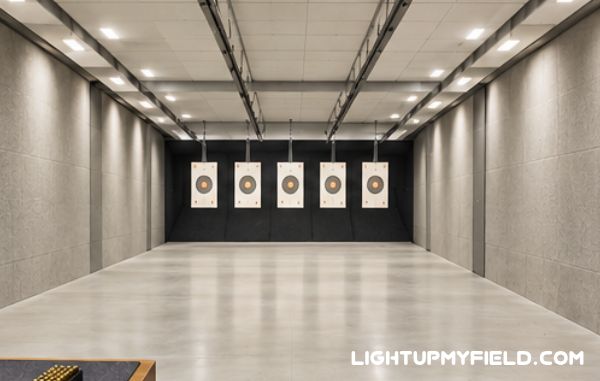 Indoor lighting budgets are influenced by building size, ceiling height, mounting arrangements, electrical capacity, and the need to work around existing equipment. An older building may require additional electrical improvements before a new lighting system can be installed.
The indoor environment also needs to be considered when selecting products. Ventilation, cleaning procedures, airborne contaminants, and environmental exposure can affect fixture suitability and maintenance requirements.
A site assessment should establish the mounting conditions, existing circuits, control requirements, and relevant environmental constraints. Those details help the designer specify suitable equipment and give contractors a more reliable basis for pricing the installation.
Outdoor Shooting Range Lighting
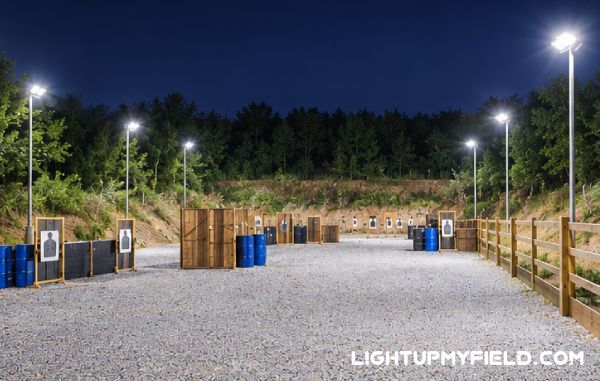 Outdoor projects can require weather-resistant fixtures, poles, foundations, underground conduits, and electrical distribution equipment. Costs may rise quickly when the site is large or the nearest suitable electrical supply is far from the areas being illuminated.
For early budgeting, a small outdoor project might fall within the lower five-figure range, while a larger site requiring multiple poles, extensive trenching, and utility work can reach $50,000 to $100,000 or more. These are illustrative project allowances, not standardized prices.
Outdoor lighting can also affect neighboring properties, nearby roads, wildlife, and the surrounding environment. Appropriate shielding, light-spill assessment, local planning requirements, and controls should be considered as part of the design.
How Facility Size Affects the Budget
Floor area is useful for an initial estimate, but it cannot determine the required number of fixtures on its own. Ceiling height, mounting locations, fixture output, room geometry, reflectance, and the required lighting performance all influence the final design.
A professional lighting layout should be based on measured or documented site conditions and suitable photometric calculations. Simply dividing the floor area by an assumed number of square feet per fixture can produce uneven lighting, excessive glare, or unnecessary energy consumption.
Grants, Rebates, and Funding for Shooting Range Lighting
Grants and utility incentives can reduce the net cost of a lighting upgrade, but availability depends on the facility’s location, ownership, intended use, and the program’s eligibility rules. A privately operated commercial range may qualify for different programs than a municipal recreation facility or a publicly owned sports complex.
Funding should be treated as a potential cost reduction rather than guaranteed project income. Some programs reimburse part of an approved project’s cost, while others offer fixed rebates for qualifying equipment or provide assistance with energy assessments.
Energy-Efficiency Grants and Utility Rebates
Utility providers sometimes offer commercial energy-efficiency incentives for qualifying LED fixtures, lighting controls, and other equipment. Programs may be available to businesses, nonprofit organizations, public facilities, or other eligible customers, depending on the provider.
The value of an incentive can vary by fixture type, rated power, expected energy savings, project size, and program rules. Some schemes calculate rebates per fixture, while others use estimated energy savings or a predefined incentive schedule.
Before including an incentive in a financial forecast, confirm whether the selected products qualify, whether an approved contractor is required, and whether the application must be submitted before purchasing equipment. Some programs will not reimburse work that has already begun.
Government Grants for Shooting Range Improvements
Government funding may be available through public recreation, community infrastructure, sports facility, or public safety programs. However, a program that funds general sports facilities does not necessarily cover a shooting range, and funding for law-enforcement facilities may be restricted to specific public agencies or approved uses.
Facility owners should check federal, state, county, and municipal funding opportunities in their own jurisdiction. Publicly owned facilities may also have access to capital improvement budgets that are unavailable to private operators.
Grant applications commonly require a project description, an itemized budget, evidence of ownership or authorization, contractor quotations, and an explanation of the expected benefits. Energy-efficiency applications may also request existing electricity consumption, proposed equipment specifications, and projected annual savings.
How Much Funding Can a Lighting Project Receive?
There is no single grant amount that applies to all shooting range lighting projects. The program may set a maximum award, reimburse a percentage of eligible costs, require matching funds, or restrict which expenses can be claimed.
Consider an illustrative $25,000 lighting upgrade that receives a hypothetical $5,000 approved incentive. The remaining project cost would be $20,000 before other expenses or financing adjustments.
If the same project qualified for a $7,500 incentive, the remaining cost would be $17,500. These examples demonstrate the arithmetic only and do not represent available grant amounts or promises of funding.
It’s also worth checking whether incentives can be combined. Some programs permit multiple sources of assistance, while others reduce their award when another incentive has already been applied. The terms of each program should be reviewed before assuming that different funding sources can be stacked.
Preparing a Strong Grant Application
A clear application starts with a well-defined project. The facility should be able to explain what equipment will be replaced, why the upgrade is being proposed, how much it will cost, and what measurable benefits are expected.
A comparison of current and proposed energy consumption can strengthen an application where energy savings are relevant. For example, the illustrative retrofit described earlier reduces annual lighting consumption from 27,375 kWh to 16,425 kWh, a reduction of 10,950 kWh. At $0.15 per kWh, that represents projected annual energy savings of $1,642.50.
The estimate should be supported by actual fixture specifications, operating hours, and the applicable electricity rate. Grant reviewers may require particular calculation methods or documentation, so applicants should follow the program’s instructions rather than relying solely on a general estimate.
A Better Lighting Budget Starts With a Clear Plan
Shooting range lighting costs are easier to manage when fixtures, installation, electricity, maintenance, and potential funding are considered as parts of the same project. A lower purchase price may look attractive at first, but a system that delivers suitable performance with less energy use and manageable maintenance can offer better value over time.
Before making a decision, compare itemized contractor quotations, calculate annual electricity expenses, verify the applicable design requirements, and investigate any grants or rebates that may be available. A properly documented budget gives you a clearer picture of the upfront investment and the likely cost of operating the system over several years.
If you’re planning a new shooting range lighting installation or considering an LED upgrade, contact our team for a lighting consultation. We can help you review your project requirements, compare suitable fixture options, estimate installation and running costs, and assess potential energy-saving opportunities so you can make a more informed decision about your lighting investment.Shooting range lighting is one of those facility upgrades that can look straightforward on paper but turn into a much bigger project once equipment, installation, electricity, and maintenance enter the picture. A few new fixtures might be enough for a small facility, while a larger indoor range could require electrical upgrades, specialized equipment, and a carefully planned lighting system.
So, how much should you budget? The answer depends on the size of the range, the type of fixtures you choose, the condition of the existing electrical system, and how many hours the lights operate each day. A project that looks affordable at the purchasing stage can also become expensive over time if the fixtures consume too much electricity or require frequent repairs.
The good news is that a well-planned lighting upgrade can help control long-term expenses while improving visibility, comfort, and day-to-day facility management. From fixture prices and installation labor to electricity bills and potential grants, here’s what range owners and facility managers should consider before starting a project.