

Football field lighting needs to do more than make the pitch look bright. Players must be able to follow the ball, judge distances, and react quickly, while referees and spectators need a clear view of the action. For facilities that host evening matches, the right lighting setup can make a noticeable difference to the playing experience.
But how bright should a football field actually be? The answer depends on how the pitch is used. A community training ground does not need the same lighting performance as a professional stadium hosting televised matches. The required illuminance, lighting uniformity, glare control, and installation budget can vary considerably between these facilities.
Two measurements commonly used to describe sports lighting are lux and foot-candles (FC). Lux is the standard metric unit, while foot-candles are frequently used in the United States. They measure the same thing, so it is useful to show both values when comparing lighting requirements.
This guide explains recommended football field brightness levels, how different competition standards affect lighting design, and what clubs and facility owners should budget for LED floodlights. It also covers fixture quantities, installation costs, electricity consumption, and practical ways to check whether a lighting system is performing as expected.
Recommended Football Field Lighting Levels by Competition
There is no single brightness level that suits every football pitch. The target depends on the standard of play, the age group, training or match use, and whether the venue needs to support spectators or broadcast cameras.
For an initial planning estimate, the following ranges provide a useful starting point. They are indicative design ranges, not universal regulatory requirements. Always check the rules of the relevant football association, competition organiser, and local authority before finalising a project.
Football field lux and FC requirements at a glance
| Type of football facility | Suggested average horizontal illuminance |
|---|---|
| Casual recreational pitch | 75–150 lux (7.0–13.9 FC) |
| Youth and community training | 100–200 lux (9.3–18.6 FC) |
| School and local competition | 200–300 lux (18.6–27.9 FC) |
| Amateur and regional competition | 300–500 lux (27.9–46.5 FC) |
| Higher-level club competition | 500–750 lux (46.5–69.7 FC) |
| Professional and broadcast venues | 800–1,500+ lux (74.3–139.4+ FC) |
These figures refer to average horizontal illuminance on the playing surface. A professional broadcast installation may also need substantially higher vertical illuminance, depending on camera positions and competition requirements.
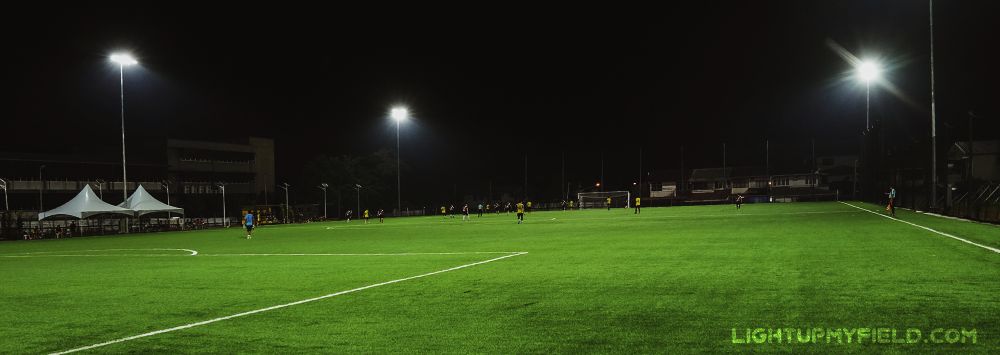
Recreational and community football pitches
A recreational pitch used for casual games, youth activities, or occasional evening training generally has more modest lighting requirements. An indicative target of 75–150 lux (7.0–13.9 FC) may be suitable for some informal uses, while more organised community training may call for around 100–200 lux (9.3–18.6 FC).
The aim is to provide enough light for players to see the ball and surrounding activity without creating unnecessarily high installation and running costs. Uniformity still matters. A pitch with bright areas near the floodlight poles and dark patches in the middle can be uncomfortable to play on, even if its average reading looks acceptable.
School, amateur, and regional football grounds
School pitches and local competition venues often need a higher lighting level because they host more structured matches and regular evening sessions. A preliminary design range of 200–500 lux (18.6–46.5 FC) can be used for planning, depending on the level of competition and applicable standards.
At this level, the lighting layout deserves careful attention. The system should distribute light across the full playing area, including the goal areas and touchlines. Better uniformity can help players track passes and judge the movement of the ball more consistently.
Higher-level club and professional stadiums
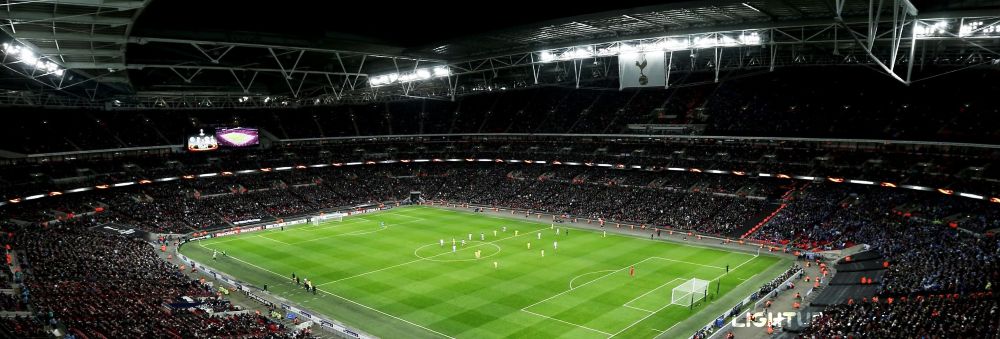
Professional and higher-level venues have more demanding requirements. Depending on the competition, a system may be designed around 800–1,500 lux (74.3–139.4 FC) or higher.
For televised matches, simply measuring the light falling on the grass is not enough. Cameras need to capture players, the ball, and movement clearly from different angles. This makes vertical illuminance, glare control, colour rendering, and flicker performance part of the design process.
A stadium should therefore be designed around the actual competition specification rather than a general lux target.
Lux vs. Foot-Candles – Understanding the Two Measurements
Lux and foot-candles are both units of illuminance. They describe how much light reaches a surface, rather than how much light a lamp produces.
Understanding the difference makes it easier to compare lighting products, technical specifications, and project requirements from suppliers in different countries.
What does lux mean in football field lighting?
Lux is the metric unit used to measure illuminance. One lux equals one lumen of light falling on one square metre of surface.
For example, if a football pitch has an average reading of 300 lux (27.9 FC), that means the measured playing surface receives an average illuminance of 300 lumens per square metre.
Lux readings are commonly used in lighting calculations and commissioning reports. They help designers check whether a proposed system can meet the required brightness across the pitch.
What does FC mean?
Foot-candle, usually written as FC, is another unit of illuminance. One foot-candle represents one lumen of light falling on one square foot of surface.
Foot-candles are widely used in American sports lighting specifications. A supplier working with a US club may therefore describe a system using FC, while a European supplier may use lux.
Both measurements describe the same lighting condition. The difference is simply the unit of measurement.
Lux to FC conversion table
The conversion is straightforward:
- 1 lux = 0.0929 FC
- 1 FC = 10.764 lux
Here are some common football field lighting values shown in both units.
| Lux | Foot-candles (FC) |
|---|---|
| 50 lux | 4.6 FC |
| 75 lux | 7.0 FC |
| 100 lux | 9.3 FC |
| 150 lux | 13.9 FC |
| 200 lux | 18.6 FC |
| 250 lux | 23.2 FC |
| 300 lux | 27.9 FC |
| 400 lux | 37.2 FC |
| 500 lux | 46.5 FC |
| 600 lux | 55.7 FC |
| 750 lux | 69.7 FC |
| 800 lux | 74.3 FC |
| 1,000 lux | 92.9 FC |
| 1,200 lux | 111.5 FC |
| 1,400 lux | 130.1 FC |
| 1,500 lux | 139.4 FC |
| 2,000 lux | 185.9 FC |
When comparing floodlights or reviewing a lighting design, make sure the figures refer to the same measurement. Average illuminance, minimum illuminance, and vertical illuminance are different values, even when they are all expressed in lux or FC.
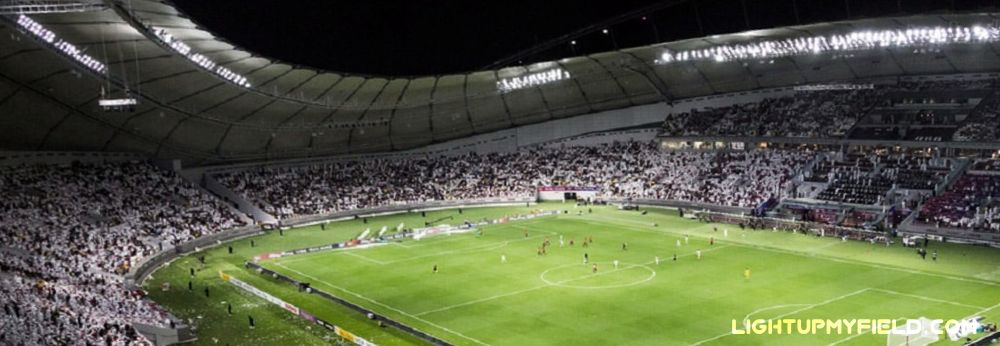
Football Field Lighting Standards and Competition Requirements
Football lighting standards help clubs and facility owners decide how much light a pitch needs. However, requirements vary between countries, football associations, competitions, and facility types.
A training ground may have a relatively modest target, while a stadium hosting international matches may need a more advanced system. The specification should always be checked against the rules that apply to the venue.
FIFA guidance for football stadium lighting
FIFA stadium guidance considers several aspects of lighting quality rather than relying on one horizontal illuminance figure. These include the amount of light reaching the playing surface, the distribution of light, vertical illuminance, glare, and the needs of television production.
Horizontal illuminance describes the light falling onto the pitch. Vertical illuminance describes the light reaching a vertical plane, such as the front of a player or the surface seen by a camera. Both can matter in a stadium environment.
FIFA guidance also highlights the need for appropriate measurement grids and consistent lighting performance. A system should be evaluated across the playing area, not just by taking a reading directly beneath a floodlight.
UEFA stadium lighting requirements
UEFA competition requirements can vary by stadium category and the level of competition being hosted. Higher categories generally require more demanding lighting performance, particularly where broadcast coverage is involved.
A club should not assume that one general lux value will satisfy every UEFA competition. The applicable regulations and competition-specific technical requirements should be checked during the design stage.
For a professional stadium, the lighting designer may need to assess:
- Average and minimum horizontal illuminance.
- Vertical illuminance at relevant camera positions.
- Lighting uniformity across the pitch.
- Glare for players, officials, spectators, and cameras.
- Colour rendering and colour temperature.
- Flicker performance for slow-motion and high-frame-rate broadcasting.
Local and national sports lighting standards
National standards can provide different lighting classes for training, recreational play, and formal competition. For example, some local sports field guidance uses around 50 lux (4.6 FC) for community training and 100 lux (9.3 FC) for basic competition.
These figures should not be treated as a universal football standard. The required level depends on the local standard, the intended use, and the authority responsible for the facility.
Before ordering equipment, confirm the required lighting class and measurement method. It is much easier to adjust a design on paper than to replace floodlights after installation.
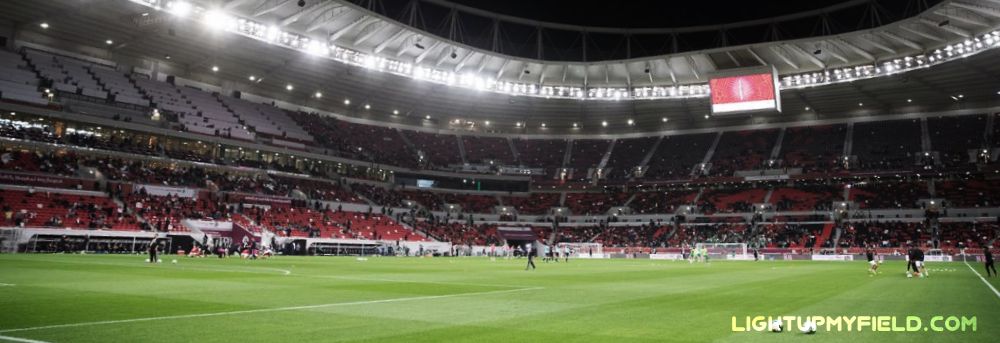
Football Field LED Lighting Installation Cost by Competition Level
The cost of installing football field lighting can vary significantly. A basic community pitch may need a relatively straightforward system, while a professional stadium may require high-output fixtures, advanced controls, extensive electrical work, and broadcast-ready performance.
The figures below are broad US$ planning estimates for new or upgraded installations. They are not supplier quotations or guaranteed market prices. Actual costs depend on the project location, site conditions, existing infrastructure, pole requirements, and the technical specification.
Estimated installation costs by facility type
| Competition or facility level | Indicative lighting target | Broad installation budget |
|---|---|---|
| Youth and community pitch | 100–200 lux (9.3–18.6 FC) | US$50,000–US$150,000 |
| School and local competition | 200–300 lux (18.6–27.9 FC) | US$75,000–US$200,000 |
| Amateur and regional club | 300–500 lux (27.9–46.5 FC) | US$120,000–US$350,000 |
| College and higher-level venue | 500–750 lux (46.5–69.7 FC) | US$150,000–US$450,000 |
| Professional and broadcast stadium | 800–1,500+ lux (74.3–139.4+ FC) | US$500,000–US$2 million+ |
The ranges overlap because the competition level is only one part of the cost calculation. A school upgrading existing poles may spend less than a community facility that needs new foundations, cabling, and electrical infrastructure.
For reference, a 2025 City of Calexico project document listed LED sports field installation costs in the approximate range of US$146,840–US$343,976 for high school, college, and recreational-level facilities. This provides a real-world example, although individual project costs can differ considerably.
Youth and community football lighting costs
A youth or community pitch generally has more modest lighting requirements. A system designed around 100–200 lux (9.3–18.6 FC) may be suitable for some facilities, subject to local standards and the intended use.
A preliminary budget of US$50,000–US$150,000 may be reasonable for planning a relatively straightforward installation. The lower end is more achievable when suitable poles, foundations, and electrical connections are already available.
Costs can increase if the project needs new poles, underground cabling, switchgear, or substantial civil works. Even a modest system should include a lighting design to avoid dark areas and unnecessary spill light.
School and local competition lighting costs
School and local competition pitches may need around 200–300 lux (18.6–27.9 FC) as an initial planning range, although the relevant sports standard may specify a different level.
A broad budget of US$75,000–US$200,000 can be used for early project discussions. This may cover LED floodlights, installation, electrical work, controls, and some supporting infrastructure.
Schools should also consider how the pitch will be used outside match hours. Dimming or switching options can help the facility operate at a lower lighting level for training rather than running the entire system at full output every evening.
Amateur and regional club lighting costs
Amateur and regional venues often need a more capable system because they host regular fixtures, training sessions, and sometimes larger spectator events.
A preliminary target of 300–500 lux (27.9–46.5 FC) may be considered for some facilities, with a broad installation allowance of US$120,000–US$350,000.
At this level, fixture distribution and uniformity deserve particular attention. The design may need additional floodlights, taller poles, more advanced optics, and improved controls.
College and higher-level competition lighting costs
College and higher-level facilities may require a target around 500–750 lux (46.5–69.7 FC), depending on the competition and whether broadcasting is involved.
A broad planning budget of US$150,000–US$450,000 may be appropriate for some projects. Higher costs are possible where the installation includes new lighting structures, complex electrical upgrades, or demanding performance requirements.
The design should also account for future use. If the venue may host higher-level competitions later, it can be worth assessing those requirements before choosing poles and electrical infrastructure.
Professional and broadcast stadium lighting costs
Professional stadium lighting is a different scale of project. The system may need high horizontal and vertical illuminance, carefully controlled glare, excellent uniformity, and stable performance for television cameras.
A preliminary budget of US$500,000–US$2 million or more may be considered for some installations. Large stadium projects can exceed this range, particularly when they involve extensive structural, electrical, and control-system upgrades.
The budget should allow for photometric modelling, high-performance LED floodlights, mounting structures, electrical distribution, control systems, commissioning, and compliance testing.
What makes football field lighting installation more expensive?
The fixture price is only one part of the total project. A useful budget should consider all major cost categories.
| Cost category | What it may include |
|---|---|
| LED floodlights | Fixtures, drivers, optics, surge protection |
| Poles and brackets | New poles, crossarms, mounting frames, access systems |
| Foundations | Excavation, concrete, reinforcement, structural work |
| Electrical infrastructure | Cabling, switchgear, distribution boards, connections |
| Lighting controls | Switching, dimming, scheduling, control interfaces |
| Installation | Lifting equipment, labour, wiring, aiming |
| Design and testing | Photometric calculations, commissioning, lux measurements |
Before comparing supplier quotations, check that each proposal includes the same scope of work. One quote may cover only the floodlights, while another includes poles, foundations, wiring, installation, and commissioning.
How to Measure Football Field Lux and FC Levels
Once the floodlights have been installed, the pitch should be measured to check whether the lighting system meets its design targets.
A lux meter is commonly used for this purpose. It measures illuminance at a specific position and can help identify areas that are brighter or darker than expected.
Use a calibrated lux meter
Choose a suitable lux meter and check that it is calibrated according to the manufacturer’s instructions. The sensor should be positioned at the measurement height and orientation specified by the relevant lighting standard.
Because 1 lux equals approximately 0.0929 FC, the readings can be converted into foot-candles when needed.
Measure the entire playing surface
Do not take just one reading in the centre of the pitch. A measurement grid should cover the full playing area, including the corners, goal areas, touchlines, and central zones.
The number and spacing of measurement points should follow the applicable standard or project specification. A simple 10-by-6 grid may be useful for an initial site check, but it should not replace a formal measurement layout where one is required.
Check average, minimum, and maximum illuminance
After collecting the readings, calculate the average, minimum, and maximum values. These figures help show whether the pitch meets the target and whether the lighting is evenly distributed.
For example, a system might have an average of 300 lux (27.9 FC), but the minimum reading could be much lower in one corner. That would indicate a distribution problem that an average figure alone would not reveal.
Prepare a commissioning report
A commissioning report should record the measurement locations, readings, lighting conditions, equipment used, and any adjustments made during testing.
For professional and broadcast venues, the report may also need vertical illuminance, glare-related assessments, and other competition-specific checks.
Plan a Football Field Lighting System That Fits Your Competition Level
Choosing football field lighting is about finding the right balance between brightness, uniformity, visibility, installation cost, and long-term energy use. A community training pitch may need a straightforward LED setup, while a professional stadium requires a much more detailed design that accounts for competition rules and broadcast performance.
Start by confirming the required illuminance in lux (FC), then assess the pitch dimensions, pole positions, fixture optics, and existing electrical infrastructure. A photometric lighting design can help estimate the number of floodlights and show how evenly the light will reach the playing surface. It also gives you a clearer basis for comparing installation quotations and future running costs.
If you are planning a new football field lighting installation or upgrading an existing system, our team can help you assess the project requirements, recommend suitable LED floodlights, and prepare a lighting solution around your facility and budget. Contact us for a consultation to discuss your pitch dimensions, competition level, target lux (FC), and installation requirements.