
Building a football field from scratch can be an exciting project, especially if you already own a piece of land and are considering turning it into a sports facility. Perhaps you want to establish a local football club, open a training center, develop a community sports ground, or create a commercial facility where players can rent the field by the hour. Whatever your goal, having the land is only the first step. There are still plenty of things to figure out before construction can begin, and getting the planning right can make a big difference to your overall investment.
From choosing the right field dimensions and preparing the ground to installing artificial turf, designing a drainage system, and selecting suitable LED sports lights, every part of the project needs to work together. You will also need to consider lighting pole positions, electrical capacity, construction permits, maintenance expenses, and the amount of money required to complete the facility. If you plan to let people play in the evening, sports lighting should be included in the original design rather than treated as an extra feature to think about later.
So, how much land do you actually need? Is natural grass or artificial turf a better choice? How many floodlights and lighting poles should you install, and what kind of budget should you prepare? Let’s go through the process step by step, with practical examples, estimated costs in US$, and useful considerations for anyone planning to turn an empty piece of land into a football facility.

Understanding Your Land Before Starting Football Field Construction
Before thinking about turf, goalposts, or floodlights, start by understanding the land you already own. A plot that looks suitable at first glance may have uneven ground, poor soil conditions, drainage problems, or development restrictions that could affect the construction process. These issues are not always obvious until a proper site investigation has been completed, so it is worth spending time on this stage before making major purchasing decisions.
The condition of the land will influence almost every part of the project, including excavation costs, drainage requirements, foundation design, and the final playing surface. For example, a relatively flat plot with stable soil may require much less preparation than a sloping site with soft ground or a high groundwater level. Getting a clearer picture of these conditions early can help you prepare a more realistic budget and avoid expensive changes during construction.
How Much Land Do You Need to Build a Football Field?
The amount of land required depends mainly on the type of football field you want to construct. A full-size 11-a-side pitch needs considerably more space than a five-a-side or seven-a-side field, so the first thing to decide is how the facility will be used. If your goal is to host organized matches, a full-size pitch may be the most suitable option. However, if you are developing a smaller training center or recreational facility, a reduced-size field could make better use of your available land.
According to commonly used association football dimensions, a full-size pitch can measure between 90 and 120 meters in length and 45 to 90 meters in width. For international matches, the permitted playing dimensions are generally 100 to 110 meters long and 64 to 75 meters wide. A widely used reference size for professional football is 105 meters by 68 meters, which gives a playing surface of 7,140 square meters.
However, the actual land requirement will be larger than the playing area itself. You need additional space around the pitch for safety run-off zones, team benches, spectator access, maintenance equipment, fencing, and other facilities. If you plan to include changing rooms, toilets, parking spaces, or a small reception building, the total site area will increase further.
For a basic full-size outdoor facility without extensive spectator seating or large supporting buildings, approximately 8,500 to 10,000 square meters may provide a starting point for planning. A more developed sports complex with parking, changing rooms, storage areas, and spectator facilities may require 12,000 to 20,000 square meters or more.
| Field type | Approximate playing area | Suggested planning area |
|---|---|---|
| 5-a-side | 800–1,500 m² | 1,200–2,000 m² |
| 7-a-side | 2,000–4,000 m² | 3,000–5,000 m² |
| 9-a-side | 4,500–6,500 m² | 6,000–8,000 m² |
| Full-size 11-a-side | 7,140 m² | 8,500–10,000 m² or more |
These figures are intended for preliminary planning rather than as fixed construction requirements. The actual land area will depend on the playing format, applicable competition regulations, local building restrictions, safety clearances, and the supporting facilities you intend to provide. If your land is relatively small, you do not necessarily need to abandon the project, as a smaller training pitch or multi-purpose football facility may be a more practical alternative.
What Should You Check Before Developing the Land?
The first thing to investigate is the ground elevation, because a football field needs a carefully planned surface that allows rainwater to drain away without creating uncomfortable playing conditions. Even a relatively small difference in ground level can affect drainage performance and the amount of excavation or filling required. A topographic survey can help identify high and low areas, existing slopes, nearby roads, drainage channels, and other physical features that may influence the field layout.
Soil conditions are another area worth investigating before construction begins. Some sites have stable sandy or gravelly soils that are relatively straightforward to prepare, while others contain clay, soft ground, or materials that may need to be removed or stabilized. If the ground has poor bearing capacity, additional work may be required to support the playing surface and the foundations for lighting poles.
You should also think about vehicle access, especially if the project will involve large construction equipment. Excavators, concrete mixers, turf delivery trucks, and cranes used to install lighting poles all need sufficient access to the site. A narrow entrance or unsuitable access road can create delays and additional transportation costs, so these details should be checked during the early planning stage.
The surrounding environment also deserves attention. Nearby residential buildings, roads, trees, and existing structures may influence the field orientation, lighting pole positions, and permitted operating hours. For example, if homes are located close to the proposed football field, you may need to consider glare control and light spill when planning the outdoor lighting system.
Do You Need a Soil Test and Topographic Survey?
A topographic survey and geotechnical investigation are two useful starting points for a new football field project. Although they may seem like additional expenses at the beginning, the information they provide can help engineers make better decisions about ground preparation, drainage, and structural foundations.
A topographic survey records the elevation and physical features of the land, allowing engineers to understand the existing slope and determine how the site should be graded. A geotechnical investigation focuses on the soil itself and may involve boreholes, soil sampling, groundwater observations, and laboratory testing to establish the ground’s engineering properties.
These investigations are particularly relevant when the project includes tall sports lighting poles. A pole measuring 20 or 30 meters in height can experience substantial wind loads, especially when it carries several large LED floodlights. The foundation must therefore be designed according to the soil’s bearing capacity, groundwater conditions, wind loading, and structural characteristics of the pole.
For early budgeting, a basic survey and geotechnical investigation may cost approximately US$2,000 to US$8,000 for a relatively straightforward site. Larger plots, remote locations, or projects with more complicated ground conditions may require a higher budget. It is best to obtain a quotation from a local engineering company based on the actual size and condition of your land.
Planning Football Pitch Dimensions and Layout
Once you understand the land conditions, the next step is to decide what kind of football facility you want to build. A field intended for weekend recreational matches will have different requirements from a professional training ground or a competition venue. The dimensions, surface materials, safety zones, lighting arrangement, and supporting facilities should all reflect the intended use.
It is also worth thinking about how the facility might develop over time. You may initially want to build a single football field, but there could be opportunities to add another training pitch, spectator seating, or a small sports center later. Leaving enough space for future expansion can make the overall site plan more flexible.
What Is the Standard Size of a Football Field?
There is no single mandatory dimension for every football field, as association football regulations allow a range of pitch sizes depending on the level and type of competition. For international matches, the playing area generally measures 105 meters by 68 meters, and this dimension is widely used as a reference for professional and semi-professional facilities.
The overall layout should be larger than the marked playing area because players need suitable space around the touchlines and goal lines. For example, if you allow an additional 3 meters on each side of a 105-meter by 68-meter pitch, the overall rectangular area becomes approximately 111 meters by 74 meters, or 8,214 square meters.
For youth training, community recreation, and smaller football clubs, reduced dimensions may be more suitable. A smaller pitch can make better use of limited land while also reducing the amount of turf, drainage, fencing, and lighting equipment required. However, if the facility is expected to host official matches, you should confirm the relevant competition regulations before finalizing the design.
How Should You Orient the Football Pitch?
Field orientation can influence player comfort, visibility, and lighting performance, so it is worth considering during the early design stage. A north-south orientation is often considered for outdoor football fields because it can help reduce direct sunlight shining into players’ eyes during certain playing periods. However, the best direction depends on the site’s latitude, surrounding buildings, terrain, and the usual times when the field will be used.
The prevailing wind direction may also affect the layout, particularly if the site is exposed to strong winds. Nearby residential properties, roads, and other buildings should be considered as well, since they may influence where lighting poles can be installed and how the luminaires should be aimed.
From a sports lighting perspective, field orientation and surrounding structures can affect the final lighting distribution. If the pole positions are not planned properly, some areas may receive too much light while other parts of the pitch remain relatively dark. For this reason, it is a good idea to involve a lighting designer before approving the final site layout, especially if the facility will be used for organized evening matches.
What Additional Facilities Should Be Included?
A football field can be developed with fairly basic facilities, but a commercial venue or organized sports center will usually need more than just a playing surface. Changing rooms, toilets, showers, storage rooms, referee facilities, and first-aid areas can make the venue more convenient for players and staff. If you intend to host spectators, you may also need seating areas, accessible walkways, entrance gates, and suitable emergency access.
Parking is another feature that should not be overlooked, particularly if the facility will host tournaments or multiple training sessions throughout the day. You should also consider perimeter fencing, security cameras, waste collection areas, and basic site lighting for walkways and entrances.
For a smaller recreational facility, supporting buildings may occupy only a few hundred square meters. A larger sports complex with spectator seating, parking, and multiple pitches may require several thousand additional square meters. Even if you do not plan to construct every facility immediately, reserving suitable space in the original layout can make future development much easier.
Choosing Between Natural Grass and Artificial Turf

The playing surface is one of the biggest decisions in football field construction because it affects the initial investment, maintenance budget, playing experience, and expected operating life of the facility. Natural grass and artificial turf both have advantages, but they are designed for somewhat different operating conditions.
Natural grass offers a traditional playing experience and is commonly used at professional football venues and facilities with sufficient maintenance resources. Artificial turf is often preferred by schools, training centers, community sports grounds, and commercial football facilities where the pitch needs to accommodate frequent use throughout the week.
The right choice depends on your climate, available maintenance staff, expected playing hours, and the type of users you want to attract. It is worth comparing the full life-cycle cost rather than looking only at the initial installation quotation.
Is Natural Grass or Artificial Turf Better?
Natural grass can provide a comfortable and familiar playing surface when it is properly maintained. It generally requires regular mowing, watering, fertilizing, aeration, pest management, and occasional reseeding. Weather conditions and playing frequency also influence how well the surface performs throughout the year. In areas with heavy rainfall, drought, or extreme temperatures, maintaining a consistent natural grass pitch can become more challenging.
Artificial turf offers a different set of advantages, particularly for facilities that need to accommodate frequent training sessions and commercial bookings. It is less dependent on natural growing conditions and can often support more playing hours than a natural grass pitch, provided the system has been properly designed and maintained.
However, artificial turf should not be treated as a maintenance-free solution. It still requires regular brushing, cleaning, infill management, seam inspections, and occasional repairs. The turf fibers and infill materials may also wear over time, so replacement costs should be included in your long-term financial planning.
For a facility that expects heavy daily use, artificial turf may be worth considering because it can provide more consistent availability. For a venue focused on traditional match play and able to maintain the surface properly, natural grass may be a better fit.
How Much Does Football Field Turf Installation Cost?
The cost of installing a football field surface depends on the materials, preparation work, drainage system, irrigation requirements, and quality of the finished product. Natural grass installation may cost approximately US$4 to US$12 per square foot for early budgeting, depending on the grass variety, soil preparation, irrigation system, and construction specification.
Artificial turf installation may range from approximately US$7 to US$18 per square foot for many sports-field projects. Higher-specification systems can cost more, especially when they include specialized shock pads, advanced drainage layers, premium turf products, or particular performance certifications.
For a full-size playing area of 7,140 square meters, equivalent to approximately 76,875 square feet, the estimated surface costs could look like this:
| Surface type | Indicative cost per sq. ft. | Estimated field cost |
|---|---|---|
| Natural grass | US$4–US$12 | US$307,500–US$922,500 |
| Artificial turf | US$7–US$18 | US$537,000–US$1,383,750 |
These figures are broad planning allowances rather than fixed supplier prices. The actual quotation may vary depending on whether excavation, sub-base construction, drainage, irrigation, infill, line markings, and installation labor are included. When comparing contractors, ask for a detailed breakdown so you can see exactly what each quotation covers.
What Maintenance Does Each Surface Require?
Natural grass generally needs more frequent maintenance because it is a living surface that responds to weather, soil conditions, and playing activity. Depending on the climate and growing season, mowing may be needed several times a week, while watering, fertilization, aeration, and occasional reseeding help maintain the playing quality.
Artificial turf has a different maintenance routine, but regular care is still necessary to protect the surface and extend its service life. Brushing helps keep the turf fibers upright and distributes infill more evenly, while cleaning removes leaves, dust, and other debris. You should also inspect seams, line markings, infill levels, and drainage outlets periodically.
The amount of maintenance required depends heavily on how often the field is used. A recreational pitch that receives a few bookings each week will have different maintenance needs from a commercial facility that operates for eight or more hours every day. Before choosing a surface, ask the supplier for a recommended maintenance schedule and an estimate of the associated annual costs.
Ground Preparation, Drainage, and Field Construction
A good football field starts below the surface. Even high-quality turf will not perform as expected if the ground underneath is unstable or the drainage system has not been designed properly. Ground preparation may not be the most visible part of the project, but it has a direct effect on the field’s durability, playing conditions, and long-term maintenance requirements.
The construction method will depend on whether you choose natural grass or artificial turf, as well as the existing soil and groundwater conditions. A professional civil engineer or sports field contractor should prepare the construction specification before materials are ordered.
How Do You Prepare and Level the Ground?
Ground preparation usually begins with clearing vegetation, removing unsuitable materials, and excavating the site to the required formation level. The contractor then carries out earthworks to create the designed elevations and slopes, which may involve cutting higher areas, filling lower sections, or importing suitable materials.
Once the ground has been shaped, the subgrade is compacted according to the engineering specification. Depending on the soil conditions, geotextile materials or stabilization layers may be required to improve the performance of the ground. These layers help provide a more stable base for the playing surface and reduce the risk of uneven settlement.
For artificial turf installations, the construction system generally includes engineered aggregate layers designed to provide stability and drainage. The exact depth depends on the soil conditions, climate, turf system, and engineering design. Natural grass fields may use a different arrangement involving a root zone, growing medium, drainage layers, and irrigation infrastructure.
It is not advisable to rely on visual inspection alone when checking the finished ground. A surface that looks flat may still contain small variations that affect ball movement and water drainage, so proper surveying and construction quality checks should be part of the process.
Why Does a Football Field Need a Proper Drainage System?
Water accumulation can make a football field difficult to use, particularly after heavy rainfall. Poor drainage may also damage the playing surface, affect the stability of the sub-base, and increase maintenance requirements. A well-designed drainage system collects rainwater and directs it away from the pitch through surface grading, drainage channels, perforated pipes, or a combination of these methods.
The design depends on several factors, including rainfall intensity, soil permeability, groundwater conditions, and the type of playing surface. For example, a site with clay-rich soil may require a more extensive drainage arrangement than a site with naturally permeable sandy soil.
Consider a full-size pitch measuring 105 meters by 68 meters. If lateral drainage pipes are installed at approximately 5-meter spacing across the width of the pitch, the system may require around 14 lateral runs, each measuring approximately 105 meters. This would represent about 1,470 meters of lateral drainage pipe before including perimeter collectors, inspection chambers, and connections.
This is only an illustrative layout, not a recommended specification for every site. Pipe spacing, diameter, gradient, aggregate requirements, and outlet capacity should be determined by a drainage engineer based on the actual site conditions and expected rainfall.
How Much Does Football Field Ground Preparation Cost?
Ground preparation costs can vary considerably because the original condition of the land has a major influence on the amount of work required. A relatively flat site with suitable soil may need less excavation and imported material than a sloping plot with weak ground or poor drainage.
For preliminary budgeting, basic earthworks, grading, and compaction may cost around US$3 to US$10 per square foot of developed field area. More complicated sites may exceed this range, particularly when they require extensive excavation, soil replacement, retaining structures, or ground stabilization.
Drainage installation may add approximately US$2 to US$6 per square foot, depending on the pipe network, excavation, aggregate, geotextiles, and discharge arrangements. These costs should be checked carefully against the contractor’s quotation because some suppliers include drainage and base preparation in a complete field package, while others price each component separately.
Understanding Football Field Lighting Requirements
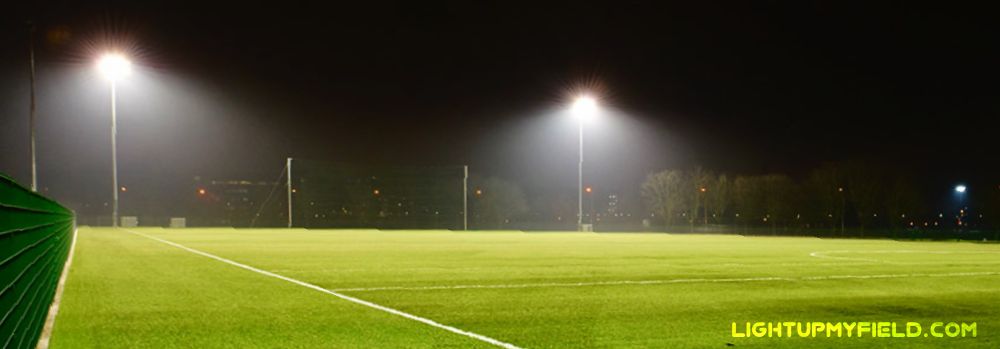
If your football field will be used during the evening or at night, sports lighting needs to be included in the overall construction plan. A properly designed lighting system allows players to see the ball clearly, improves visibility across the playing area, and gives the facility more flexibility when scheduling training sessions and matches.
However, lighting a football field involves more than installing a few powerful floodlights on tall poles. The system needs to be designed around the required illumination level, lighting uniformity, glare control, pole height, beam distribution, electrical capacity, and the surrounding environment. These factors influence both the final equipment cost and the quality of the lighting.
Does a Football Field Need Floodlights?
Not every football field needs permanent floodlights. If the facility will only be used during daylight hours, a dedicated sports lighting system may not be necessary. However, lighting can make a considerable difference for commercial football facilities, schools, academies, and community sports centers where evening bookings are part of the operating plan.
Many people are only available to play football after work or school, which means evening operating hours can represent a large part of the facility’s potential business. A field without suitable lighting may lose valuable booking opportunities, particularly during winter when daylight hours are shorter.
For example, imagine that a football facility rents its field for US$80 per hour and can offer an additional four hours of evening operation each day. If the field is booked for all four hours over 25 operating days, the potential additional monthly gross revenue would be US$8,000.
The calculation is straightforward: US$80 multiplied by four hours and 25 days. Of course, this is not guaranteed profit, as the actual result depends on customer demand, weather, electricity costs, staffing, maintenance, and other operating expenses. Still, it shows why sports lighting can be viewed as part of the facility’s revenue strategy rather than simply an optional feature.
How Many Lux Does a Football Field Need?
Lux is the unit used to measure illuminance, which describes how much light reaches a surface. In sports lighting design, the required lux level depends on the type of activity, competition level, and whether the facility is intended for recreational play, training, organized matches, or television broadcasting.
A recreational football field does not need the same lighting performance as a professional stadium. Setting a suitable target from the beginning helps prevent unnecessary equipment costs while ensuring the playing area receives sufficient illumination.
For early planning, the following ranges can be used as general reference points:
| Usage category | Indicative average horizontal illuminance |
|---|---|
| Casual recreational play | 50–100 lux |
| Community training | 100–200 lux |
| Club-level competition | 200–300 lux |
| Higher-level competition | 300–500 lux |
| Professional televised events | 500–1,000+ lux |
These figures are preliminary planning ranges rather than universal requirements. The actual target should follow the applicable lighting standard, competition rules, and project specification. Professional broadcasting may also require specific vertical illuminance levels, uniformity, glare control, color quality, and flicker performance to ensure that cameras can capture the action clearly from different positions.
It is also worth remembering that higher lux levels usually require more lighting output, which may increase the number of luminaires, installed power, pole requirements, and overall project budget. Before requesting quotations, decide how the field will actually be used and confirm the relevant lighting requirements.
What Is Lighting Uniformity and Why Does It Matter?
Average lux is only one part of a football field lighting design. Uniformity is equally relevant because it describes how consistently light is distributed across the playing surface. Imagine two football fields that both achieve an average illuminance of 200 lux. On the first field, the light is spread relatively evenly, while the second has very bright areas near the poles and noticeably darker corners. Although the average reading is the same, the playing experience will be quite different.
One commonly used uniformity measure is minimum illuminance divided by average illuminance:
U1 = Emin / Eavg
For example, if a field has an average illuminance of 200 lux and a minimum reading of 100 lux, the minimum-to-average uniformity ratio is 0.50. Another measure sometimes used is minimum illuminance divided by maximum illuminance, which provides a different view of the lighting distribution.
For preliminary recreational projects, designers may consider a minimum-to-average uniformity target of around 0.4 to 0.5, although higher-level facilities may require more demanding performance. The exact target should be based on the applicable lighting standard and the intended use of the venue.
A well-designed lighting system should distribute illumination across the entire playing area rather than concentrating excessive light in a few locations. This is one reason why a photometric simulation is useful before purchasing the luminaires.
How Many LED Floodlights Are Needed for a Football Field?
There is no universal number of floodlights for every football field because the required quantity depends on the playing area, target lux level, luminaire output, optical distribution, pole height, and maintenance factor. A smaller recreational pitch may require considerably fewer fixtures than a full-size field designed for higher-level competition.
A useful starting point is the lumen method, which provides an approximate estimate of the total luminous flux required for a particular playing area. The formula is:
Required lumens = (E × A) / (UF × MF)
In this formula, E represents the target average illuminance in lux, A is the playing area in square meters, UF is the utilization factor, and MF is the maintenance factor.
Let’s use a full-size football field measuring 105 meters by 68 meters. The playing area is 7,140 square meters. Assume that the target average illuminance is 200 lux, the utilization factor is 0.50, and the maintenance factor is 0.80.
The calculation becomes:
Required lumens = (200 × 7,140) / (0.50 × 0.80)
Required lumens = 1,428,000 / 0.40
Required lumens = 3,570,000 lumens.
If each LED floodlight produces 100,000 lumens, the theoretical number of luminaires would be 3,570,000 divided by 100,000, giving approximately 36 floodlights.
This is a preliminary sizing estimate, not a final equipment recommendation. The lumen method does not fully account for individual beam distributions, pole positions, aiming angles, light spill, and the geometry of the installation. A real project should therefore be checked using photometric simulation software such as DIALux, with suitable IES or LDT files from the proposed luminaires.
How Many Watts of LED Sports Lights Are Needed?
Wattage tells you how much electrical power a floodlight consumes, but it does not directly tell you how much useful light reaches the playing surface. Two LED floodlights with the same wattage can produce noticeably different lumen outputs because their LED chips, drivers, optical systems, and thermal management designs may differ.
For example, a 1,000W LED floodlight with an efficacy of 150 lumens per watt produces approximately 150,000 lumens. Another 1,000W model with an efficacy of 120 lumens per watt produces only 120,000 lumens. Both consume the same amount of electricity, but the first delivers 25% more nominal luminous output.
This is why it is better to compare actual lumen output, efficacy, beam distribution, and photometric performance rather than choosing sports lights based on wattage alone. Depending on the field size and lighting requirements, a project may use luminaires ranging from several hundred watts to 1,500W or more.
Smaller recreational pitches may be adequately served by lower-output floodlights, while large stadium installations often require high-output sports luminaires with specialized optics. The correct power rating should be determined after the target lux level and lighting layout have been established.
What Is the Difference Between Recreational and Professional Football Field Lighting?
The main difference between recreational and professional football field lighting is not simply the brightness of the luminaires. Higher-level sports lighting generally has more demanding requirements for uniformity, glare control, vertical illuminance, color quality, and operating performance.
A recreational field may be designed around 100 to 150 lux, depending on the applicable requirements, while a professional competition venue may need several hundred lux or more. Television broadcasting introduces additional considerations because cameras need sufficient light on players from different directions, and the lighting system may need to meet specific flicker requirements for slow-motion recording.
Professional facilities may also use multiple lighting scenes, allowing operators to select different settings for training, matches, maintenance, and special events. For example, a field might operate at 50% or 70% output during training and use the full specified lighting output during matches. This approach can help reduce electricity consumption when maximum illumination is unnecessary.
Designing the Football Field LED Lighting Layout
Once the target lux level has been established, the next step is deciding where the floodlights should be installed. The pole arrangement, mounting height, beam angle, aiming direction, and number of fixtures all influence the final lighting result.
This is also the stage where a professional lighting simulation becomes particularly useful. Rather than relying on general recommendations, the designer can use the actual field dimensions and proposed luminaires to estimate how much light will reach different areas of the pitch.
Should You Choose a Four-Pole, Six-Pole, or Eight-Pole Layout?
Four-pole, six-pole, and eight-pole arrangements are commonly considered for outdoor football field lighting, although the best configuration depends on the field dimensions and required lighting performance. A four-pole layout usually places one pole near each corner of the field. It may be suitable for smaller facilities, but achieving good uniformity can be more challenging depending on the pole height and luminaire optics.
A six-pole layout typically places three poles along each long side of the pitch. This arrangement provides more flexibility when distributing light across the playing surface and may be suitable for community and club-level facilities. An eight-pole layout generally uses four poles along each long side, offering additional flexibility for luminaire positioning and aiming.
| Layout | Typical arrangement | General application |
|---|---|---|
| 4 poles | One near each corner | Smaller recreational fields |
| 6 poles | Three along each long side | Community and club facilities |
| 8 poles | Four along each long side | Larger or higher-specification facilities |
These arrangements are conceptual examples rather than mandatory layouts. A larger number of poles does not automatically produce better lighting, because the position, height, optical distribution, and aiming direction of each floodlight are equally relevant.
You should also consider the total installation cost when comparing pole configurations. Every additional pole may require a concrete foundation, anchor bolts, electrical cabling, lifting equipment, installation labor, and future inspection work. A lighting simulation can help determine whether a four-pole, six-pole, or eight-pole system offers the most suitable balance between performance and cost.
What Is the Best Height for Football Field Lighting Poles?
Lighting pole height affects the distribution of light, glare, shadows, and the amount of illumination reaching the playing surface. For many recreational football fields, pole heights of approximately 12 to 18 meters may be considered during preliminary planning. Medium-sized training and competition facilities may use poles around 18 to 25 meters, while larger stadium installations can use structures measuring 25 to 40 meters or more.
These are general planning ranges rather than fixed requirements. The actual height should be selected through photometric simulation, structural engineering, and a review of local planning regulations.
Higher poles can provide a wider distribution of light and may allow luminaires to be aimed from more favorable angles. However, taller structures also create greater structural and foundation demands, particularly in areas with high wind speeds. They may require larger foundations, more substantial steel structures, and specialized lifting equipment during installation.
Choosing the tallest pole available is not necessarily the best solution. The goal is to find a suitable combination of pole height, luminaire optics, and mounting positions that delivers the required lighting performance without adding unnecessary costs.
What Type of LED Floodlight Beam Angle Should You Choose?
Beam angle describes how widely a luminaire distributes its light. A narrow beam concentrates light into a smaller area, while a wider beam spreads it over a larger area. Sports lighting projects often use different optical distributions within the same installation because the position of each pole influences how the light needs to reach the playing surface.
For example, floodlights installed farther away from the field may require a more concentrated distribution to deliver sufficient illumination over the target area. Other fixtures may use wider distributions to cover a larger section of the pitch. The correct optical selection depends on mounting height, pole location, distance to the playing area, and aiming direction.
Using an unsuitable beam angle can create bright spots, darker areas, and unnecessary light spill beyond the field boundaries. This is why you should request photometric files in IES or LDT format when comparing LED sports floodlights. These files allow lighting designers to simulate the actual light distribution of the proposed products instead of relying only on the manufacturer’s general specifications.
How Can You Reduce Glare and Light Pollution?
Glare can occur when players, referees, spectators, or nearby residents experience excessive brightness from a lighting installation. On a football field, this may happen when luminaires are aimed incorrectly or when their optical systems do not provide suitable control over the light distribution.
A well-designed system should consider the viewing positions of players, goalkeepers, spectators, and people living near the facility. The selection of suitable luminaire optics is one way to improve the situation. Controlled-beam or asymmetric optical designs can direct more light toward the playing area and reduce unnecessary illumination outside the pitch.
Pole positioning and mounting height also influence glare performance. Incorrect locations or excessive aiming angles can cause direct glare, even when the total number of floodlights is appropriate. In some locations, additional shielding may be required to control light reaching nearby properties.
Local outdoor lighting regulations should also be checked before the final design is approved. Some areas have restrictions on upward light, property boundary illumination, and operating hours. A lighting designer can review these requirements and incorporate suitable glare and spill-light control measures into the simulation.
Choosing the Right Football Field Lighting Poles
Lighting poles are a substantial part of a football field lighting budget, but they are sometimes treated as a separate purchase after the floodlights have already been selected. A better approach is to consider the poles and luminaires as one complete system because the pole height, structural capacity, mounting arrangement, and luminaire weight all influence the final design.
The right pole configuration can support good lighting performance while making maintenance and installation more manageable. It should also be suitable for the local wind conditions and the surrounding environment.
How Many Lighting Poles Are Needed for a Football Field?
The number of lighting poles depends mainly on the selected lighting layout and the performance requirements of the field. A standard full-size pitch may use four, six, or eight poles in a preliminary design, while larger stadiums may require more complex arrangements to accommodate spectator areas and broadcasting requirements.
For a six-pole layout, three poles may be positioned along each long side of the field. An eight-pole layout may use four poles along each side, allowing additional flexibility when positioning the luminaires. Some projects may use different arrangements depending on the available land, surrounding buildings, and local regulations.
When deciding on the pole count, look at the total installed cost rather than just the purchase price of each pole. Every additional structure may require a foundation, anchor bolts, underground cables, electrical connections, crane rental, and installation labor. A properly prepared lighting simulation can help determine how many poles are actually needed to meet the project’s requirements.
Should You Use Fixed Lighting Poles or Mobile Lighting Towers?
Fixed lighting poles are commonly used for permanent football facilities because they provide a stable mounting structure for the floodlights. They are installed on engineered foundations and are suitable for community sports grounds, schools, training centers, and stadiums that require regular nighttime operation.
Mobile lighting towers are designed for temporary or relocatable applications. They may be useful for temporary sporting events, construction sites, or locations where permanent infrastructure is not practical. However, their deployment, stability, maintenance, and operating requirements should be considered before selecting them for a long-term project.
For a permanent football field, fixed poles are often the more straightforward option because they can be integrated into the original site and electrical design. The final choice will depend on how frequently the facility is used and whether the lighting needs to be moved between different locations.
What Materials Are Used for Sports Lighting Poles?
Steel is widely used for outdoor sports lighting poles because of its strength and suitability for tall structural applications. Many poles are manufactured from galvanized steel to improve corrosion resistance, while additional coating systems may be used in environments where exposure to moisture, salt, or industrial pollutants is a concern.
Aluminum poles are also available for certain applications, although the material selection depends on the required height, structural loading, and design specification. For large football field installations, structural capacity and wind resistance are major considerations, so the pole material should be selected according to the engineering calculations rather than appearance alone.
When requesting a quotation, ask the manufacturer about the steel grade, galvanizing specification, coating system, structural calculations, and expected maintenance requirements. If the project is located near the coast, pay particular attention to the corrosion protection specification because salt exposure can accelerate deterioration.
What Foundation Is Required for Football Field Lighting Poles?
A lighting pole foundation transfers the structural loads from the pole into the ground. Its design depends on the pole height, wind speed, pole geometry, luminaire arrangement, soil conditions, groundwater level, and other site-specific factors.
For example, a 20-meter pole carrying several large LED floodlights may experience considerable bending forces during strong winds. The foundation could be designed as a reinforced concrete structure or another engineered arrangement depending on the soil and structural calculations.
The foundation should never be selected using only the pole height or a generic drawing from another project. Two poles of the same height can have different structural requirements because they may carry different numbers of luminaires or be installed in locations with different wind conditions.
A structural engineer should calculate the foundation dimensions, reinforcement, and anchor-bolt arrangement based on the actual site conditions. It is also worth coordinating the foundation design with the pole manufacturer so that the anchor-bolt cage and base plate match the supplied structure.
How Much Do Football Field Lighting Poles Cost?
Pole prices vary according to height, material, steel thickness, structural design, galvanizing, access platform requirements, and manufacturing specifications. A standard pole for a small recreational field will generally have a different price from a custom-engineered structure designed to support several high-output stadium floodlights.
For preliminary budgeting in the United States, the following figures may be used as broad supply-only allowances:
| Pole height | Indicative supply cost per pole |
|---|---|
| 12–15 meters | US$2,000–US$5,000 |
| 18–20 meters | US$3,500–US$8,000 |
| 25–30 meters | US$6,000–US$15,000 |
| 35–40 meters | US$10,000–US$25,000+ |
These are illustrative estimates rather than verified market quotations. Custom-engineered poles, higher wind-load requirements, specialized access systems, and premium finishes can increase the purchase price. The complete installed cost will also include concrete foundations, excavation, anchor bolts, crane rental, electrical connections, transportation, and labor.
For a six-pole project, the total pole-related budget can therefore be considerably higher than the cost of the poles alone. When comparing suppliers, ask whether the quotation covers the pole structures, base plates, anchor bolts, accessories, and installation support.
Electrical Infrastructure and Power Requirements
A football field lighting system needs a suitable electrical supply, distribution equipment, protection devices, and control arrangements. These should be planned before construction because underground cable routes and electrical rooms are much easier to coordinate during the initial site development stage.
The required electrical capacity depends on the total lighting load and other equipment operating at the facility. If the site does not already have sufficient power available, you may need to arrange an electrical service upgrade or additional infrastructure, which can affect both the construction schedule and budget.
How Much Electricity Does Football Field LED Lighting Consume?
Electricity consumption depends on the total installed power and the number of operating hours. The basic calculation is straightforward:
Energy consumption (kWh) = Total power (kW) × Operating hours
Let’s assume a football field uses 40 LED floodlights, each rated at 1,000W. The total connected lighting load would be 40,000W, or 40kW. If the lights operate for five hours per day, daily consumption would be 40kW multiplied by five hours, giving 200kWh.
If the field operates 26 days per month, monthly consumption would be 200kWh multiplied by 26 days, or 5,200kWh. Assuming an electricity tariff of US$0.15 per kWh, the estimated monthly lighting cost would be US$780. If the same operating pattern continues throughout the year, the annual electricity cost would be approximately US$9,360.
The following table shows how different lighting loads can affect the monthly electricity bill:
| Total lighting load | Hours per day | Monthly usage (26 days) | Monthly cost at US$0.15/kWh |
|---|---|---|---|
| 20kW | 4 | 2,080kWh | US$312 |
| 30kW | 5 | 3,900kWh | US$585 |
| 40kW | 5 | 5,200kWh | US$780 |
| 50kW | 6 | 7,800kWh | US$1,170 |
| 60kW | 6 | 9,360kWh | US$1,404 |
These calculations assume that the full connected lighting load operates continuously during the stated hours. Actual consumption may be lower if the system uses dimming or different lighting scenes. The electricity tariff also varies significantly by location, so you should replace the example rate with the rate charged by your local utility provider.
What Electrical Equipment Is Needed?
A permanent football field lighting system generally requires more than the floodlights themselves. The electrical installation may include a main distribution board, circuit breakers, surge protection devices, residual-current protection where required, contactors, control panels, underground cables, earthing systems, and suitable connections at each pole.
The electrical system should be designed by a qualified engineer according to the applicable local electrical code. Cable sizes depend on the connected load, cable length, voltage, installation method, ambient temperature, and permitted voltage drop. Protection devices must also be selected to suit the electrical characteristics of the installation.
For example, a 40kW lighting load supplied by a three-phase 400V system with a power factor of 0.95 would draw approximately 60.8A under the simplified three-phase current calculation:
I = P / (√3 × V × PF)
I = 40,000 / (1.732 × 400 × 0.95)
I ≈ 60.8A.
This is an estimated operating current rather than a final circuit rating. The actual electrical design must also consider equipment characteristics, circuit grouping, protection coordination, starting behavior, and local regulations. A qualified electrical engineer should confirm the required supply and distribution arrangements before installation.
Should Football Field LED Lights Have Dimming Controls?
Dimming controls can help reduce electricity consumption when the field does not need full lighting output. For example, a facility may use one lighting scene for casual training and another for organized matches, allowing operators to adjust the system according to the activity taking place.
A simplified operating schedule might use 10% to 20% output for certain maintenance activities, 40% to 60% for casual training, 60% to 80% for structured club training, and 100% for matches requiring the full specified lighting level. These percentages are examples of control settings rather than guaranteed lux levels because actual illumination depends on the luminaire and control characteristics.
Before choosing a dimming system, confirm that the LED drivers, luminaires, and control equipment are compatible. You should also check whether dimming affects color consistency, flicker performance, or other lighting characteristics. A suitable control system can make the facility more flexible while helping to manage electricity costs over time.
Estimating the Total Cost of Building a Football Field
Budget planning is often the stage where a football field project starts to feel more realistic. Even if you already own the land, construction costs can still be substantial because the project may involve earthworks, drainage, turf installation, lighting equipment, foundations, electrical infrastructure, and supporting facilities.
The final amount depends on the field dimensions, site conditions, surface type, lighting requirements, and standard of the completed facility. For this reason, it is better to prepare a preliminary budget based on separate construction components rather than relying on one general cost estimate.
How Much Does It Cost to Build a Football Field from Scratch?
For a full-size outdoor football facility in the United States, a broad preliminary budget might range from approximately US$700,000 to US$2,500,000 or more for a relatively straightforward project. A premium stadium-style development with extensive spectator seating, supporting buildings, specialized playing surfaces, and professional broadcasting infrastructure can cost considerably more.
The following example shows how a project budget could be organized:
| Construction component | Indicative budget |
|---|---|
| Surveys and engineering | US$10,000–US$30,000 |
| Earthworks and ground preparation | US$60,000–US$150,000 |
| Drainage infrastructure | US$40,000–US$100,000 |
| Artificial turf system | US$550,000–US$1,000,000 |
| LED sports lighting equipment | US$35,000–US$100,000 |
| Lighting poles and foundations | US$50,000–US$120,000 |
| Electrical infrastructure | US$20,000–US$60,000 |
| Fencing and basic accessories | US$20,000–US$60,000 |
| Contingency allowance | Project dependent |
These figures are broad planning allowances for a hypothetical full-size facility. They should not be treated as a complete contractor quotation or simply added together without checking whether some costs overlap. For example, certain artificial turf packages already include drainage and base preparation, while others exclude these items entirely.
The same applies to lighting. A quotation for LED sports floodlights may cover only the luminaires, while another supplier may offer a complete package that includes poles, mounting accessories, and lighting design support. Always compare the scope of supply before deciding which quotation offers better value.
How Much Should You Budget for Football Field Lighting?
Lighting costs depend on the required lux level, number of luminaires, pole arrangement, pole height, electrical infrastructure, and installation conditions. A community-level full-size field may use approximately 30 to 40 LED floodlights, depending on the photometric design, together with six or eight lighting poles.
The complete system may also require pole foundations, anchor-bolt assemblies, electrical distribution equipment, underground cabling, control panels, and installation labor. For early budgeting, a complete sports lighting installation for a recreational or club-level field might fall within approximately US$80,000 to US$200,000. Higher-output systems, taller poles, more demanding uniformity requirements, and broadcast-ready installations may exceed this range.
A practical way to compare quotations is to separate the budget into four categories: LED floodlights, lighting poles, civil and foundation works, and electrical installation. This makes it easier to identify what is included in each offer and whether additional expenses may arise during installation.
You should also ask the supplier whether the quotation includes photometric simulation and technical support. A lighting system that has been properly designed for your field dimensions is generally a better starting point than simply purchasing a certain number of floodlights based on wattage.
What Other Expenses Are Commonly Overlooked?
It is easy to focus on the playing surface and lighting equipment while overlooking the costs associated with operating the facility. Water supply, irrigation, security systems, access roads, parking, changing rooms, waste management, insurance, and routine maintenance can all influence the total investment.
Local planning fees, building permits, environmental assessments, construction supervision, and inspections should also be included in the budget. If the facility will host paid matches or tournaments, additional spectator facilities, emergency access, accessible routes, and public safety infrastructure may be required.
A contingency allowance of around 10% to 15% of the construction budget is often used as an initial planning provision. However, projects involving difficult soil conditions, uncertain drainage requirements, or complicated site access may need a larger reserve. Having a reasonable contingency can make it easier to manage unexpected expenses without disrupting the entire construction schedule.
Permits, Regulations, and Professional Contractors
Owning land does not automatically mean you can start building a football facility. Development approvals and technical compliance requirements vary depending on local zoning laws, land-use classifications, building regulations, and environmental rules.
Before spending heavily on materials or construction, contact the relevant local authorities and confirm which approvals are required. It is also worth involving experienced professionals early because the different parts of a football field project need to be coordinated carefully.
What Permits Are Required to Build a Football Field?
The permits required depend on the location and scale of the development. A project may need planning permission, grading and excavation approval, stormwater management approval, electrical permits, and building permits for supporting facilities. Inspections may also be required before the completed field can be opened to the public.
If the site is close to residential properties, there may be additional restrictions relating to operating hours, noise, outdoor lighting, and light spill. Larger developments may also require environmental assessments, particularly if the land contains protected vegetation, wetlands, or sensitive drainage areas.
It is best to contact the local planning authority before finalizing the design. They can explain the applicable zoning conditions, setbacks, access requirements, and approval procedures. Confirming these details early can help prevent situations where a completed design needs to be changed because it does not comply with local regulations.
Should You Hire a Professional Sports Facility Contractor?
A football field combines several areas of engineering and construction, including earthworks, drainage, surface installation, electrical infrastructure, structural engineering, and sports lighting design. Coordinating all these activities without experienced professionals can lead to design conflicts, installation delays, and unnecessary expenses.
You do not necessarily need one contractor to handle every part of the project. Depending on the size of the facility, you may work with a general contractor and several specialist suppliers. The civil contractor could handle excavation and drainage, while a sports surface specialist installs the artificial turf. An electrical contractor would be responsible for the power distribution, while a sports lighting supplier provides the luminaires and lighting design support.
The key is to define each contractor’s responsibilities clearly. For example, the civil contractor and lighting supplier should agree on who is responsible for pole foundations, anchor bolts, cable routes, and installation coordination. A clear scope of work can reduce misunderstandings and make it easier to manage the project from start to finish.
What Should You Ask a Sports Lighting Supplier Before Purchasing?
A sports lighting supplier should be able to provide more than a product catalogue and a list of wattage options. For a football field project, you should ask whether the supplier can provide genuine photometric files, lighting simulation reports, fixture specifications, and suggested mounting arrangements based on your field dimensions.
You should also review the luminaire’s efficacy, beam distribution, color temperature, color rendering, glare-control features, surge protection, ingress protection rating, and warranty conditions. IP66-rated floodlights are commonly specified for outdoor sports installations because they provide protection against dust and powerful water jets when correctly manufactured and tested.
Other factors worth checking include the operating temperature range, driver quality, corrosion resistance, and availability of replacement parts. For lighting poles, request structural calculations, material specifications, galvanizing details, foundation interface drawings, and relevant certifications.
A supplier with experience in sports lighting applications can help identify potential problems before equipment is manufactured and delivered. This is particularly useful when the project involves several poles, different luminaire optics, or a specific lighting uniformity target.
Installation Schedule and Project Management
Once the design and budget have been approved, you can start preparing a construction schedule. The actual timeline depends on site conditions, weather, material availability, local approvals, and the size of the facility.
It is worth coordinating the work of different contractors before construction begins because several activities can take place at the same time. For example, lighting pole fabrication can start while earthworks are underway, provided that the structural design and pole specifications have already been finalized.
How Long Does It Take to Build a Football Field?
A relatively straightforward full-size outdoor football field may take approximately four to eight months from initial site preparation to completion. However, the entire development process can take longer when planning approvals, detailed engineering, procurement, and contractor coordination are included.
A preliminary schedule may look like this:
| Project stage | Indicative duration |
|---|---|
| Site surveys and feasibility | 2–4 weeks |
| Design and engineering | 3–6 weeks |
| Permits and approvals | 4–12+ weeks |
| Earthworks and grading | 3–6 weeks |
| Drainage and base construction | 3–6 weeks |
| Turf installation | 2–4 weeks |
| Lighting poles and electrical work | 3–6 weeks |
| Testing and commissioning | 1–2 weeks |
These activities do not always need to happen one after another. Some work can overlap, which may shorten the overall project duration. However, the schedule should allow sufficient time for concrete curing, material delivery, inspections, and weather-related delays.
When Should You Install Lighting Poles?
Lighting pole foundations should generally be constructed during the civil works stage, once the pole positions and structural calculations have been approved. The foundations need suitable curing time and should be inspected before the poles are erected.
The actual pole installation can take place after the foundations are ready and the necessary lifting equipment has been arranged. Depending on the structure and manufacturer’s installation procedure, floodlights may be mounted before the poles are lifted or installed after the poles have been erected.
The electrical contractor can then complete the connections, protection systems, control equipment, and testing. It is best to coordinate this work with the turf contractor so that cranes, trucks, and other heavy equipment do not damage the finished playing surface.
Planning the lighting installation at the same time as the civil works can also help ensure that underground cable routes and electrical connections are completed without unnecessary excavation later.
What Tests Should Be Completed Before Opening the Field?
Before opening the facility, the project team should inspect the playing surface, drainage outlets, electrical systems, lighting poles, and floodlight installations. These checks help confirm that the field has been completed according to the approved design and that the various systems are operating properly.
For the lighting system, commissioning should include electrical safety checks, functional testing, control-system checks, and a photometric measurement survey. The lighting survey records illuminance across a defined grid of measurement points on the playing surface, allowing the actual performance to be compared with the design requirements.
For example, a full-size pitch measuring 105 meters by 68 meters could be assessed using a measurement grid with points spaced approximately 5 to 10 meters apart, depending on the applicable testing procedure. The results can then be used to calculate average illuminance and uniformity. If the readings are below the specified levels, the lighting contractor may need to adjust the aiming angles, revise the control settings, or investigate equipment performance.
A commissioning report should be kept for future reference. It provides a useful record of the original lighting performance and can help the facility manager identify changes during later inspections.
Common Mistakes to Avoid When Building a Football Field
Many football field projects encounter difficulties because decisions are made in the wrong order or different contractors work without coordinating their designs. A mistake during the planning stage can affect several parts of the project, from construction costs and playing conditions to lighting performance and long-term maintenance. Understanding the common problems before construction begins can help landowners make better decisions, manage their budgets, and avoid unnecessary repairs.
1. Choosing the Turf Before Assessing the Ground Conditions
One of the most common mistakes is selecting the football field surface before checking the soil, ground stability, and drainage conditions. Different sites have different characteristics, and the existing ground may not be suitable for direct turf installation. For example, soft soil, uneven terrain, or areas with poor water absorption may require additional excavation, soil replacement, compaction, or drainage work.
Even a premium artificial turf system cannot compensate for a poorly constructed base. If the foundation is uneven or unstable, the finished surface may develop dips, bumps, or areas where water collects. These problems can affect ball movement, player comfort, and the lifespan of the turf.
Before choosing a turf system, arrange a site assessment and, where appropriate, a geotechnical investigation. The results can help determine the required base materials, construction depth, compaction standards, and drainage design. This allows the turf supplier and civil engineering contractor to recommend a surface that suits the actual site conditions.
2. Underestimating the Importance of Drainage
Drainage is sometimes treated as a secondary construction detail, especially when the project uses artificial grass. However, artificial turf still needs an effective drainage system to remove rainwater from the playing surface and prevent water from collecting underneath it.
A poorly designed drainage system can cause puddles, slow drying times, movement of infill materials, and damage to parts of the field structure. In areas with heavy rainfall, the project may need a combination of surface gradients, perforated drainage pipes, gravel layers, and suitable outlets.
The drainage design should consider local rainfall patterns, soil permeability, groundwater conditions, and the field’s surrounding landscape. It is also worth checking where collected water will be discharged, as local regulations may apply. Planning drainage properly from the beginning is usually more cost-effective than correcting water-related problems after the turf has been installed.
3. Choosing Sports Floodlights Based Only on Wattage
Another frequent mistake is selecting sports floodlights by comparing wattage alone. A 1,000W LED floodlight is not automatically better than an 800W model because actual lighting performance also depends on luminous efficacy, optical distribution, LED performance, and the luminaire’s design.
For example, an 800W floodlight with an efficacy of 150 lumens per watt produces approximately 120,000 lumens. A 1,000W model with an efficacy of 120 lumens per watt produces the same nominal lumen output. However, even matching lumen figures do not guarantee identical results on the field because the beam distribution and optical design may be different.
Instead of choosing fixtures based only on electrical power, compare their lumen output, efficacy, beam angles, glare control, ingress protection, and photometric performance. Request the manufacturer’s IES or LDT photometric files so that a lighting designer can evaluate the actual light distribution.
4. Skipping a Professional Football Field Lighting Simulation
Estimating the number of floodlights using a simple wattage calculation can lead to an unsuitable lighting layout. The field might have dark areas, excessive brightness near certain positions, poor uniformity, or unnecessary light spill outside the playing area.
A professional lighting simulation using software such as DIALux or an equivalent lighting design tool can help identify these problems before equipment is purchased. The designer can model the actual field dimensions, mounting heights, pole positions, luminaire specifications, aiming angles, and surrounding conditions.
The simulation should report average illuminance, minimum illuminance, maximum illuminance, and uniformity. For example, a recreational training field may have a different lighting target from a facility used for organised competitions or televised matches. The appropriate values should be selected according to the intended use and applicable standards.
It is also worth checking the lighting design from different viewing positions. Glare can affect players, goalkeepers, coaches, spectators, and nearby properties, so fixture positioning and aiming should be assessed carefully.
5. Installing Too Few or Too Many Lighting Poles
The number of lighting poles affects both installation costs and lighting performance. Using too few poles may make it difficult to distribute light evenly across the pitch, while installing too many can increase foundation, cabling, equipment, and maintenance expenses.
For example, a small-sided football field may use a four-pole arrangement, while a larger field may require six or eight poles, depending on its dimensions, lighting targets, and fixture characteristics. These configurations are examples rather than fixed rules. The final layout should be determined through a lighting simulation and structural assessment.
Pole locations also need to be coordinated with the playing area, run-off zones, access roads, spectator areas, and surrounding buildings. Poor positioning can create obstructions, increase glare, or expose the poles to accidental impact. Reviewing the layout before construction helps avoid expensive changes later.
6. Selecting Lighting Poles Based Only on Height or Purchase Price
Some developers choose lighting poles by comparing their height or initial purchase price without considering the complete structural requirements. However, pole selection involves more than finding a product tall enough to support the floodlights.
The design should account for wind loads, the number and weight of installed luminaires, mounting brackets, cable arrangements, local environmental conditions, and applicable structural standards. Corrosion protection is also worth considering, particularly in coastal areas or locations with high humidity.
The foundation must be designed to suit the pole structure and the ground conditions. A pole installed on an unsuitable foundation may experience excessive movement or fail to meet the required structural performance. For this reason, pole specifications, structural calculations, and foundation drawings should be reviewed by qualified professionals before installation.
7. Overlooking Glare and Light Spill
A football field can achieve a high average illuminance level and still provide an uncomfortable playing environment if the luminaires are poorly positioned or aimed. Excessive glare may make it difficult for players to follow high balls, while poorly controlled light can spill into neighbouring homes, roads, or other properties.
This problem is particularly common when powerful floodlights are installed without a detailed optical design. A fixture with a suitable beam angle and glare-control features can help direct light towards the playing surface rather than wasting it outside the field.
The lighting design should consider mounting height, aiming angles, pole positions, shielding, and the surrounding environment. Where nearby residents or roads may be affected, check local requirements for obtrusive light and outdoor lighting before finalising the design.
8. Underestimating the Electrical Infrastructure
Another problem is budgeting only for the floodlights while overlooking the electrical infrastructure needed to operate them. A complete sports lighting installation may require a new electrical supply, distribution boards, circuit protection, underground cables, earthing, control equipment, and suitable cable routes.
For example, a field with 24 LED floodlights rated at 800W each has a connected lighting load of 19.2kW before accounting for other equipment and electrical system considerations. The actual supply requirements must be assessed by a qualified electrical professional, including starting characteristics, circuit design, voltage drop, protection, and applicable regulations.
The electrical infrastructure should be included in the initial project budget. It is also useful to plan for separate lighting circuits or switching zones so that the field can operate at different lighting levels when full output is not required. This can help reduce electricity consumption during training sessions or casual use.
9. Failing to Coordinate Contractors and Suppliers
Building a football field often involves several parties, including civil engineers, turf suppliers, drainage contractors, lighting designers, pole manufacturers, electricians, and general construction teams. If each party works independently, their designs may not fit together properly.
For example, lighting pole foundations may conflict with underground drainage pipes or electrical cable routes. The turf contractor may also require a specific finished base level that has not been considered in the civil works. These coordination problems can cause construction delays, redesign work, and additional expenses.
A project manager or lead contractor should coordinate the drawings, specifications, installation sequence, and responsibilities of each supplier. Before construction begins, review the site plan, drainage layout, electrical drawings, lighting pole positions, and turf specifications together. This helps ensure that the different parts of the project work as one system.
10. Ignoring Local Permits and Planning Requirements
Some landowners begin construction without checking whether the project requires planning permission, building approval, environmental assessments, or other local authorisations. Requirements vary depending on the location, land classification, field size, intended use, and proposed facilities.
A football field with high-mast lighting may also be subject to restrictions concerning operating hours, noise, traffic, light spill, and the visual impact of the installation. Additional requirements may apply if the site includes changing rooms, parking areas, fencing, spectator facilities, or commercial operations.
Contact the relevant local authority before starting major construction work. Confirm which permits and technical documents are required, and allow enough time for applications and approvals. This can prevent costly delays or changes after construction has already started.
11. Forgetting About Access, Parking, and Supporting Facilities
A football field needs more than a playing surface. Visitors, players, coaches, and maintenance teams must be able to access the site safely and conveniently. A project that focuses entirely on the pitch may overlook parking spaces, pedestrian routes, entrances, toilets, changing rooms, storage areas, and emergency vehicle access.
The required facilities depend on the intended use and expected number of visitors. A small private training field may need only basic access and storage, while a commercial sports centre may require more extensive amenities.
Consider these facilities during the early layout stage rather than adding them after the pitch has been completed. Their locations can affect drainage, underground services, fencing, lighting pole positions, and the overall use of the available land.
12. Not Planning for Maintenance and Replacement Costs
The initial construction budget is only part of the cost of owning a football field. Turf cleaning, infill management, brushing, drainage inspections, lighting maintenance, electrical repairs, and replacement components all contribute to the long-term operating expenses.
Artificial turf may require regular brushing and debris removal to maintain its playing characteristics. Depending on the system, infill levels may also need inspection and adjustment. Drainage channels and outlets should be checked periodically to reduce the risk of blockages.
LED floodlights generally require less frequent maintenance than many older lighting technologies, but they are not maintenance-free. Electrical connections, mounting brackets, protective components, and control systems should be inspected according to the manufacturer’s recommendations. Preparing an annual maintenance budget can help landowners plan for these expenses instead of dealing with unexpected repair costs.
13. Choosing Equipment Without Checking Product Certifications and Warranty Terms
Selecting the cheapest available turf, floodlights, or electrical components can create problems if the products are not suitable for outdoor sports applications. Product specifications should be checked carefully rather than relying only on marketing descriptions or supplier claims.
For LED floodlights, review the declared lumen output, efficacy, colour characteristics, ingress protection rating, surge protection, operating temperature range, photometric files, and warranty conditions. For turf, examine the fibre specifications, backing, drainage performance, infill requirements, and relevant sports performance test results.
It is also worth checking whether the supplier can provide technical support, replacement components, and documentation after installation. A clear warranty should explain what is covered, how long coverage lasts, and which operating or maintenance conditions apply.
14. Failing to Test the Field and Lighting Before Opening
A football field should not be considered ready for use simply because the construction work has been completed. Before opening, the surface, drainage, electrical installation, and lighting system should be inspected and tested.
For the playing surface, check that the finished levels, seams, infill distribution, and relevant performance characteristics meet the project specifications. Test the drainage system where appropriate and inspect the field after rainfall to identify any areas where water collects.
The lighting installation should also be commissioned. Measurements can be taken at representative points across the pitch to verify average and minimum illuminance, uniformity, and compliance with the specified design targets. Check the operation of switching zones, timers, and control systems, and confirm that all luminaires are correctly aimed.
Keeping commissioning records, test results, equipment manuals, and warranty documents provides a useful reference for future maintenance and troubleshooting.
15. Designing Only for Current Needs Instead of Future Expansion
A final mistake is designing the football field around the owner’s immediate requirements without considering how the facility might be used in the future. The site may initially serve as a private training area but later become a commercial rental facility, coaching centre, or competition venue.
Future changes could require additional parking, spectator seating, changing rooms, upgraded lighting, or improvements to the electrical supply. If the original layout leaves no room for these additions, expansion may become difficult and expensive.
Even if the full project is not being built immediately, consider possible future requirements when planning the site. Allowing suitable space for additional facilities, reserving routes for underground services, and choosing adaptable lighting controls can make later upgrades easier.
Making Better Decisions Before Construction Begins
Avoiding these mistakes starts with a coordinated plan that covers the land, ground conditions, drainage, playing surface, lighting, electrical infrastructure, permits, and long-term maintenance. Each part affects the others, so decisions should be reviewed together rather than made independently.
For landowners planning to install football field lighting, a professional lighting design can help determine the appropriate floodlight specifications, pole positions, mounting heights, and installation requirements. It can also identify potential glare and light-spill issues before equipment is purchased.
If you are planning to build a football field from scratch, contact our team for a sports lighting consultation. Share your field dimensions, location, intended use, and preferred lighting level, and we can help you assess suitable LED floodlights, lighting poles, and a layout that fits your project requirements.
Getting Your Football Field Project Started
Building a football field from an empty piece of land involves several stages, from site assessment and planning to surface construction, drainage installation, lighting design, and final commissioning. The best way to approach the project is to establish your intended field size and usage first, assess the land conditions, and prepare a preliminary budget based on the actual requirements of the site.
Once these decisions are clear, you can coordinate the civil engineering, turf selection, drainage design, electrical infrastructure, and sports lighting system. If you plan to operate the facility at night, it is worth giving the lighting design attention early in the process. The number of LED floodlights, pole height, pole arrangement, lux level, uniformity, and glare control will all influence the final result, so getting these details right before construction can help avoid unnecessary modifications and additional expenses.
For anyone planning a new football field, our team can provide guidance on LED sports floodlights, football field lighting layouts, lux calculations, lighting pole selection, and project-specific sports lighting solutions. Whether you are developing a small community pitch, a football training ground, or a full-size stadium, feel free to approach us for a consultation. Simply share your field dimensions, intended usage, project location, and preferred lighting requirements, and we will be happy to help you explore a suitable lighting configuration for your football field project.