
Lighting a baseball field is not simply about installing powerful LED fixtures and pointing them toward the field. A well-designed lighting system needs to place the right amount of light in the right areas while keeping glare, shadows, and wasted energy under control. One of the biggest factors that affects the final result is the beam angle selection of the lighting fixtures.
Whether it is a community baseball field, a school stadium, or a professional venue, choosing the right beam angle can make the difference between a field that feels comfortable to play on and one where players struggle to track the ball under artificial lighting.
Understanding how beam angles work, how they match different field areas, and what problems can happen when the wrong angle is selected can help facility owners, contractors, and sports managers make better lighting decisions.
Understanding Beam Angle in Baseball Field Lighting
What Is a Beam Angle?
Beam angle refers to the spread of light produced by a lighting fixture. It describes how wide the light travels from the fixture before the intensity begins to decrease significantly.
A narrow beam angle concentrates light into a smaller area, allowing the fixture to throw light farther. A wider beam angle spreads light across a larger area but provides less intensity over long distances.
For baseball field lighting, beam angle works together with fixture power, mounting height, pole location, and aiming direction. A 1000W LED fixture with the wrong beam angle may perform worse than a lower-powered fixture with the correct optical design.
Why Beam Angle Matters on a Baseball Field
A baseball field has many different zones that require different lighting approaches. The area around home plate needs strong visibility because players need to react quickly to fast-moving pitches. The outfield requires longer-distance illumination because of the larger playing area.
Using the same beam angle for every location often creates uneven lighting. Some areas may become overly bright, while others may appear darker. Good baseball field lighting design focuses on uniform light distribution, allowing players to follow the ball naturally without constantly adjusting their eyes.
How to Choose the Right Beam Angle for Different Baseball Field Areas
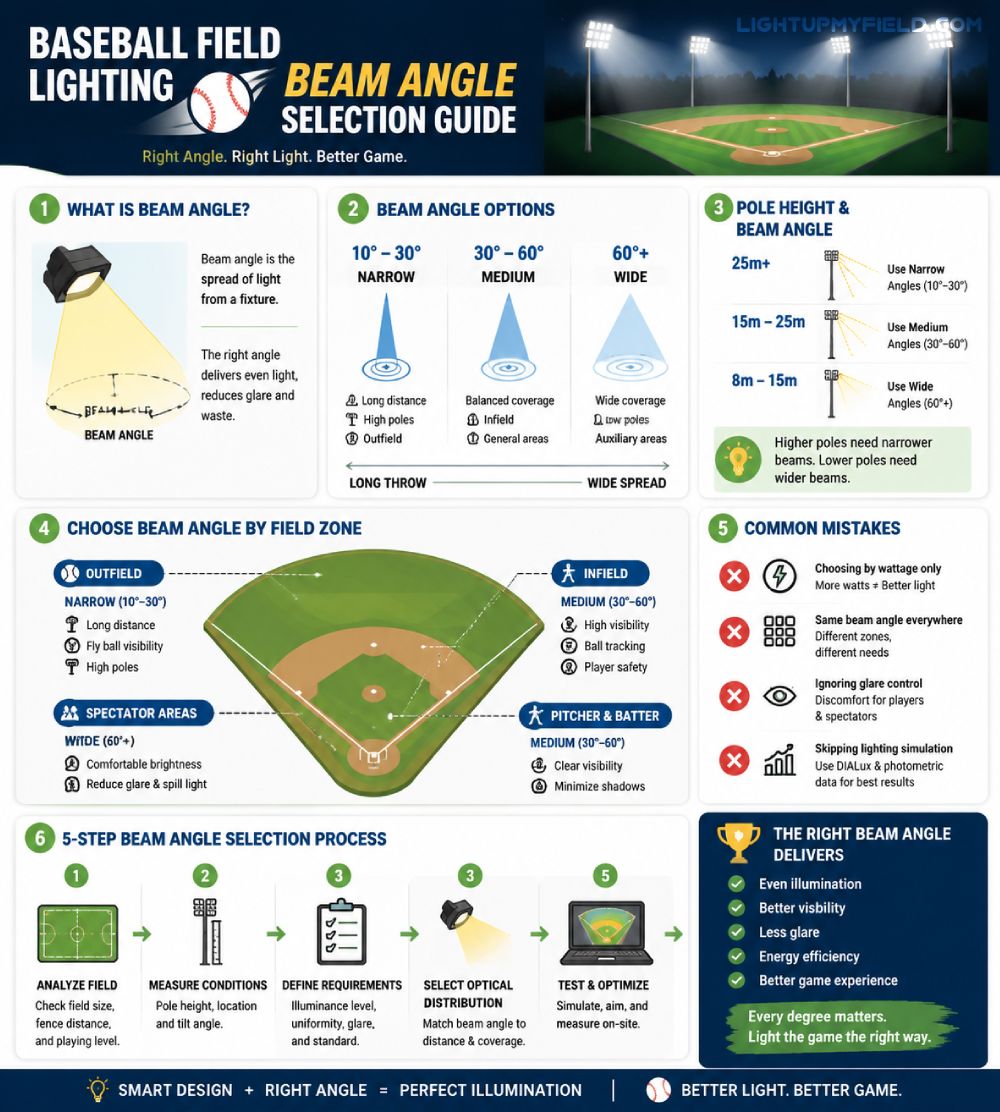
A baseball field is not a single lighting zone. Each area has its own viewing requirements, playing movements, and distance challenges. The lighting needs around home plate are very different from those in the deep outfield, which is why using the same beam angle across the entire field often leads to uneven performance.
A properly designed baseball field lighting system usually combines different beam angles to create balanced illumination. The goal is to make sure players can clearly see the ball, fielders can react quickly, and spectators can enjoy the game without uncomfortable glare. Choosing the right beam angle for each area helps improve lighting uniformity, visual comfort, and overall field performance.
| Baseball Field Area | Recommended Beam Angle | Main Purpose |
|---|---|---|
| Home Plate & Pitcher’s Mound | 30°–60° (Medium) | Balanced lighting and glare control |
| Infield | 30°–60° (Medium) | Smooth coverage and player visibility |
| Outfield | 10°–30° (Narrow) | Long-distance light projection |
| Spectator Areas | 60°+ (Wide) | Comfortable area illumination |
| Bullpens & Warm-up Zones | 60°+ (Wide) | Broad coverage for smaller spaces |
Home Plate and Pitcher’s Mound Lighting Requirements
The area around home plate and the pitcher’s mound is one of the most demanding zones in baseball field lighting design. The interaction between pitcher and batter happens within seconds, meaning players need excellent visibility and a stable lighting environment.
Medium beam angles, usually around 30° to 60°, are commonly used for these areas because they provide a good balance between light intensity and coverage. They can illuminate the playing zone evenly without creating a concentrated hotspot that may distract players.
For batters, glare control is especially important. A batter needs to focus on the incoming pitch while also dealing with bright stadium lighting around the field. If fixtures are positioned incorrectly or use overly narrow beams, concentrated light sources may appear in the player’s line of sight.
A well-designed home plate lighting layout often combines medium beam fixtures with precise aiming angles. This creates enough brightness on the batter’s box, catcher’s area, and pitcher’s mound while keeping direct glare away from the players.
In competitive baseball environments, designers may also consider higher lighting levels around home plate compared with other areas because reaction speed is extremely important. Many professional and tournament-level fields use specialized optical designs to maintain consistent visibility during fast gameplay.
Infield Area Lighting for Quick Player Reactions
The infield requires smooth and consistent illumination because players are constantly moving and reacting. Shortstop, second baseman, third baseman, and first baseman all need to judge ball speed, direction, and distance within a very short time.
Medium beam fixtures are often a suitable choice for the infield because they provide broad enough coverage while maintaining sufficient intensity. When combined with proper fixture placement, they can reduce shadows and create a more natural playing environment.
Lighting uniformity is especially important in the infield. If one section of the dirt area is significantly brighter than another, players may struggle when tracking fast ground balls or making quick throws.
For example, an infield area with uneven lighting may create situations where a player moves from a bright zone into a darker zone while following the ball. The eyes need time to adjust, which can affect reaction speed.
A combination of medium beam LED fixtures and careful aiming usually provides effective coverage. Designers often overlap multiple light distributions so that the beams blend together smoothly instead of creating separate bright and dark sections.
Outfield Area Lighting for Long-Distance Coverage
The outfield creates a completely different lighting challenge because of the large distance involved. Players must track fly balls traveling high into the air and moving across a wide area.
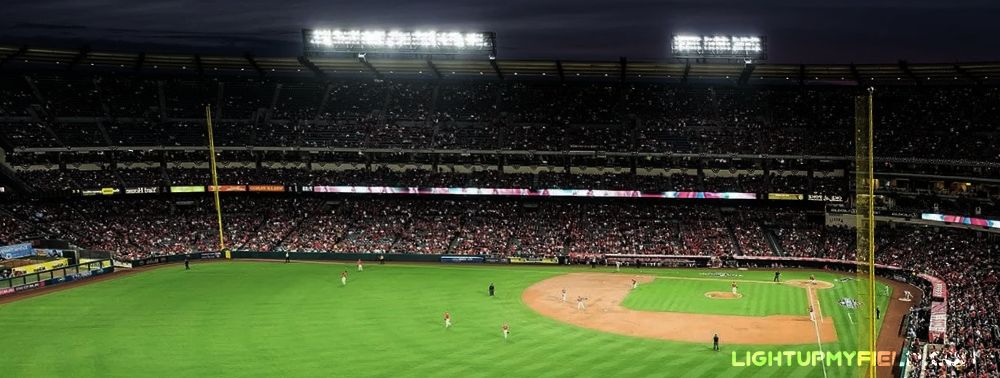
For this reason, narrow beam fixtures are often preferred for outfield lighting. With beam angles commonly between 10° and 30°, these fixtures can project light farther while maintaining stronger illumination levels at long distances.
A deep outfield area may be more than 100 meters away from home plate, depending on the field design. Using a wide beam fixture from a distant pole may cause the light to spread too quickly before reaching the grass, reducing the usable brightness where players actually need it.
Narrow beam LED sports lights help solve this issue by concentrating the light output toward specific target areas. They are especially useful when mounted on tall poles because they can provide better horizontal illumination and improve visibility throughout the outfield.
However, outfield lighting requires accurate aiming. Since narrow beams are highly focused, improper adjustment can create uneven coverage. Professional installation and photometric testing are often used to ensure the entire outfield receives balanced illumination.
Spectator Areas and Surrounding Spaces
Spectator seating areas have different lighting goals compared with the playing field. The priority here is comfort, safety, and general visibility rather than long-distance projection.
Wide beam fixtures are often suitable for these areas because they provide softer and broader light distribution. A wider beam can cover more seating space with fewer fixtures while creating a comfortable atmosphere for spectators.
Unlike players on the field, spectators are not tracking a fast-moving ball at high speed, so the lighting requirements are usually less intense. However, the lighting should still be carefully controlled to avoid unnecessary glare.
Excessive brightness around seating areas can reduce the viewing experience, especially during night games. A good lighting design provides enough visibility for walking, seating, and movement while keeping the focus on the playing field.
Factors to Consider When Selecting Baseball Field Lighting Beam Angles
Field Size and Layout Influence Beam Selection
The size and layout of a baseball field directly affect the type of beam angle required. A small youth baseball field and a professional stadium may have completely different lighting requirements.
A youth field may have shorter distances between lighting poles and playing areas, allowing wider beam angles to provide effective coverage. On the other hand, a regulation baseball field with a large outfield requires more controlled light distribution to maintain proper illumination levels.
For example, a full-size baseball field can have an outfield distance exceeding 100 meters from home plate to the deepest fence area. Lighting designers need to consider how far each fixture must project light and how overlapping beams create uniform coverage across the entire field.
A proper lighting design avoids situations where one area receives excessive brightness while another area appears noticeably darker.
Pole Height and Fixture Position Affect Light Distribution
Lighting pole height is another major factor in beam angle selection.
A taller pole allows a fixture to cover a larger section of the field, but the light must travel farther before reaching the ground. In these situations, narrower beam angles often provide better control.
Lower poles usually require wider beam distributions because the fixture is closer to the playing area and needs to cover more space horizontally.
A common mistake in baseball field lighting projects is choosing LED fixtures first and trying to adjust the pole layout afterward. The pole height, mounting position, fixture wattage, and beam angle should be planned together as one complete lighting system.
Lighting Requirements Change Based on Field Usage
Not every baseball field needs the same lighting performance.
A community field used for evening practice may only require moderate illumination, while a tournament venue may need higher lighting levels, better uniformity, and stronger glare control.
For competitive baseball games, players need consistent visibility when tracking fast-moving balls. Even small differences in brightness can affect how easily players adapt when looking between different areas of the field.
Professional lighting designers often use photometric analysis to check factors such as average lux levels, minimum illumination, uniformity ratios, and glare ratings before installation.
What Happens When Using the Wrong Beam Angle in Baseball Field Lighting?
Selecting the wrong beam angle can create several problems that affect player performance, operating costs, and the overall experience of the venue.
Uneven Lighting and Dark Spots Across the Field
One of the most common problems caused by incorrect beam selection is uneven illumination.
When the beam angle is too narrow for the installation height or field size, the light may concentrate in certain areas while leaving other zones under-lit. Players may notice these differences when moving around the field or trying to follow fly balls between brighter and darker areas.
On the other hand, if the beam angle is too wide, the light intensity may become too weak before reaching the target area. The field may look bright from the spectator seats, but the actual playing surface may not receive enough useful illumination.
A properly designed baseball lighting system aims for strong lighting uniformity, often targeting ratios such as less than 3:1 between maximum and minimum illumination levels depending on the application and lighting standard.
Excessive Glare That Affects Players
Glare is another major issue caused by poor beam angle selection.
Baseball players frequently look upward when tracking pop flies or long hits. If fixtures are not properly controlled, direct light from the LEDs can enter the players’ field of vision and create discomfort.
This problem is especially noticeable around home plate, where batters need clear vision while facing high-speed pitches. Excessive glare can make the lighting environment feel harsh and uncomfortable.
The goal of good sports lighting design is not simply to maximize brightness. It is to deliver controlled illumination where players need it while minimizing unwanted light entering their eyes.
Higher Energy Consumption and Operating Costs
Using an unsuitable beam angle can also increase long-term expenses.
When light distribution is inefficient, facility owners may need to install additional fixtures or use higher-powered equipment to compensate for poor coverage. This increases electricity consumption and maintenance requirements.
A properly designed LED baseball field lighting system can often achieve better results with fewer fixtures because the light is directed more efficiently toward the playing area.
For example, a well-planned system using the correct beam angles may reduce unnecessary lighting overlap and improve overall energy efficiency by 20% to 40% compared with poorly designed installations, depending on the original system and operating conditions.
Unwanted Light Spill Beyond the Baseball Field
Baseball fields are often located near schools, residential communities, parks, or public roads. When fixtures use incorrect beam angles, excess light may escape outside the field boundaries.
Light spill can create discomfort for nearby residents and reduce the overall quality of the lighting installation.
Using suitable beam angles, proper fixture aiming, and glare-control technology helps keep the light focused on the game area instead of sending unnecessary illumination into surrounding spaces.
A successful baseball field lighting design combines the right beam angle, fixture placement, mounting height, and lighting calculation. By understanding how different beam spreads affect performance, facility owners can create a field that provides better visibility, improved player comfort, and more efficient energy use. When planning a new baseball field lighting project or upgrading an existing system, working with a professional lighting team can help you select the right LED fixtures and beam angles based on your field size, pole layout, and usage requirements.
Why Photometric Simulation Helps With Beam Angle Selection
Choosing a beam angle based only on fixture wattage or previous experience can sometimes lead to unexpected results. Every baseball field has different dimensions, pole locations, mounting heights, and surrounding conditions.
This is where photometric simulation becomes valuable.
Professional lighting designers use photometric software to create a digital model of the baseball field before installation. The simulation can predict how different LED fixtures and beam angles will perform in real conditions.
The analysis usually considers factors such as light levels, uniformity, beam coverage, and potential glare areas.
For example, a simulation can show whether a narrow beam fixture aimed toward the outfield creates enough illumination near the fence area or whether a medium beam fixture creates excessive overlap near the infield.
This allows designers to adjust fixture quantity, mounting angles, and beam distributions before the equipment is installed. Making these changes during the design stage is much easier and less expensive than modifying the system after installation.
For large baseball stadiums, photometric simulation becomes even more valuable. A small lighting mistake on a large field can affect hundreds of square meters of playing space. A professional lighting calculation helps ensure that the final system delivers the expected performance.
Common Mistakes When Choosing Baseball Field Lighting Beam Angles
Choosing Fixtures Based Only on Wattage
One of the most common mistakes in baseball field lighting projects is focusing only on wattage. Many people assume that a higher-powered LED fixture will automatically create better lighting.
However, wattage only describes electrical power consumption. It does not explain how effectively the light is distributed.
A 1000W LED fixture with an unsuitable beam angle may perform worse than an 800W fixture with the correct optical design. Poor beam selection can create glare, uneven brightness, and wasted light.
The key is matching the fixture’s optical distribution with the field layout, pole height, and target area.
Using the Same Beam Angle for Every Location
Another common mistake is installing the same beam angle across the entire baseball field.
Because baseball fields contain different zones, each area has different lighting requirements. The outfield needs long-distance projection, while home plate needs controlled brightness and glare reduction.
Using identical beam angles everywhere can create an unbalanced lighting system. Some areas may become over-lit, while others may not receive enough illumination.
A better approach is to combine different beam angles based on the function of each zone.
Ignoring Future Field Usage
Some lighting projects only consider current needs and overlook possible future events.
A field used only for local practices may have different requirements compared with a venue that later hosts tournaments, school competitions, or night games.
Planning for future usage can make the lighting system more flexible. Adjustable LED fixtures, multiple lighting zones, and smart control systems can allow the field to adapt to different events.
For example, a facility may use lower lighting levels during training sessions but increase brightness and uniformity for official games.
Overlooking Glare Control and Light Spill
Beam angle selection is not only about putting light onto the field. It is also about controlling where the light does not go.
Poorly selected beam angles can send unnecessary light toward players, spectators, nearby buildings, or roads. This creates glare issues and reduces the overall quality of the lighting environment.
A well-designed baseball field lighting system balances brightness, coverage, and control. By selecting the correct beam angles for each area and using professional lighting analysis, facilities can achieve better visibility, improved player comfort, and more efficient energy use.
Creating a Better Baseball Field Lighting Experience With the Right Beam Angle
Beam angle selection may seem like a small technical detail, but it has a major impact on the overall performance of baseball field lighting. The right combination of narrow, medium, and wide beams can improve visibility, reduce glare, control light spill, and create a more enjoyable playing environment.
Every baseball field has different dimensions, pole arrangements, and usage requirements, so there is no single beam angle that works for every project. A carefully planned lighting design based on real field conditions will always deliver better results. If you are planning a baseball field lighting upgrade or need help choosing the right LED fixtures and beam angles, feel free to contact our team for professional consultation and project recommendations tailored to your field requirements.