
Aircraft hangars consume a surprising amount of electricity. Whether the space is used for routine aircraft maintenance, storage, inspections, or repairs, lighting often operates for long hours to provide a safe and productive working environment. As electricity prices continue to rise and sustainability becomes a bigger priority across the aviation industry, more airport operators, FBOs, maintenance facilities, and private aircraft owners are looking at solar-powered lighting as a practical alternative.
The good news is that solar hangar lighting is no longer limited to small buildings or remote locations. Modern solar technology has advanced significantly over the past decade, making it possible to power everything from outdoor security lights to large indoor LED lighting systems. With higher-efficiency solar panels, longer-lasting lithium batteries, and energy-saving LED fixtures, solar lighting has become a realistic option for many types of aircraft hangars.
If you’re wondering whether solar lights can work in an aircraft hangar, what equipment is involved, how much money they can save, and whether funding is available, here’s what you should know.
Can You Use Solar Lights in an Aircraft Hangar?
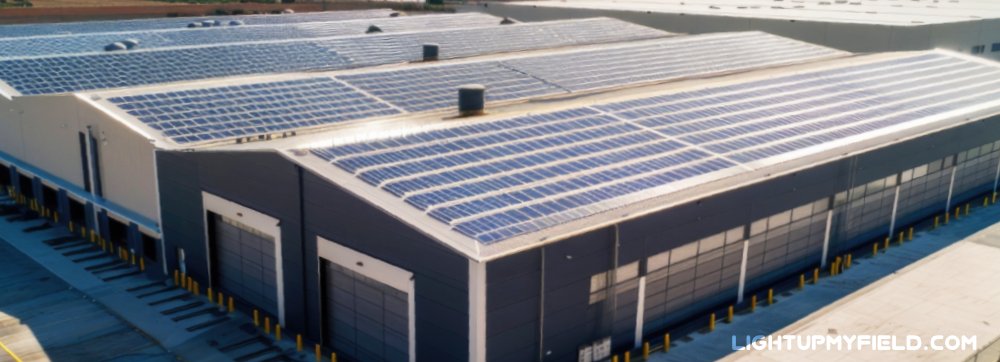
Yes, Solar Lighting Is Suitable for Many Hangars
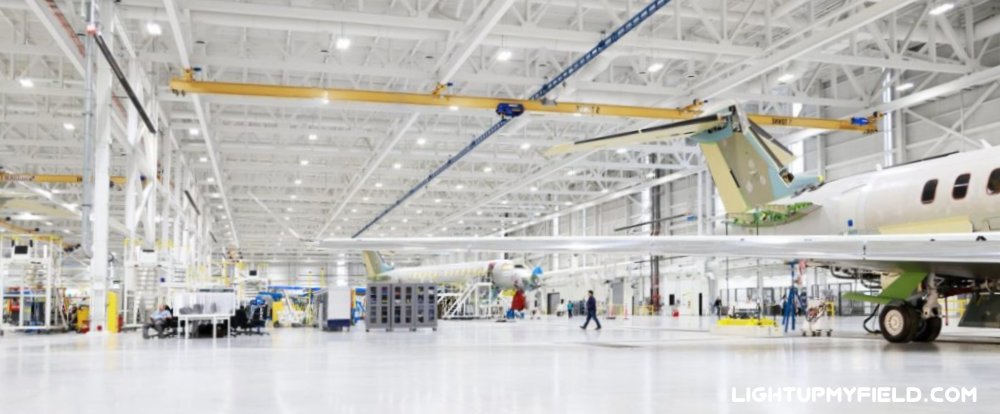
The short answer is yes. Solar lighting can be installed in many types of aircraft hangars, from small private aviation buildings to large commercial maintenance facilities. The right solution depends on factors such as the building size, daily operating hours, lighting requirements, and local weather conditions.
Some hangars use completely off-grid solar lighting systems, while others install rooftop solar panels that generate electricity for a grid-connected lighting system. Hybrid solutions are also becoming increasingly popular because they combine solar power with the electrical grid, providing greater flexibility during periods of poor weather or unusually high electricity demand.
For facilities located in remote airports or areas where running underground electrical cables is expensive, solar lighting can be an especially attractive option.
Common Applications Around Aircraft Hangars
Solar lighting isn’t only used inside the hangar itself. Many aviation facilities also install solar-powered lighting around the surrounding areas to improve visibility and security.
These applications include aircraft maintenance bays, storage hangars, helicopter shelters, loading zones, entrance roads, parking areas, perimeter fencing, walkways, and outdoor apron spaces. Solar-powered floodlights and security lights can also continue operating during power outages when paired with battery storage, helping improve operational reliability.
How Solar Hangar Lighting Works
The operating principle is fairly straightforward. Solar panels installed on the roof or nearby ground-mounted structures capture sunlight and convert it into direct current (DC) electricity.
During daylight hours, the electricity generated can either power LED lighting directly, charge a battery storage system, or feed excess electricity into the local power grid if the system is grid-connected.
When daylight fades, the stored energy inside the batteries powers the lighting system. Intelligent controllers automatically switch between solar power, battery storage, and grid electricity when needed, allowing the lights to operate with minimal user intervention.
Modern systems can also include smart monitoring software, allowing facility managers to track energy production, battery status, and electricity consumption from a computer or smartphone.
Components of a Solar Hangar Lighting System
Solar Panels
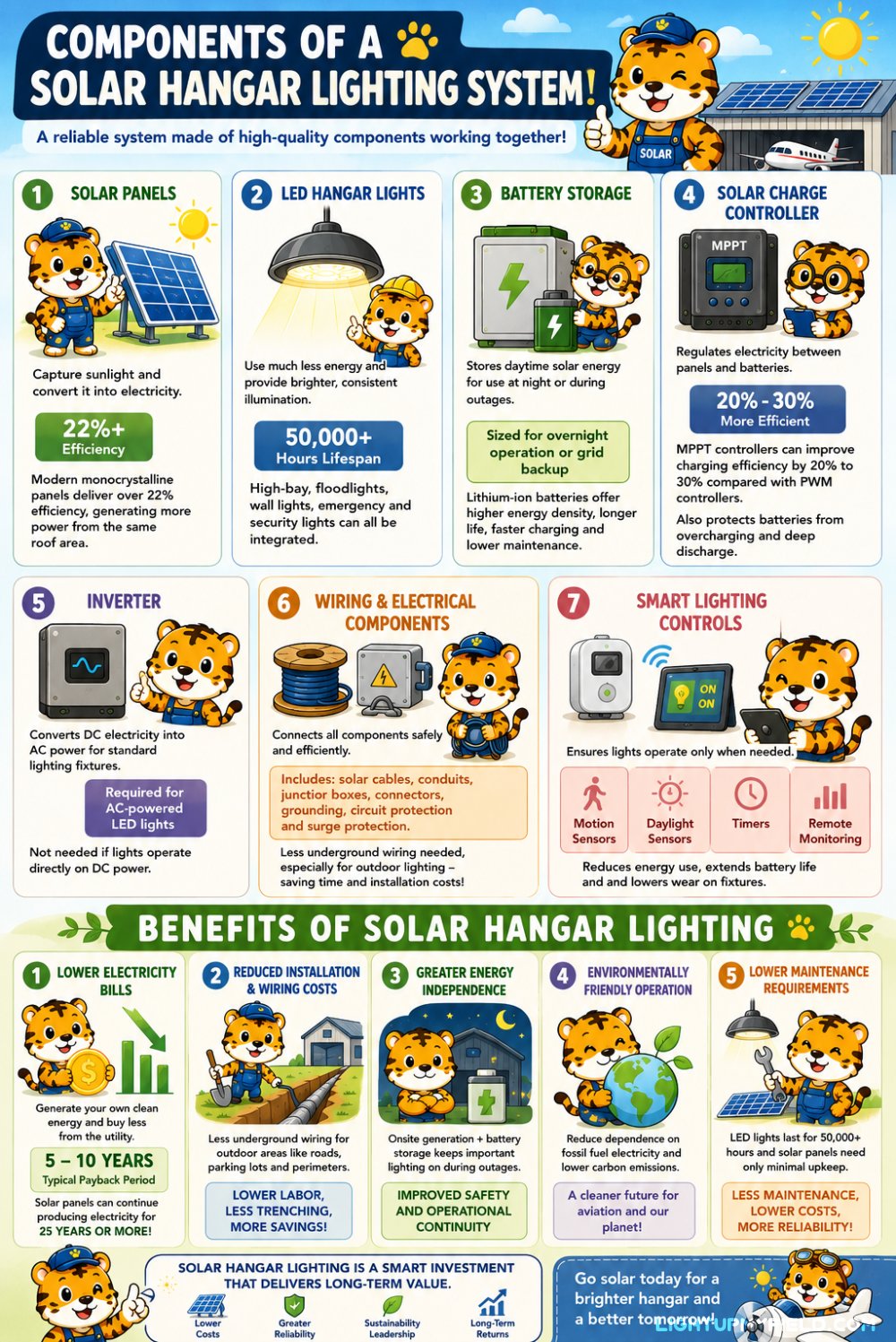
Solar panels are the heart of any solar lighting installation. Their job is to capture sunlight and convert it into electricity.
Most commercial aviation projects use monocrystalline solar panels because they offer higher efficiency than older polycrystalline models. Many modern panels now achieve efficiencies above 22%, allowing more electricity to be generated from the same roof area.
Since aircraft hangars typically have large roof surfaces, they often provide an excellent location for installing sizeable solar arrays.
LED Hangar Lights
LED technology has transformed industrial lighting over the last decade. Compared with traditional metal halide or fluorescent fixtures, LEDs consume significantly less electricity while delivering brighter and more consistent illumination.
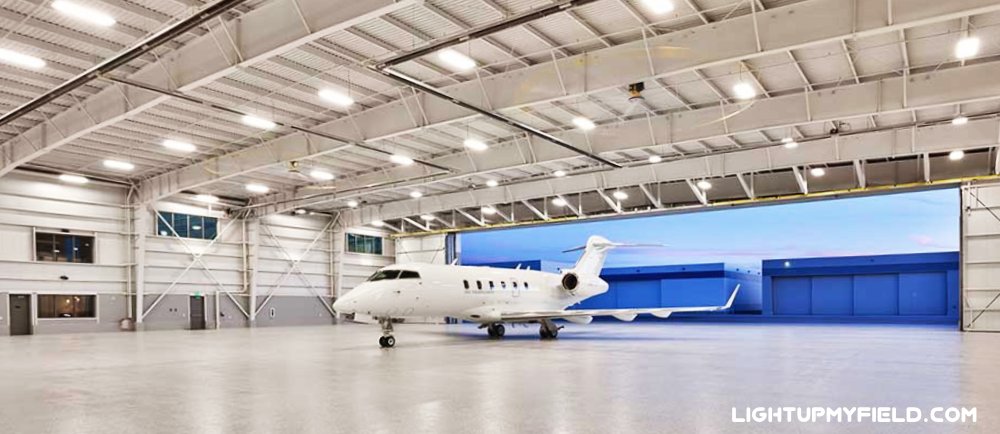
High-bay LED fixtures are commonly used inside aircraft hangars because of their ability to illuminate large open spaces with fewer fixtures. Outdoor floodlights, wall-mounted lights, emergency lighting, and security lights can also be integrated into the same solar system.
Many quality LED fixtures have operating lifespans exceeding 50,000 hours, which can translate into well over 10 years of regular use.
Battery Storage
Battery storage allows solar-generated electricity collected during the day to be used after sunset.
Lithium-ion batteries have become the preferred choice because they offer higher energy density, faster charging, longer service life, and lower maintenance compared with traditional lead-acid batteries.
Battery capacity is selected according to the facility’s daily energy consumption and the desired backup time. Larger aviation facilities often size their battery systems to provide lighting throughout the night or during temporary grid outages.
Solar Charge Controller
The charge controller regulates the flow of electricity between the solar panels and the batteries.
Many commercial systems now use Maximum Power Point Tracking (MPPT) controllers, which can improve charging efficiency by as much as 20% to 30% compared with conventional PWM controllers under certain operating conditions.
Besides improving performance, charge controllers also protect batteries from overcharging and excessive discharge, helping extend battery lifespan.
Inverter
Not every solar lighting system requires an inverter. If the lighting fixtures operate directly on DC power, an inverter may not be necessary.
However, many commercial hangars use standard AC-powered LED fixtures. In these cases, the inverter converts DC electricity from the solar panels or batteries into alternating current that the lighting equipment can use.
Wiring and Electrical Components
Although solar lighting can reduce the amount of electrical infrastructure required, wiring still plays a role in connecting the various components.
The system typically includes solar cables, electrical conduits, junction boxes, connectors, grounding equipment, circuit protection devices, and surge protection.
One of the advantages of solar lighting, particularly for outdoor applications, is that less underground wiring may be required, reducing both installation time and construction costs.
Smart Lighting Controls
Today’s lighting systems are much smarter than they used to be.
Motion sensors, daylight sensors, programmable timers, and remote monitoring platforms help ensure lights operate only when necessary. This not only reduces energy consumption but also extends battery life and minimizes unnecessary wear on lighting fixtures.
For facilities operating around the clock, these automation features can contribute to noticeable long-term savings.
Benefits of Solar Hangar Lighting
Lower Electricity Bills
One of the biggest reasons organizations invest in solar lighting is to reduce ongoing energy costs.
Lighting represents a considerable portion of electricity consumption in many aircraft maintenance facilities. By generating renewable electricity onsite, operators purchase less electricity from the utility company, leading to lower monthly operating expenses.
Depending on local electricity prices, system size, and energy usage, many commercial solar installations recover their initial investment within five to ten years, while the panels themselves can continue producing electricity for 25 years or more.
Reduced Installation and Wiring Costs
Running electrical cables across large airport properties isn’t always simple.
Long cable runs, trenching work, conduit installation, and electrical labor can quickly increase project costs. Solar-powered lighting, particularly for outdoor areas such as access roads, parking lots, and perimeter security, often requires much less underground wiring.
For remote hangars or newly developed airport facilities, this can translate into meaningful savings during installation.
Greater Energy Independence
Solar lighting provides an additional layer of resilience by generating electricity onsite.
Facilities equipped with battery storage can continue operating certain lighting systems during utility outages, reducing disruptions to maintenance work and improving safety after dark.
While solar systems are not necessarily intended to replace every backup power solution, they can provide valuable support when combined with other energy systems.
Environmentally Friendly Operation
The aviation industry continues working toward lower carbon emissions across many aspects of its operations.
Installing solar-powered lighting allows airport operators and aviation businesses to reduce their reliance on electricity generated from fossil fuels. Over the lifetime of a commercial solar system, the reduction in greenhouse gas emissions can be substantial.
Besides environmental benefits, many organizations also appreciate demonstrating their commitment to sustainability to customers, partners, and regulatory authorities.
Lower Maintenance Requirements
Modern LED lighting requires far less maintenance than older lighting technologies.
There are no bulbs that need frequent replacement, and quality solar panels generally require only occasional cleaning and routine inspections.
Combined with long-life lithium batteries and durable industrial fixtures, maintenance costs are often lower than conventional lighting systems over the long term.
Costs of Installing Solar Hangar Lighting
What Determines the Overall Cost?
There isn’t a one-size-fits-all price for a solar hangar lighting system because every aviation facility has different lighting requirements and operating hours. A small private hangar used to store one or two aircraft will naturally require a much smaller system than a busy maintenance hangar operating well into the evening.
Several factors influence the overall investment, including the size of the building, the number and wattage of LED fixtures, the capacity of the solar panel array, battery storage requirements, inverter size, mounting structures, electrical wiring, labor, engineering, and any structural upgrades that may be needed for the roof.
For example, a hangar that only needs lighting during occasional evening inspections may require a relatively modest solar array. On the other hand, a maintenance facility operating 10 to 16 hours a day will usually need a much larger system with higher-capacity battery storage to ensure reliable lighting after sunset.
Typical Installation Costs
The total investment can vary significantly depending on the project’s scale.
A small private aircraft hangar with a basic solar lighting setup may cost anywhere from US$8,000 to US$30,000, depending on the number of fixtures and battery capacity required. Mid-sized corporate or general aviation hangars often invest between US$40,000 and US$150,000, while large commercial or MRO (Maintenance, Repair and Overhaul) facilities may spend US$250,000 or more on comprehensive rooftop solar systems with advanced energy management and battery storage.
Although these figures may seem substantial at first glance, it’s worth remembering that solar lighting is a long-term investment rather than a short-term expense. High-quality solar panels are commonly designed to operate for 25 to 30 years, while commercial LED fixtures often have lifespans exceeding 50,000 to 100,000 hours, reducing replacement and maintenance costs over many years.
Long-Term Savings Can Be Significant
One of the biggest reasons aviation businesses choose solar lighting is the opportunity to lower operating expenses year after year.
Electricity prices have steadily increased in many regions over the past decade, and lighting often represents a sizeable portion of a hangar’s energy consumption. By generating electricity onsite, businesses can reduce their dependence on utility providers and enjoy more predictable operating costs.
Depending on local electricity tariffs, sunlight availability, and system size, many commercial solar projects achieve a return on investment within five to ten years. After that, much of the electricity generated by the solar panels is essentially free, apart from routine maintenance.
Over the lifetime of the system, it’s not unusual for facility owners to save tens or even hundreds of thousands of dollars in electricity costs. For larger aviation facilities with extensive lighting requirements, the cumulative savings can be even greater.
Lower Maintenance Adds More Value
Another factor that’s sometimes overlooked is maintenance.
Traditional lighting systems often require regular bulb replacements, especially when older metal halide fixtures are still in use. Replacing lights mounted high above aircraft can involve lifts, specialized equipment, and labor, all of which add to ongoing maintenance expenses.
Modern LED fixtures, however, require much less attention. Combined with durable solar panels and lithium battery systems, maintenance requirements are generally lower than those of conventional lighting systems. That means fewer disruptions to daily operations and lower maintenance budgets over the long run.
| Category | Typical Value |
|---|---|
| Maintenance Hangar Operation | 10 to 16 hours/day |
| Small Private Hangar System | US$8,000 to US$30,000 |
| Mid-Sized Hangar System | US$40,000 to US$150,000 |
| Large Commercial/MRO System | US$250,000+ |
| Solar Panel Lifespan | 25 to 30 years |
| LED Fixture Lifespan | 50,000 to 100,000 hours |
| Typical Payback Period | 5 to 10 years |
| Potential Lifetime Savings | Tens to hundreds of thousands of US dollars |
Funding and Financial Incentives
Government Incentive Programs
One of the biggest reasons solar projects have become more affordable over the past decade is the increasing support from governments around the world. To encourage businesses to adopt renewable energy, many national, state, and local authorities now offer financial assistance in the form of grants, rebates, low-interest loans, and clean energy incentive programs.
Depending on where your aircraft hangar is located, these programs may help cover 10% to 50% or more of eligible project costs, including solar panels, battery storage, installation, engineering, or other related expenses. The exact amount varies by country and program, but even partial funding can significantly reduce the upfront investment.
For airport operators and aviation businesses planning infrastructure upgrades, renewable energy projects are sometimes eligible under airport modernization or sustainability initiatives. Combining these funding opportunities with a solar lighting project can make the overall investment much easier to justify from a financial perspective.
Since incentive programs are updated regularly and available budgets may be limited each year, it’s a good idea to check what’s currently available before moving ahead with a project.
Tax Incentives Can Improve the Payback Period
Besides direct funding, many governments also encourage renewable energy investments through tax incentives.
Depending on local regulations, businesses may qualify for investment tax credits, accelerated depreciation, capital allowances, or other tax benefits that reduce the overall cost of the project. In some regions, these incentives can recover 20% to 30% of eligible project costs through reduced tax liabilities, although the exact percentage depends on the applicable regulations.
When combined with ongoing electricity savings, these tax benefits can shorten the system’s payback period by one to several years. For companies operating multiple hangars or facilities, the long-term financial benefits can become even more noticeable over the lifetime of the solar system.
Because tax rules differ between countries and frequently change, it’s always worth speaking with an accountant or renewable energy consultant to identify the incentives available for your specific project.
Flexible Financing Options
Paying for a large solar installation upfront isn’t always the preferred option, especially for businesses managing multiple capital projects at the same time.
Fortunately, several financing solutions are available to spread the investment over a longer period. Solar loans, equipment leasing, Energy-as-a-Service (EaaS), and Power Purchase Agreements (PPAs) allow businesses to install solar lighting without making a substantial one-time payment.
In many cases, the monthly financing cost is partly offset by lower electricity bills, helping businesses improve cash flow while benefiting from renewable energy almost immediately. Some financing agreements also include system monitoring and maintenance, reducing ongoing management responsibilities for the facility owner.
For airport operators with several hangars, these financing models can also make it easier to upgrade buildings in phases instead of completing every installation at once.
Looking Beyond the Upfront Cost
When evaluating a solar hangar lighting project, it’s worth looking beyond the initial purchase price.
A better approach is to consider the total cost of ownership over the system’s entire lifespan. While the upfront investment is typically higher than conventional lighting, solar systems can continue generating electricity for 25 to 30 years, while commercial LED fixtures commonly last 50,000 to 100,000 hours with relatively little maintenance.
When you combine lower electricity bills, reduced maintenance costs, available grants, tax incentives, and flexible financing, the long-term financial benefits become much more attractive. For many aviation businesses, solar hangar lighting isn’t just about reducing monthly expenses. It’s also a way to improve energy resilience, stabilize future operating costs, and invest in infrastructure that continues delivering value for decades.
Frequently Asked Questions
Can solar hangar lighting work during several cloudy days?
Yes. A properly designed system doesn’t rely solely on the sunshine it receives each day. Battery storage is sized according to the facility’s daily energy consumption and local weather conditions, allowing the lights to continue operating during cloudy periods or rainy days. In regions with less consistent sunlight, designers often increase the battery capacity or install additional solar panels to maintain reliable performance throughout the year.
How much roof space is needed for solar panels?
The required roof area depends on the amount of electricity the lighting system uses. As a general guideline, 1 kilowatt (kW) of solar panels typically requires around 5 to 7 square metres (54 to 75 square feet) of roof space, depending on the panel’s efficiency.
Since many aircraft hangars have large, unobstructed roofs, they often provide plenty of room for solar installations. If roof space is limited or unsuitable, ground-mounted solar arrays or solar canopies can also be considered.
Will solar panels damage the hangar roof?
Not when they’re installed correctly. Professional installers use mounting systems that are specifically designed to distribute weight safely while maintaining the roof’s weatherproofing. Before installation, the roof structure is usually inspected to confirm it can support the additional load.
In many cases, solar panels can even provide some protection by shielding sections of the roof from direct sunlight, helping to reduce heat exposure over time.
Can an existing aircraft hangar be upgraded with solar lighting?
Absolutely. Many solar projects involve retrofitting existing hangars rather than building new ones.
Older facilities can often replace traditional lighting fixtures with energy-efficient LEDs while adding rooftop solar panels and battery storage. Depending on the condition of the existing electrical system, only minor upgrades may be required, making retrofits a practical option for many aviation businesses.
How long does a solar hangar lighting system last?
Most commercial solar panels are designed to continue generating electricity for 25 to 30 years, and many still produce more than 80% of their original output after 25 years.
LED fixtures commonly last between 50,000 and 100,000 hours, while lithium batteries generally have a service life of 10 to 15 years, depending on usage patterns and charging cycles. Routine inspections and occasional maintenance help maximize the lifespan of the entire system.
Does solar lighting require a lot of maintenance?
Not really. Compared with conventional lighting systems, maintenance is relatively straightforward.
Most facilities simply schedule periodic inspections, clean the solar panels when dirt or debris builds up, and check the electrical connections and battery health. In many locations, rainfall naturally removes much of the dust from the panels, reducing the need for frequent cleaning.
Can solar lighting be expanded in the future?
Yes. One of the advantages of modern solar systems is their flexibility.
If your aviation business expands, additional hangars are constructed, or lighting requirements increase, many systems can be upgraded with extra solar panels, batteries, or LED fixtures. Planning for future expansion during the initial design stage can also make upgrades easier and more cost-effective later on.
Is solar hangar lighting suitable for airports in colder climates?
Yes. Solar panels actually perform quite well in cooler temperatures. While snow accumulation can temporarily reduce power generation, sunlight reflecting off snow can sometimes improve solar output once the panels are clear.
For locations with long winters or frequent snowfall, the system can be designed with larger solar arrays and additional battery storage to maintain dependable lighting throughout the year.
How do I know if solar hangar lighting is the right choice for my facility?
The best way to find out is by carrying out a professional site assessment. Factors such as your current electricity usage, operating hours, roof condition, local sunlight levels, and future expansion plans all influence the ideal system design.
A detailed assessment provides a clearer picture of the expected installation cost, estimated energy savings, projected payback period, and long-term return on investment, helping you make a well-informed decision before moving ahead.
Is Solar Hangar Lighting Worth the Investment?
For many aviation facilities, the answer is yes.
Advances in solar panels, lithium battery technology, LED lighting, and intelligent energy management have made solar hangar lighting much more practical than it was even 10 years ago. When properly designed, these systems can deliver lower electricity costs, reduced maintenance, improved energy resilience, and long-term environmental benefits.
Every hangar is different, so the ideal solution depends on local sunlight conditions, operational requirements, available installation space, and budget. Working with experienced professionals helps ensure the system is properly sized and delivers reliable performance for many years.
If you’re considering installing a solar hangar lighting system or upgrading an existing aircraft hangar, our team is happy to help. We can evaluate your facility, recommend a solution tailored to your operational needs, and provide guidance on system design, available funding opportunities, and long-term cost savings. Feel free to contact us for a consultation and discover how solar hangar lighting can become a smart investment for your aviation facility.