
Walk into any shooting range and you’ll notice it right away. If the lighting feels off, shooters feel it too. Eyes strain, targets blur, and concentration slips. On the flip side, when lighting is done well, most people don’t consciously notice it at all. They just shoot better, feel safer, and stay longer. That quiet effectiveness is what good shooting range lighting is all about.
Modern ranges are no longer just concrete lanes with paper targets. They’re professional facilities used by recreational shooters, law enforcement, and military teams. Lighting has to keep up, balancing visibility, durability, compliance, and operating cost, all without getting in the shooter’s way.
 Shooting ranges are nothing like warehouses, gyms, or offices. The visual environment is intense and unforgiving. Shooters move between bright firing lines and darker downrange areas, forcing the eye to constantly adjust. Poor lighting exaggerates that contrast and makes aiming feel uncomfortable.
Smoke and airborne particles add another layer of complexity. Even with good ventilation, burnt powder and dust scatter light and create haze. Fixtures with poor optics can turn that haze into glare, especially when mounted directly above the firing line.
Then there’s vibration. Repeated gunfire sends shockwaves through ceilings and mounting structures. Fixtures not designed for this environment loosen over time or fail early. Add high noise levels, occasional heat buildup, and strict cleaning requirements due to lead residue, and you’re dealing with a lighting environment that punishes shortcuts.
That’s why range lighting tends to be purpose-built rather than borrowed from general industrial designs.
Lighting in shooting ranges isn’t just a style choice or a comfort upgrade. It’s closely tied to range safety, shooter confidence, and operational approval. In the U.S., lighting plans usually sit at the intersection of OSHA workplace guidance, IES (Illuminating Engineering Society) recommendations, and local building or fire codes. For public and training ranges, the NRA Range Source Book is often treated as a practical reference, even when it’s not legally binding.
In real projects, inspectors and insurers tend to look less at brand names and more at whether lighting levels are reasonable, consistent, and appropriate for how the range is actually used. Poor lighting doesn’t just affect shooting performance. It can raise red flags during inspections, especially if visibility is uneven or emergency lighting feels like an afterthought.
| Area / Zone | Recommended Lux | Foot-Candles (fc) |
|---|---|---|
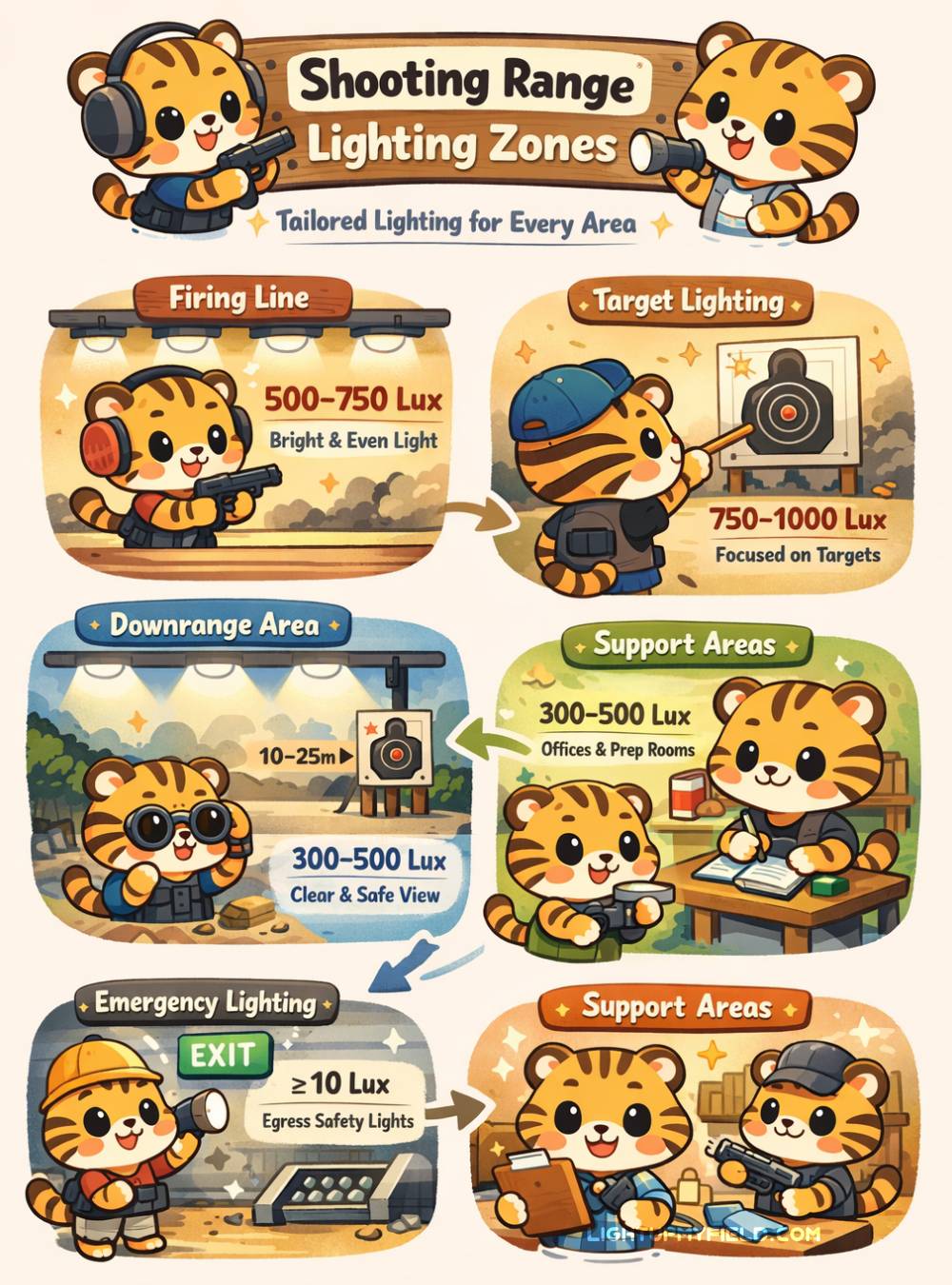
| Firing Line | 500 – 750 | 50 – 70 |
| Target Face (10–25 m) | 750 – 1,000 | 70 – 90 |
| Support Areas / Walkways | 200 – 300 | 20 – 30 |
| Offices / Classrooms | 300 – 500 | 30 – 50 |
| Emergency / Exit Paths | ≥ 10 | ≥ 1 |
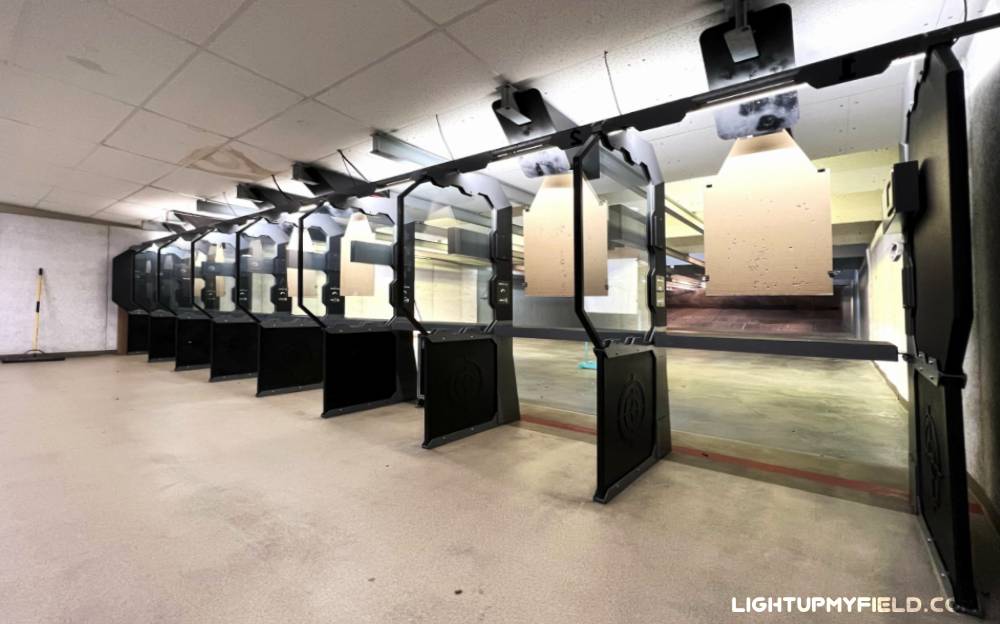
Most modern indoor ranges aim for 500 to 750 lux (50 to 70 foot-candles) at the firing line. That range strikes a balance. It’s bright enough for clear sight alignment, reading firearm controls, and loading safely, but not so intense that it flattens contrast or causes eye strain during longer sessions.
Target illumination is typically higher. For paper or steel targets placed 10 to 25 meters downrange, designers often push levels to 750 to 1,000 lux (70 to 90 fc) directly on the target face. At longer distances, such as 50 meters, higher output or tighter beam control is often needed so targets don’t fade into the background. Shooters notice this immediately. When targets are evenly lit, shot placement reads faster and scoring becomes less frustrating.
Support areas follow a different logic. Walkways, prep zones, and spectator areas usually sit around 200 to 300 lux (20 to 30 fc). That’s plenty for safe movement without creating visual competition with the firing line. Offices and classrooms inside range facilities often follow standard commercial lighting practices, typically 300 to 500 lux, depending on use.
Emergency lighting is non-negotiable. Even during a power outage, exit paths need to remain visible. Most codes expect at least 10 lux (1 fc) along egress routes, supported by battery-backed fixtures or generators. In practice, many ranges go a bit higher to keep visibility clear in smoke or low-visibility conditions.
Hitting a lux number once doesn’t mean much if it only exists directly under a fixture. Uniformity is where many lighting designs fall short. A firing line that averages 600 lux but drops to 250 lux between fixtures feels uncomfortable, even if it technically meets minimum requirements.
Experienced designers usually aim for a uniformity ratio of 3:1 or better, meaning the brightest point isn’t more than three times brighter than the darkest point in the shooting zone. When lighting stays even across the lane, shooters don’t feel their eyes constantly adjusting as they shift stance or check their target.
 Lux and foot-candles are easy to measure, which is why they get so much attention. But on their own, they don’t tell the whole story. Two ranges can both measure 600 lux at the firing line and still feel completely different to shoot in. The difference usually comes down to optical control, fixture placement, and visual comfort.
Visual stability matters more than people expect. Large swings in brightness across the field of view create subtle distraction. Shooters may not consciously notice why they feel off, but fatigue sets in faster. Keeping light levels consistent from lane to lane also matters, especially in commercial ranges where customers compare experiences without saying a word.
Glare is one of the most common complaints in poorly lit ranges. Exposed LED diodes, mirror-like reflectors, or badly angled fixtures can throw light straight into a shooter’s line of sight. This becomes more obvious when aiming down iron sights or optics, where even small reflections feel amplified.
Well-designed range fixtures use shielded optics, controlled beam angles, and diffusers to reduce high-angle glare. The goal isn’t to dim the space, but to put light where it’s useful and keep it out of the shooter’s eyes. When glare is under control, shooters tend to relax more and maintain focus longer.
Most shooting ranges land in the 4000K to 5000K color temperature range. This neutral white light feels clean and alert without drifting into the cold, bluish tone that some people find harsh. Warmer lighting, like 3000K, can make targets look dull, especially under smoke or haze.
Color rendering also plays a role. A CRI of 80 or higher helps targets, scoring rings, and range markings appear accurate. Firearms and accessories also look more natural, which matters in training environments where visual clarity supports safe handling.
Flicker is one of those issues people rarely name, but they feel it. Low-quality LED drivers can introduce subtle flicker at frequencies that don’t show up on a phone camera but still affect the human eye. Over time, this can contribute to headaches or general fatigue, especially during sessions that run one or two hours.
High-quality drivers operate at higher frequencies and provide stable, flicker-free output, even when dimmed or operating for long periods. In a shooting range, where concentration matters, that stability makes a noticeable difference.
Lighting performance also has to hold up over time. Recoil vibration, airborne particles, and regular cleaning all take a toll. Fixtures rated for higher impact resistance and dust protection tend to maintain their output longer, which helps preserve those carefully planned lux levels year after year.
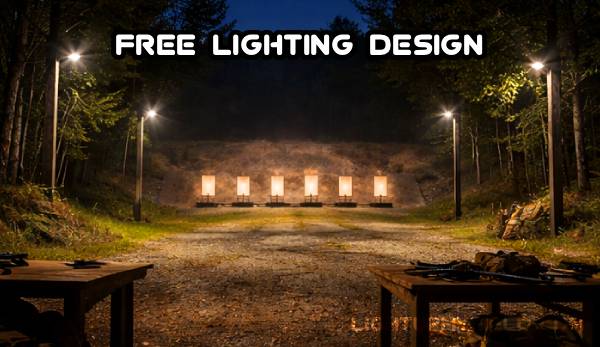 A shooting range might look like one long room, but lighting-wise it behaves more like a series of connected environments. Each zone asks the eye to do something different, and lighting has to support that shift smoothly. When zones aren’t treated separately, shooters feel it right away. Eyes tire faster, focus drifts, and small visual annoyances start adding up.
Designing lighting by zone helps control contrast, reduce glare, and keep brightness where it actually helps.
The firing line is where lighting gets judged the hardest. Shooters spend most of their time here, and even minor flaws become obvious after a few magazines. The goal is stable, evenly spread light that keeps hands, sights, and optics clearly visible without creating harsh reflections.
In most indoor ranges, firing line illumination lands between 500 and 750 lux (50 to 70 fc) measured at chest height. What matters just as much is consistency. When light drops sharply between fixtures, shooters feel their eyes constantly adjusting. That’s why fixtures are usually mounted slightly forward of the firing line and angled downrange. This reduces shadows on the firearm and keeps light out of the shooter’s direct line of sight.
A well-lit firing line feels calm. Nothing flickers, nothing glares, and nothing pulls attention away from the target.
Target lighting works differently. Instead of filling the whole space with brightness, it focuses light where it’s needed. The target face should stand out clearly, even at longer distances.
At 10 to 25 meters, target illumination often sits around 750 to 1,000 lux (70 to 90 fc). For 50-meter ranges, tighter beam control or higher output is common so targets don’t wash out against the backstop. Focused lighting also helps reduce stray reflections from steel traps or rubber berms.
When target lighting is dialed in properly, shooters can read shot placement faster, and range officers can monitor targets without strain.
Downrange areas don’t need to be bright, but they can’t disappear either. These zones are monitored constantly for safety and maintenance, so visibility still matters. Typical designs land in the 300 to 500 lux (30 to 50 fc) range.
At these levels, range officers can clearly see equipment, target carriers, and any unusual activity without pulling attention away from the firing line. Softer lighting here also helps manage contrast, making the transition between firing line and target more comfortable on the eyes.
Support spaces follow more familiar rules but still need range-friendly fixtures. Classrooms and training rooms usually sit around 300 to 500 lux, similar to offices. Retail and lobby areas often use warmer or more decorative lighting, depending on the brand image of the range.
Gun prep rooms and cleaning areas often need brighter task lighting, sometimes 500 lux or more, especially for detailed work. Across all these spaces, durability and easy cleaning matter more than style. Dust, residue, and frequent wipe-downs are part of daily life in a range.
Most modern shooting ranges rely on LED lighting, and it’s not just about efficiency. LEDs handle vibration far better than fluorescent or HID systems, which matters in an environment with constant shockwaves from gunfire. They also turn on instantly, with no warm-up or color shift.
From an operational standpoint, LEDs reduce maintenance headaches. With rated lifespans of 50,000 to 100,000 hours, they can run for years before output drops noticeably.
| Fixture Type / Feature | Value / Range |
|---|---|
| LED Lifespan | 50,000 – 100,000 hours |
| Indoor Linear Fixture Ceilings | 9 – 14 ft |
| High-Bay Fixture Ceilings | > 20 ft |
| Metal Halide Power | 400 – 1,000 W |
| LED Fixture Power | 120 – 240 W |
| Impact Rating (IK) | IK08 – IK10 |
| Dust Protection (IP) | IP65+ |
Linear LED fixtures are common over firing lines, especially in indoor ranges with ceiling heights between 9 and 14 feet. They spread light evenly across lanes and help maintain good uniformity without creating hot spots.
High-bay LEDs are more common in large facilities or outdoor covered ranges where ceilings climb above 20 feet. These fixtures use tighter optics to push light downrange efficiently while keeping glare under control.
Choosing between the two isn’t about preference. It’s about ceiling height, lane width, and how tightly light needs to be controlled.
Not all industrial lights survive in a shooting range. Fixtures rated IK08 or IK10 are better equipped to handle vibration and occasional impact. IP65 or higher dust protection helps keep residue from settling inside the housing, which preserves light output and extends driver life.
Sealed fixtures with smooth housings are also easier to clean. Over time, that alone can make a noticeable difference in how bright the range feels compared to older, dust-filled lights.
Older metal halide systems often consumed 400 to 1,000 watts per fixture, with a good chunk of that energy turning into heat. Modern LED range fixtures typically deliver equal or better illumination at 120 to 240 watts.
In a range with 30 to 40 fixtures, that difference adds up fast. Lower wattage means reduced electrical load, less heat buildup, and more flexibility when upgrading existing wiring.
Just as important, LEDs maintain their brightness more consistently over time. Instead of sudden lamp failures, output slowly tapers, giving operators time to plan maintenance rather than react to outages.
Lighting placement can quietly shape the entire shooting experience. On paper, mounting fixtures directly overhead feels neat and efficient. In reality, that approach often backfires. Straight-down light tends to cast shadows on hands, firearm controls, and optics, especially when shooters lean forward or change stance. Those shadows move as the shooter moves, which gets distracting fast.
That’s why many experienced designers place fixtures slightly forward of the firing line, typically 0.6 to 1.2 meters ahead, and angle them downrange. This approach pushes light onto the firearm and target path while keeping glare out of the shooter’s eyes. The difference feels subtle at first, but over a full session, shooters usually report less eye fatigue and better visual comfort.
Ceiling height plays a big role in deciding fixture type and layout. In indoor ranges with 9 to 12 feet ceilings, wide-beam linear LED fixtures tend to work best. They spread light evenly across each lane and help keep uniformity ratios within the desired 3:1 range.
Once ceilings climb higher, beam control becomes more valuable. In spaces with 16 to 25 feet ceilings, tighter optics allow designers to push light downrange without creating hot spots near the firing line. This also helps manage glare, since light isn’t spilling into angles where shooters are most sensitive.
Spacing between fixtures matters too. Placing lights too far apart creates bright and dark bands along the lane, while packing them too tightly drives up cost without improving performance. A balanced layout usually comes from lighting simulations rather than guesswork, especially in longer ranges.
Maintenance access doesn’t always get enough attention during design, but it quickly becomes a daily reality for operators. Fixtures mounted above active lanes are not easy to reach, and every repair usually means closing lanes and interrupting business.
That’s why long-life fixtures make sense here. Many modern LED range lights are rated for 50,000 to 100,000 hours, which translates to 10 to 20 years at typical operating schedules of 5,000 hours per year. Fewer failures mean fewer disruptions and lower labor costs over time.
Some ranges also design layouts so fixtures can be serviced from behind the firing line or from catwalks, reducing the need to bring lifts into shooting areas.
Shooting ranges are tough environments for lighting. Lead dust, powder residue, and frequent cleaning are part of everyday operations. Fixtures with smooth housings and sealed optics are easier to wipe down and less likely to lose output over time.
Rough surfaces and exposed seams tend to collect dust, which slowly dims light levels and makes the range feel darker than it actually is. Over a few years, that buildup can knock effective illumination down by 10 to 20 percent if fixtures aren’t designed for easy cleaning.
Thermal management is another quiet factor that affects long-term performance. Poorly designed fixtures trap heat inside the housing, which stresses LED drivers and shortens lifespan. In some cases, output drops well before the rated hours are reached.
Quality LED fixtures use passive cooling and oversized heat sinks to keep temperatures stable. Even in indoor ranges that run warm due to poor ventilation or high occupancy, well-managed fixtures maintain consistent output and color.
Lower wattage also helps here. A 160-watt LED fixture produces far less heat than a 400-watt metal halide, which reduces strain on both the lighting system and the surrounding environment.
Ventilation is doing heavy lifting in a shooting range, pulling smoke and airborne particles downrange and away from shooters. Lighting should support that process, not interfere with it.
Large fixtures placed directly in airflow paths can create turbulence or dead zones where smoke lingers. In well-planned projects, lighting designers coordinate layouts with HVAC engineers to keep airflow smooth. Sometimes that means adjusting fixture spacing or choosing slimmer profiles that sit cleanly within the ceiling plane.
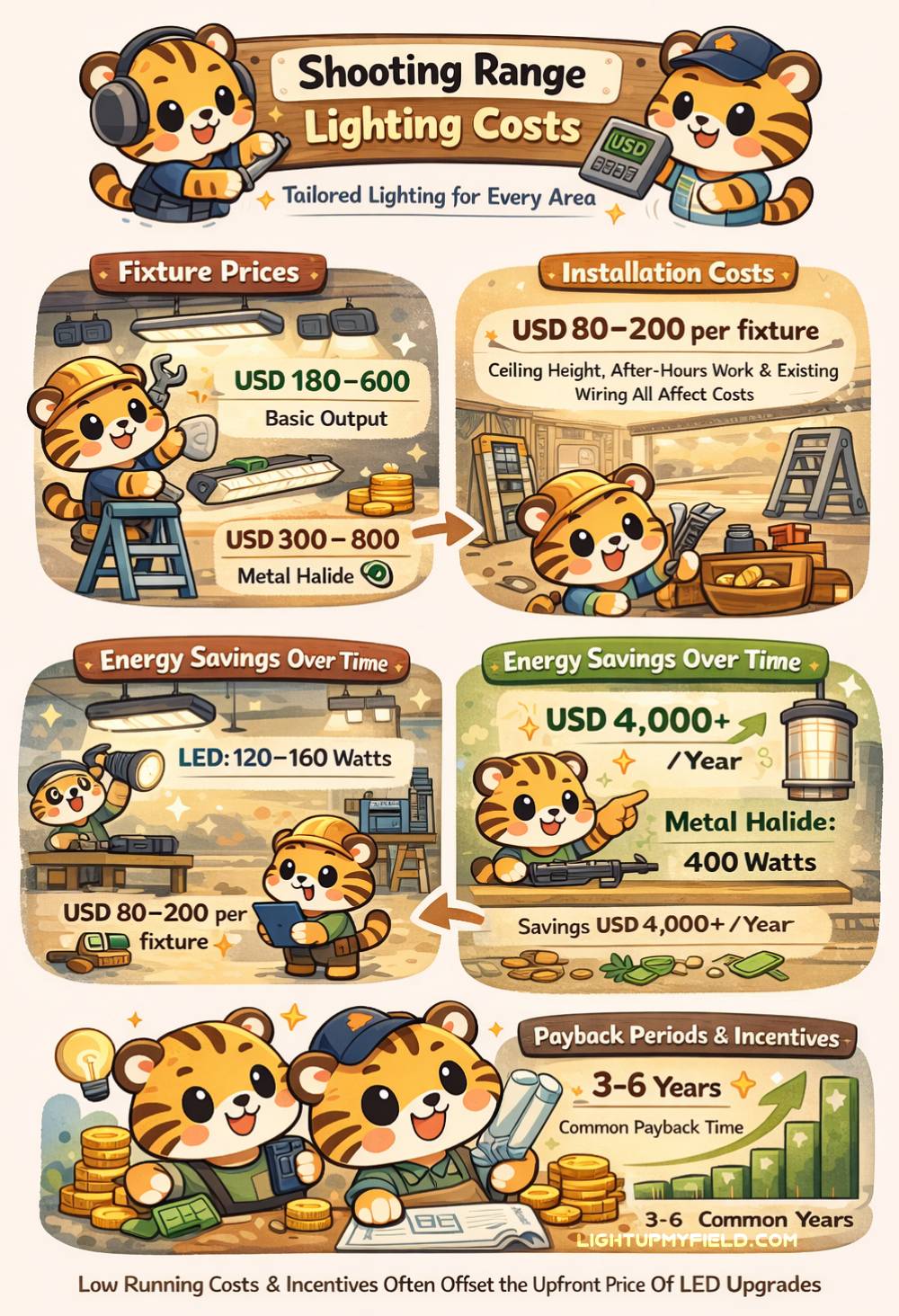
When people first look at shooting range lighting, fixture pricing is usually the biggest question mark. And honestly, the range is wide for a reason. Purpose-built LED fixtures designed for shooting ranges typically land between USD 180 and 600 per unit, depending on what’s under the hood.
Lower-cost fixtures usually cover basic output needs and are fine for smaller or lightly used ranges. As you move up the price range, you’re paying for higher lumen output, better optical control, sealed housings, stronger impact ratings like IK08 or IK10, and higher ingress protection such as IP65 or above. Fixtures with custom beam angles for target lighting or reinforced housings for heavy vibration also tend to sit on the higher end.
It’s also worth looking beyond the sticker price. A USD 250 fixture that loses 20 percent of its output in two years or fails early can end up costing more than a USD 450 fixture that runs smoothly for a decade.
Installation is where projects can swing more than expected. In many indoor ranges, lighting installation runs around USD 80 to 200 per fixture, but that’s just a baseline.
Ceiling height plays a big role. Ranges with ceilings under 12 feet are generally easier and faster to work in. Once ceilings reach 18 or 20 feet, lifts or scaffolding are often required, which adds labor time and cost. If the range stays open during installation, work may need to happen after hours, pushing labor rates higher.
Another factor is existing wiring. Older ranges sometimes need electrical upgrades to support modern LED drivers or new control systems. Removing old metal halide or fluorescent fixtures also adds time, especially if ballasts or heavy housings are involved.
That said, LED retrofits are usually simpler than people expect, and many projects are completed lane by lane to minimize downtime.
Running costs are where LED lighting really starts to shine. Older metal halide systems are energy-hungry and inefficient. A typical setup with 40 fixtures at 400 watts each pulls about 16 kW whenever the range is operating.
Switching those fixtures to 160-watt LED units drops total demand to 6.4 kW. Over 3,000 operating hours per year, that’s a reduction of about 28,800 kWh annually. At an electricity rate of USD 0.15 per kWh, that comes out to more than USD 4,000 saved every year, purely on energy.
And that’s just the power bill. Maintenance savings add up too. Metal halide lamps often need relamping every 6,000 to 10,000 hours, plus ballast replacements. LEDs, with lifespans of 50,000 to 100,000 hours, can run for years with minimal attention. Fewer lift rentals, fewer lane closures, and fewer emergency fixes quietly improve operating margins.
When you combine energy and maintenance savings, many shooting ranges see payback periods in the 3 to 6 year range, depending on usage hours and local electricity rates. Facilities with long operating hours, such as commercial ranges open seven days a week, often see returns even faster.
Over a 5 to 7 year span, it’s common for total savings to meet or exceed the initial investment, especially when older lighting systems are replaced. Beyond that point, the lighting system continues delivering lower operating costs year after year.
One area that often gets overlooked is funding support. Many regions offer energy-efficiency rebates or grants for upgrading to LED lighting. Utility companies frequently provide incentives based on reduced wattage or total kWh savings, which can cover 10 to 30 percent of fixture and installation costs in some cases.
Public or semi-public facilities, including police training ranges or municipal shooting facilities, may also qualify for state or federal energy-efficiency grants. In the U.S., programs tied to energy conservation, infrastructure upgrades, or public safety facilities sometimes include lighting improvements as eligible expenses.
Even privately owned ranges can benefit from tax incentives or accelerated depreciation for energy-efficient equipment, depending on local regulations. These programs change over time, but when they’re available, they can shorten payback periods significantly.
Working with suppliers or consultants who understand these incentive programs can make a real difference. Proper documentation, lighting calculations, and before-and-after energy estimates are often required to qualify.
| Item / Feature | LED Lighting | Metal Halide |
|---|---|---|
| Fixture Price | USD 180 – 600 | Often USD 300 – 800 |
| Installation Cost | USD 80 – 200 | Similar or slightly higher |
| Power per Fixture | 120 – 240 W | 400 W |
| Number of Fixtures Example | 40 | 40 |
| Total Load | 6.4 kW | 16 kW |
| Annual Operating Hours | 3,000 h | 3,000 h |
| Annual Energy Consumption | 6.4 kW × 3,000 h = 19,200 kWh | 16 kW × 3,000 h = 48,000 kWh |
| Annual Energy Cost (@USD 0.15/kWh) | ~USD 2,880 | ~USD 7,200 |
| Lifespan | 50,000 – 100,000 h | 6,000 – 10,000 h |
| Maintenance Needs | Low, minimal | High, frequent lamp & ballast changes |
| Glare & Flicker | Flicker-free, controllable | Flicker possible, slower start |
| Efficiency | High lumen per watt | Lower lumen per watt |
| Payback / ROI | 3 – 6 years (depending on usage) | Rarely recoups energy costs |
One of the most common mistakes in shooting range lighting is assuming more brightness automatically leads to better visibility. It’s an easy trap. Adding higher-output fixtures or packing lights closer together can push firing line levels well beyond 800 or 900 lux, but that extra light often works against the shooter.
When brightness isn’t controlled, glare increases. Reflections bounce off slides, optics, and even eye protection. Shooters start squinting without realizing why, and fatigue sets in faster. The goal isn’t maximum lux. It’s useful light placed in the right direction, with even coverage and controlled angles.
Another issue that shows up more often than people expect is mixing fixtures with different color temperatures. A firing line lit at 5000K next to a target area lit at 4000K creates a subtle visual clash. The range starts to feel inconsistent, almost patchy, even if all the numbers look fine on paper.
This usually happens during partial upgrades, when older fixtures are left in place and new LEDs are added around them. Over time, it becomes visually distracting, especially for regular shooters who spend hours in the space. Keeping color temperature and output consistent across zones helps the range feel calm and intentional.
Saving money upfront by using general-purpose fixtures is another mistake that tends to show up later. Shooting ranges are rough on lighting. Vibration, dust, and regular cleaning quickly expose weak housings, poor seals, or low-quality drivers.
Non-rated fixtures may work fine for a few months, but failures often come early. Flickering lights, dim spots, or full outages lead to lane closures and last-minute repairs. Those interruptions cost more in lost revenue and staff time than the initial savings ever covered.
Lighting designs often look great in drawings and simulations. But one of the biggest mistakes is finalizing a layout without actually standing at the firing line. Shooter perspective changes everything.
A fixture that looks harmless on a plan can sit right in the line of sight once someone shoulders a firearm. Glare that doesn’t show up in calculations becomes obvious the moment sights come up. That’s why experienced designers test layouts from shooter height and angle, not just from above.
Another oversight is not thinking far enough ahead. Fixtures that are hard to access, hard to clean, or difficult to replace become a long-term headache. Every maintenance task that requires closing lanes chips away at operating efficiency.
Most shooters tend to feel comfortable when the firing line sits around 500 to 700 lux (50 to 65 fc), assuming the light is evenly distributed. That range gives enough brightness to clearly see firearm controls, sights, and lane markings without making the space feel harsh. Once lighting levels start pushing beyond 800 lux, the benefits drop off quickly. Glare becomes more noticeable, reflections increase on slides and optics, and shooters often feel eye strain after longer sessions. Comfort usually comes from balanced light with good uniformity, not from pushing brightness as high as possible.
LED lighting doesn’t magically improve accuracy, but it does shape the conditions that support it. Flicker-free output, stable brightness, and controlled glare help shooters stay visually relaxed, which makes it easier to maintain focus and consistency. When lighting is uneven or reflective, shooters subconsciously fight the environment, adjusting their stance or sight picture more than they should. Over longer practice sessions, good LED lighting helps reduce fatigue, which can indirectly support steadier performance.
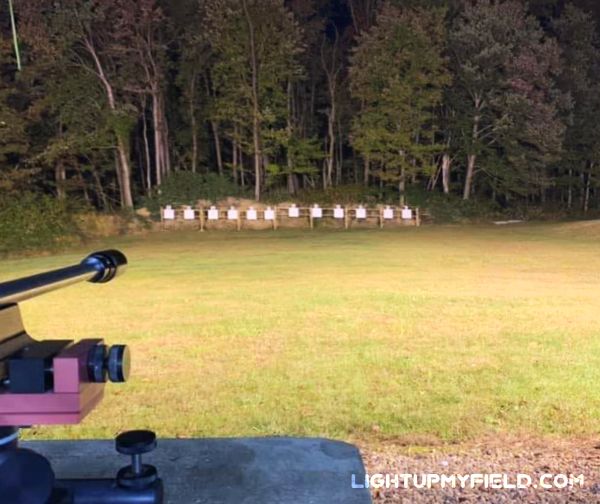
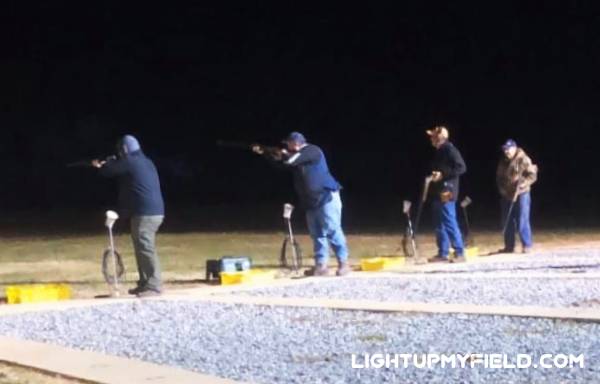
Outdoor ranges have more natural light to work with, so the approach is usually different. Covered firing lines still need carefully aimed fixtures, often with tighter beam angles, to prevent light spill and reduce light pollution. Illumination levels are typically lower than indoors, often around 300 to 500 lux (30 to 50 fc), since daylight fills in the gaps. The focus outdoors is less about overall brightness and more about target visibility, contrast, and minimizing glare, especially during early morning or evening hours.
In active indoor ranges, fixtures are commonly cleaned every 3 to 6 months, though high-traffic or heavily used ranges may need more frequent attention. Dust, powder residue, and airborne particles slowly settle on lenses and housings, which can reduce effective light output by 10 percent or more over time. Regular cleaning helps keep lighting levels consistent and avoids the temptation to overlight the space to compensate. Using sealed fixtures with smooth surfaces makes this process faster and helps preserve performance year after year.
Yes, modern range lighting systems often include zoning and dimming controls. That means different lanes or sections can have separate brightness settings. For example, during a training session, target lighting might be increased to 800–1,000 lux for precise shot tracking, while public lanes are set to softer 500–600 lux to maintain comfort. Adjustable lighting also comes in handy during maintenance, inspections, or special events, allowing ranges to adapt without adding temporary fixtures or shutting down lanes.
There are a few clear warning signs. Frequent complaints about glare, uneven light, or dim targets usually indicate the system isn’t performing well. Rising energy bills and regular lamp or driver failures are also strong indicators. If fixtures are over 10 years old, their efficiency and output have likely dropped, and older systems often consume far more power than modern LEDs. When several of these signs appear together, an upgrade can pay for itself in comfort, safety, and long-term cost savings.
Not necessarily. A Color Rendering Index (CRI) of 80–85 is generally sufficient for shooting ranges. Going higher may improve color fidelity slightly, but the difference is often negligible for target visibility. What matters more is consistency across the range—mixing CRIs or color temperatures between zones can create visual fatigue, distract shooters, and make shot placement harder to read.
Yes. Shooting is physically and mentally demanding, and poor lighting can subtly tire shooters faster. Balanced lighting that avoids glare and maintains uniformity helps reduce eye strain and mental fatigue, making sessions more comfortable. Many range operators notice that shooters spend more time practicing, return more frequently, and generally have a better experience when the lighting is well designed—even if they don’t consciously think about it. Comfortable lighting can quietly boost both satisfaction and revenue over time.
Good shooting range lighting doesn’t shout for attention. It quietly supports safety, accuracy, and comfort, shot after shot. When designed with real-world use in mind, it becomes part of the range’s reputation, something customers feel even if they don’t immediately name it.
If you’re planning a new range, upgrading an older facility, or troubleshooting lighting issues shooters keep mentioning, our team is happy to help. We work with range owners, designers, and contractors to evaluate layouts, calculate lux levels, and recommend solutions that make sense both technically and financially. Reach out anytime for a conversation and see how the right lighting approach can change the way your range performs.