
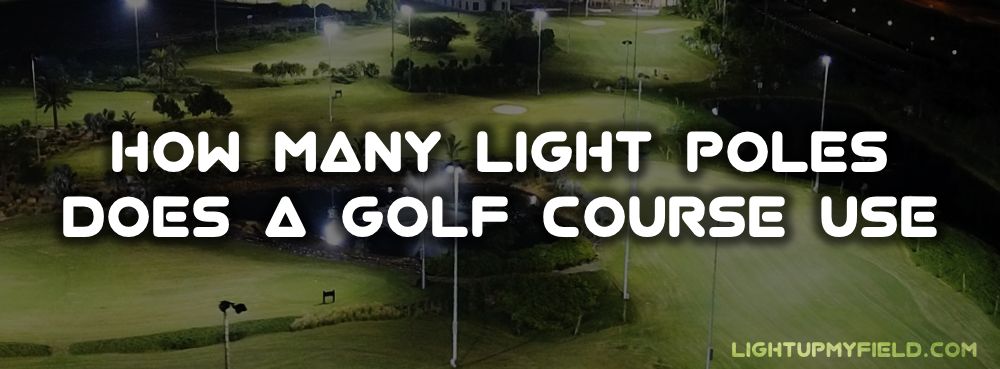
Lighting a golf course is not just about making the place brighter after sunset. It affects how comfortably players can see the ball, how safe the course feels, and even how the landscape looks at night. One of the most common questions course owners and operators ask is how many light poles are actually needed and how tall those poles should be. The answer is rarely one-size-fits-all, because every course has its own layout, usage pattern, and expectations. Still, there are clear ways to think through the numbers and arrive at a setup that makes sense.
Typical Light Pole Counts by Golf Course Area
Lighting a golf course works best when it is planned in zones. Each area is used differently, and golfers interact with light in very different ways depending on whether they are teeing off, walking a fairway, or practicing short putts. Thinking zone by zone makes pole counts feel more logical and easier to justify.
| Area | Pole Height (m) | Typical Pole Count | Spacing / Coverage |
|---|---|---|---|
| Driving Range | 22–30 | 10–20 | Along tee line, 250–300 yd reach |
| Tee Boxes (Par 4/5) | 12–16 | 1 per tee | Sometimes shared for adjacent holes |
| Par 3 Tee / Near Greens | 12–16 | 1–2 | Shared with nearby greens |
| Fairways (Partial) | 12–16 | – | Poles every 60–80 m, first 120–150 m |
| Fairways (Full) | 12–16 | – | Tighter spacing for full coverage |
| Greens | 8–12 | 2–4 per green | Positioned behind/side, wash surface evenly |
| Practice / Short-Game Areas | 8–12 | Few | Short-range, wide beam optics |
Driving Range Lighting Needs and Pole Quantity
Driving ranges are usually the brightest and most pole-dense areas on a golf property. Balls are flying high, distances are long, and players expect to clearly track ball flight from launch to landing. For a range that stretches 250 to 300 yards deep, it is common to see anywhere from 10 to 20 light poles, depending on how wide the range is.
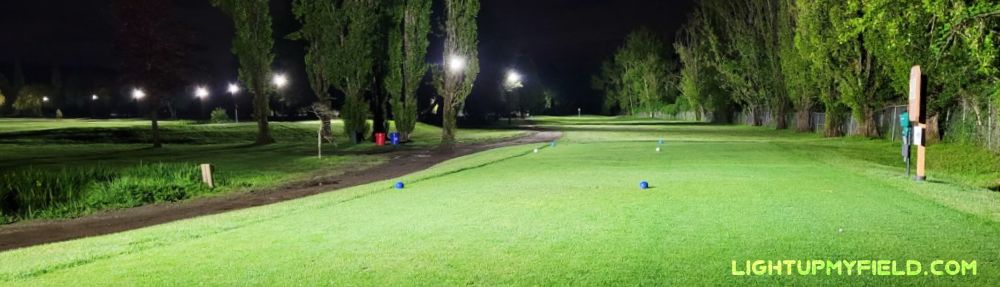
Poles are often placed along the tee line, spaced roughly 30 to 40 meters apart, with fixtures aimed outward to follow the natural spread of shots. A narrower range might work well with a single row of poles, while wider ranges often add a second row or use taller poles to avoid dark zones near the edges. When the goal is to clearly see shots beyond 220 meters, pole heights in the 22 to 30 meter range are commonly used.
Tee Boxes and Launch Areas
Tee boxes on the course itself are smaller than a driving range, but they still need good visibility. Players spend time setting up their shots, checking alignment, and watching the ball at launch. Many courses use one pole per tee box, especially on par 4 and par 5 holes where the ball travels farther.
In tighter layouts, tee boxes for neighboring holes sometimes share lighting, which helps reduce the total pole count. Par 3 tees often benefit from shared lighting with nearby greens, since the tee and target are relatively close. In these areas, pole heights typically fall between 12 and 16 meters, which is enough to provide clarity without creating glare at eye level.
Fairway Coverage and Flexible Pole Spacing
Fairways are where designers usually have the most flexibility. Some courses choose to light only the first 120 to 150 meters of the fairway, covering the main landing zones where most shots end up. This approach keeps pole counts reasonable while still supporting enjoyable night play.
In partial fairway lighting setups, poles are often spaced 60 to 80 meters apart, sometimes shared between adjacent holes. For courses that want continuous fairway lighting from tee to green, spacing becomes tighter, and the number of poles increases quickly. Full fairway lighting can double the pole count compared to selective lighting, which is why many facilities choose a hybrid approach.
Green Lighting and Shadow Control
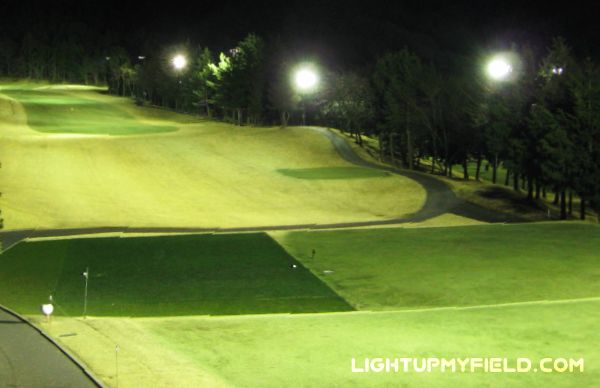 Greens usually receive more focused and careful lighting than any other area on the course. Putting requires seeing subtle slopes and contours, so shadows and glare must be tightly controlled. Most greens use two to four poles, depending on size, shape, and elevation changes.
These poles are typically shorter, often in the 8 to 12 meter range, and positioned behind or slightly to the side of the green. This placement allows light to wash across the surface instead of shining directly into players’ eyes. Larger greens with multiple tiers may need additional poles to keep light levels even across the entire putting surface.
Practice Areas and Short-Game Zones
Practice greens, chipping areas, and short-game zones usually need less intense lighting. Shots stay close to the ground, and players are not tracking long ball flights. Lighting levels around 20 to 30 lux are usually enough for these spaces.
Because of this, pole heights and quantities stay modest. Short poles combined with wide beam optics often do the job, keeping the area comfortable without making it feel overlit. These zones are also where courses often prioritize energy efficiency, since lights may be on for long periods.
How Tall Should Golf Course Light Poles Be?
Pole height is just as important as pole count, and the two are closely connected. Taller poles cover more area, which can reduce how many poles are needed. At the same time, taller structures cost more, need deeper foundations, and are more noticeable visually.
| Area / Use | Recommended Pole Height (m) | Notes on Coverage & Purpose |
|---|---|---|
| Driving Ranges & Long Fairways | 18–30 | Shows full ball trajectory, reduces glare, wide coverage |
| Tee Boxes & Fairways | 12–18 | Balances coverage and comfort, integrates with landscape |
| Greens & Practice Areas | 8–12 | Precise light control, minimizes glare, blends visually |
| Local Regulations | 15–20 max | May require more poles with lower heights and closer spacing |
Tall Poles for Long-Distance Lighting
Driving ranges and long fairways usually rely on taller poles. Heights between 18 and 30 meters are common, especially when the goal is to show full ball trajectory. A 25-meter pole, paired with the right LED optics, can comfortably light distances beyond 200 meters, making it a popular choice for modern ranges.
Taller poles also help reduce glare near the tee by placing fixtures higher above the player’s line of sight. However, they require careful aiming and structural planning to handle wind loads and long-term stability.
Medium Heights for On-Course Play
On-course lighting for tee boxes and fairways typically uses poles in the 12 to 18 meter range. This height balances coverage and comfort, allowing light to reach landing zones without overpowering the tee area.
These medium-height poles are often easier to integrate visually into the landscape. They work well along fairway edges, cart paths, and transition areas where lighting needs to feel present but not dominant.
Shorter Poles for Greens and Practice Areas
Greens and practice areas usually benefit from shorter poles, often 8 to 12 meters tall. Lower mounting heights make it easier to control beam direction and reduce glare during putting. When fixtures are carefully aimed, shorter poles can still deliver very even light across the surface.
These poles also blend more naturally into the surroundings, which matters on courses that value a clean nighttime look.
The Role of Local Regulations
Local rules sometimes place limits on pole height, often capping structures at 15 or 20 meters to reduce visual impact and light spill. When height is restricted, designers may increase the number of poles instead, using tighter spacing and lower-output fixtures to achieve the same lighting effect.
Understanding these limits early helps avoid redesigns later and keeps projects moving smoothly.
By looking at both pole count and pole height together, golf courses can build lighting systems that feel balanced, efficient, and comfortable to play under. The right combination depends on how each area is used, how bright it needs to be, and how the course wants to look once the sun goes down.
Factors That Influence How Many Light Poles a Golf Course Needs
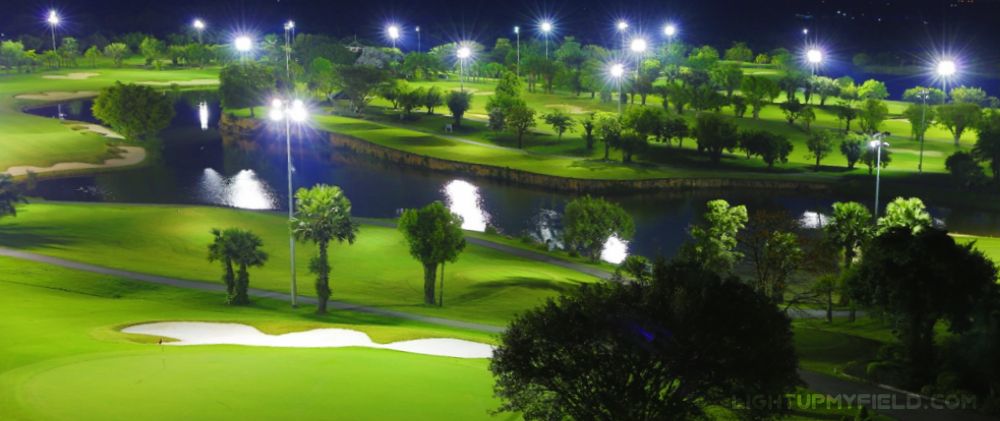
When people start estimating how many light poles a golf course needs, the first thing that usually comes up is the total size of the property. Acreage does matter, but it is only one piece of the puzzle. Two courses with the same land area can end up with very different lighting plans, simply because the layout, usage, and lighting goals are not the same.
Course Size Versus Course Layout
A compact 9-hole course where fairways run close to each other can often share lighting between holes. In these cases, a single row of poles might illuminate parts of two fairways, reducing the total pole count. On the other hand, a spread-out course with long walks between holes and wide buffers needs more individual lighting zones, even if the total acreage is similar.
Layout also affects pole spacing. Fairways that stretch 350 meters or more usually require poles every 60 to 70 meters to maintain usable illumination, while shorter holes can stretch that spacing slightly without hurting visibility. How the holes are arranged often matters more than how big the property looks on a map.
Where Golfers Spend the Most Time
Not every part of the course needs the same level of attention. Tee boxes, greens, practice greens, and short-game areas are where golfers slow down and focus on detail. These areas usually need higher uniformity and cleaner light distribution, which often means more poles or tighter spacing.
Fairways are different. Since players move through them more quickly, lighting can be more selective. Many courses choose to light fairways only to the main landing zones, typically the first 120 to 160 meters from the tee, instead of the full hole length. This approach can cut fairway pole counts by 20 to 30 percent while still supporting enjoyable night play.
Full Course Lighting Versus Partial Night Play
A course that wants full night golf across all 18 holes is in a completely different category from one that only lights the driving range and a few practice areas. Lighting all tees, fairways, and greens across 18 holes can easily double the number of poles compared to a partial setup.
For example, a course that lights only the driving range and the front nine might need 50 to 70 poles, while a fully lit 18-hole layout with similar design standards could require 120 to 150 poles or more. The intended operating hours also matter. Courses open until midnight often invest in better coverage to keep visibility comfortable as eyes tire later in the evening.
Target Light Levels and Playing Experience
Expected brightness levels have a direct impact on pole count. Casual evening play usually targets around 30 to 50 lux on tee boxes, landing areas, and practice zones. This level feels relaxed and natural, especially for public or resort courses.
Facilities focused on coaching, junior programs, or competitive practice often push higher, sometimes 80 to 100 lux in key zones like tees and greens. Reaching those levels usually requires either closer pole spacing, taller poles, or higher-output luminaires. In many cases, increasing average lux by 30 percent also increases pole count by 10 to 20 percent if pole height stays the same.
Pole Height and Coverage Distance
Pole height and pole count are closely linked. Taller poles spread light over a larger area, which can reduce the total number needed. For example, moving from a 15-meter pole to a 22-meter pole can increase effective coverage radius by 30 to 40 percent, depending on optics.
However, taller poles also cost more to install and may require deeper foundations. Some courses prefer slightly more poles at moderate heights rather than fewer very tall poles, especially in windy areas or near residential zones where visual impact matters.
Impact of Lighting Technology and Optics
Modern LED technology has changed how lighting plans are built. High-output LED fixtures with advanced optics can throw light farther and more precisely than older metal halide systems. In practical terms, one modern LED fixture can sometimes replace two or three older units, which reduces the number of poles without sacrificing uniformity.
Better beam control also means less wasted light. When more of the light actually lands on fairways and greens instead of spilling into rough or sky, fewer poles are needed to hit the same illumination targets. Over a full course, this efficiency can translate into 10 to 25 percent fewer poles compared to older designs.
Local Conditions and Surroundings
Environmental factors quietly influence pole count as well. Courses in foggy or coastal areas may need slightly higher light levels to maintain visibility, which can push pole numbers upward. Courses near homes or natural areas often limit pole height and output to control glare and spill light, sometimes increasing the number of shorter poles instead.
Trees also play a role. Mature trees can block light and create dark pockets unless poles are placed more frequently or positioned higher. Planning around existing landscaping often avoids costly adjustments later.
The Relationship Between Pole Height and Pole Quantity
When it comes to lighting a golf course, pole height and the number of poles are closely linked. They work together to determine coverage, visual comfort, and the overall cost of the project. Taller poles spread light over a larger area, which usually means you can place them farther apart and reduce the total number of poles. For example, raising pole height from 12 meters to 18 meters can sometimes allow spacing to increase by 30 to 40 percent, depending on the type of fixture and beam optics. On a standard par-4 fairway, that might mean reducing the number of poles from six down to four without compromising visibility.
Trade-Offs of Taller Poles
While taller poles reduce pole quantity, they do come with some trade-offs. Taller structures require deeper foundations, thicker steel, and additional engineering to handle structural loads, particularly in windy areas. For example, a 25-meter pole on a driving range may need a foundation depth of 2 to 3 meters, compared to 1 to 1.5 meters for a 12-meter pole. Maintenance is also slightly more complex—servicing LED fixtures at 20 meters or higher usually needs a lift or crane, adding labor costs. In windy conditions, the poles must be rated to withstand gusts over 100 km/h, which can further increase material and installation costs.
Despite the higher upfront investment, taller poles are often more energy-efficient over time. Fewer poles mean less cabling, fewer fixtures, and reduced operational complexity, which can offset the installation cost in a few years, especially for courses running lights nightly or during long evening hours.
Shorter Poles and Increased Pole Count
Shorter poles, on the other hand, are cheaper to manufacture and install. A 10- to 12-meter pole is easier to transport, requires a shallower foundation, and is simpler to maintain. The downside is that you need more of them to achieve the same coverage. On a fairway or practice range, this can mean adding 25 to 30 percent more poles to reach the target illumination levels.
More poles also bring extra considerations for the course layout. Each pole requires trenching for cabling, connection to power, and careful placement to avoid interfering with play or aesthetics. Too many poles in a small area can clutter the visual landscape, which can be distracting for golfers and may even affect depth perception during play.
Finding the Middle Ground
Most golf course lighting setups benefit from a balanced approach, where pole height and quantity complement each other rather than compete. For example, a course might use 16-meter poles for fairways, 12-meter poles for greens, and 6 to 8-meter poles for cart paths, achieving a mix of coverage and visual comfort without overloading the landscape with too many structures.
By carefully evaluating fairway width, hole length, green size, and lighting targets (lux levels), designers can optimize both pole height and quantity. On a typical par-4 hole, using four 18-meter poles instead of six 12-meter poles can maintain the same average lux of 40–50 across landing areas while reducing fixture count, cabling, and maintenance needs.
Practical Considerations
Beyond coverage, pole height affects glare, player comfort, and energy efficiency. Taller poles can direct light downward more effectively, reducing bright spots near the tee box, while shorter poles may require careful aiming to avoid shining directly into golfers’ eyes. Choosing the right mix of pole heights ensures that light spreads evenly, shadows are soft, and players can track the ball naturally without eye strain.
Glare Control and Player Comfort
When it comes to night golf, glare control can make or break the player experience, no matter how many poles are installed or how tall they are. Even a well-lit fairway can feel uncomfortable if fixtures are poorly aimed, making it hard for golfers to track the ball right after impact. This is especially noticeable on tee shots and long drives, where the ball can briefly vanish against the night sky if glare is interfering.
How Pole Height Affects Glare
Pole height plays a bigger role in glare than many people realize. Very low poles can shine directly into a player’s eyes, creating uncomfortable hotspots at ground level. On the other hand, very tall poles can also cause bright spots if the fixture optics are not carefully matched to the distance and beam angle. For instance, a 25-meter driving range pole without proper beam control might light up only a small landing zone while leaving surrounding areas dim, which is just as distracting as low glare.
Tools and Techniques to Reduce Glare
Designers use a combination of shielding, precise aiming angles, and asymmetric beam patterns to make sure light lands where it’s needed without spilling into players’ sightlines. Shields or visors on fixtures prevent sideways spill, while asymmetric optics help spread light evenly along fairways or across greens without creating bright spots. Small adjustments—just 2 or 3 degrees in tilt or rotation—can dramatically improve comfort and visibility.
Tee Boxes and Greens
On tee boxes, lights are usually angled so the brightest part of the beam starts several meters in front of the player, allowing them to see the ball clearly without being blinded. On greens, lighting is often softer, coming from multiple poles at lower intensity, so shadows are minimized and slopes are easier to read. The focus is on even illumination and gentle contrast, rather than raw brightness.
These subtle adjustments often have a bigger impact on playability than simply adding more poles. Smart glare management ensures that golfers can follow the ball, judge distance, and read the green naturally, making night rounds feel almost as comfortable as daytime play.
Cost Considerations and Long-Term Value
When planning golf course lighting, the budget goes far beyond just installation costs. Energy consumption, ongoing maintenance, and fixture lifespan all play a big role in the real cost over time. Choosing the right mix of pole height, pole count, and lighting technology can save a lot of money in the long run, even if the upfront investment is slightly higher.
Energy Use and Efficiency
For example, a mid-sized driving range with 15 high-output LED poles might consume around 12 to 15 kW per hour when all lights are on. An older metal halide system covering the same area could easily use double that, or 25 to 30 kW per hour. Over a year of nightly operation, that difference can translate into thousands of dollars in energy savings, which can help offset the higher cost of LED fixtures or taller poles.
Maintenance and Fixture Lifespan
Maintenance savings also make a big difference. Modern LED fixtures often last 50,000 hours or more, which can mean roughly 10 years of reliable use without major servicing. That’s particularly valuable for golf courses where downtime impacts player experience or revenue. Fewer poles and fewer fixtures also reduce cabling, connectors, and labor during routine checks, so maintenance teams spend less time climbing lifts or adjusting lights.
Fewer Poles, Taller Poles, Better Value
Investing in fewer, taller poles with high-output LEDs usually increases upfront costs but lowers long-term expenses. Taller poles cover more ground, requiring fewer fixtures, which cuts both energy use and maintenance. A well-designed setup balances pole height, fixture output, and spacing so that the course is evenly lit, players are comfortable, and operating costs stay manageable.
An Imaginary Case Scenario – Green Valley Golf Club
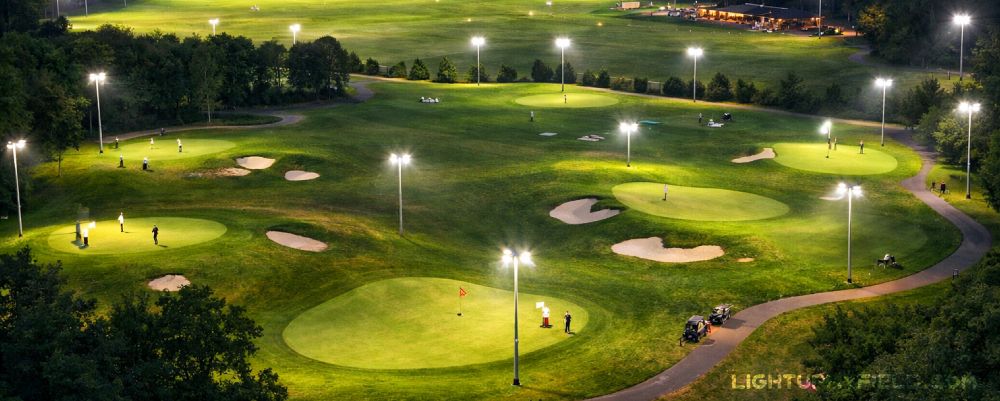
To make it easier to picture how lighting comes together on a golf course, let’s imagine a facility called Green Valley Golf Club. This is an 18-hole public course with a 20-bay driving range and a small practice area. The owners want to support evening play on the driving range and the front nine holes, so the lighting plan has to balance coverage, energy use, and player comfort.
| Area | Pole Height (m) | Number of Poles | Spacing / Coverage | Avg. Lux |
|---|---|---|---|---|
| Driving Range | 24 | 16 | Along tee line, 280 m reach | – |
| Tee Boxes (Front 9) | 14 | 9–10 | One per tee, some shared | 40 |
| Fairways (Front 9) | 16 | – | Every 70 m, first 140 m | 25 |
| Greens (Front 9) | 12 | 3 per green | Covers slopes evenly | 50 |
| Total Poles | – | 52 | – | – |
Driving Range Lighting
The driving range is the most heavily used nighttime area, so it gets the tallest poles and strongest fixtures. Green Valley uses 16 poles at 24 meters tall, spaced evenly along the tee line. Each pole carries 1,200-watt LED fixtures, which can illuminate the range out to 280 meters. This setup makes it easy for golfers to track ball flight from the tee to the landing area without dark spots or glare. The height and spacing are carefully planned so each pole’s light overlaps slightly with its neighbors, creating a smooth, uniform beam across the range.
Tee Box and Fairway Lighting
For the front nine holes, tee boxes are lit using 14-meter poles, usually one per tee. Some poles are shared between adjacent holes where tees are close together, which reduces costs without compromising coverage. Fairways are partially lit, focusing on the first 140 meters from each tee, where most shots land. To achieve this, 16-meter poles are placed approximately every 70 meters along the fairway edges. This provides enough illumination for comfortable evening play while keeping energy use reasonable.
Green Lighting
Each green is treated with three 12-meter poles, positioned to cover slopes and undulations without creating harsh shadows. This ensures players can read the greens accurately for putting, even under artificial light. Multiple lower poles allow light to wash the green from different angles, minimizing glare while keeping slopes visible.
Overall Pole Count and Lighting Levels
In total, Green Valley installs 52 light poles across the range, front nine, and practice areas. The system delivers average light levels of about 40 lux on tees, 25 lux on fairways, and 50 lux on greens, which is sufficient for casual and practice play. Energy use stays within budget, and golfers report that tracking the ball feels natural, even on longer shots where distance perception is key.
Why This Scenario Matters
This example shows how pole count, height, and placement work together in a real-world scenario. The numbers aren’t extreme—they reflect a setup tuned to actual play patterns and course layout. It demonstrates the balance between tall poles for coverage, shorter poles for precision areas like greens, and strategic spacing to reduce glare and save energy.
Courses planning nighttime play can use a similar approach: evaluating range depth, fairway length, green size, and player habits helps determine the ideal mix of pole heights and quantities. This ensures a comfortable playing experience while keeping installation and operating costs manageable.
A Few Closing Thoughts on Making the Right Choice
Deciding how many light poles a golf course needs and how tall they should be is really about understanding the course itself. Layout, usage, lighting expectations, and local rules all shape the final plan. With modern LED systems, it is often possible to achieve better results with fewer poles than people expect, as long as height and optics are chosen carefully.
If you are exploring lighting upgrades or planning a new installation, it helps to talk through your goals with people who look at these systems every day. We’re always happy to help review layouts, run lighting simulations, and suggest configurations that fit both performance goals and budgets. Feel free to approach us for consultation and let’s see what kind of lighting setup would work best for your course.