
Lighting a softball field is actually a bit of a science mixed with some good design sense. Whether you’re setting up a new field or upgrading an old one, the right lighting setup makes all the difference — for players, umpires, and fans. Let’s break it all down from what the system actually includes to how to design and position everything for the best results.
What Is a Softball Field Lighting System?
A softball field lighting system is basically the complete setup that makes night games possible. It’s not just about hanging a few bright lamps around the field — it’s an integrated system designed to deliver the right amount of light to every corner of the infield, outfield, and spectator area. The system combines several key parts: light fixtures, poles, electrical wiring, control systems, switches, and sometimes solar panels for those looking to save on energy. Every piece has a role in making sure the field is bright, uniform, and safe for play long after the sun goes down.
The Lights – The Heart of the System
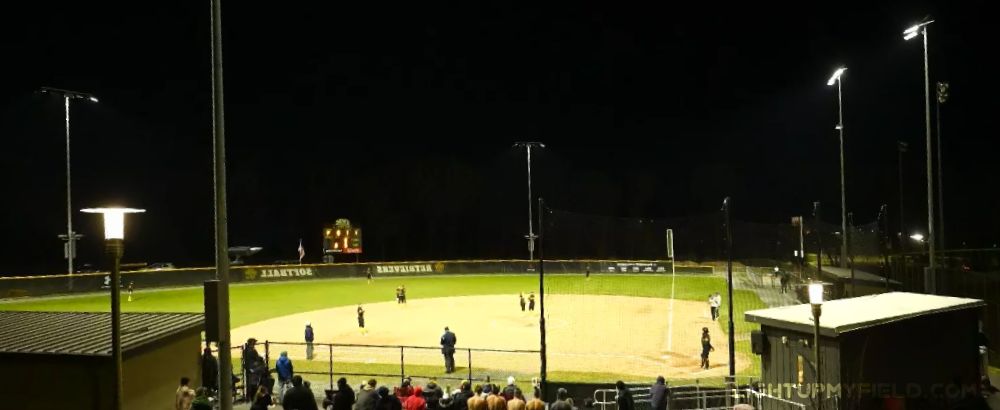
The LED floodlights are the stars of the show. Modern softball fields almost always use LEDs instead of old metal halide lamps. Why? Because LEDs are way more efficient — they can cut energy use by 60–70%, last over 50,000 to 100,000 hours, and produce a clean, steady light that doesn’t flicker or fade as the night goes on.
A typical softball field light fixture might run anywhere from 400 watts for local recreational fields up to 1500 watts for professional or televised games. In terms of brightness, that’s roughly 60,000 to 200,000 lumens per light, depending on the brand and optics. The LEDs are designed to cast light in a specific pattern, often called a beam angle, which controls how the light spreads over the field. Narrow beams help light up distant zones like the outfield, while wider beams are perfect for closer areas like the bases or home plate.
The Poles – Setting the Stage for Balance
Then come the light poles, which act as the backbone of the whole system. Pole placement and height play a huge part in how well the lighting performs. Too low, and you’ll get glare in the players’ eyes; too high, and you risk wasting light into the sky.
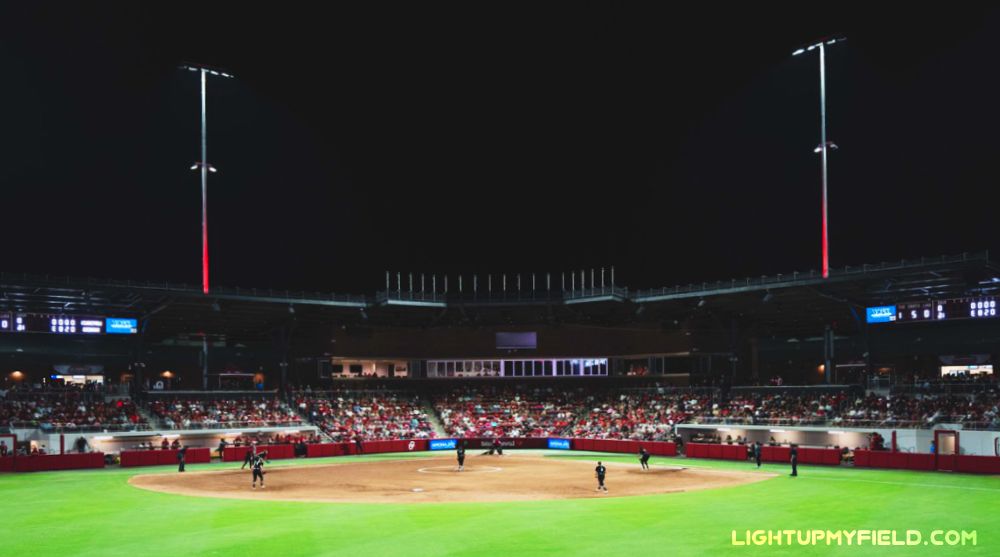
Most softball fields use poles that range between 40 to 70 feet tall, depending on the field size and competition level. Community fields with shorter fences might use 40–50 ft poles, while large complexes or stadiums go closer to 70 ft for better coverage. The poles are usually made of galvanized steel or aluminum, designed to handle strong winds and vibrations. They’re often equipped with cross arms — horizontal brackets that hold multiple fixtures — to fine-tune the light distribution across the field.
A standard setup might have 4 to 6 poles positioned strategically around the diamond — typically two near the foul lines and two to four behind the outfield fence. Each pole can hold anywhere from 6 to 10 LED floodlights, depending on the required illumination level.
The Control System – The Brain Behind the Brightness
If the lights are the heart of the system, the control system is definitely the brain. It’s what manages when, how, and how much light is produced. The simplest setups might just have a manual switch or breaker panel, while more advanced systems include digital control units with programmable timers, motion sensors, and even remote operation through mobile apps or web dashboards.
For example, some modern systems can automatically dim the lights between games or turn them off completely when no motion is detected. These smart features not only make life easier for facility managers but can save up to 30% more energy every season.
And for leagues that host multiple games a week, programmable controls help ensure lighting levels stay consistent game after game, avoiding unnecessary wear on the fixtures. Many LED systems now include DMX or DALI control protocols, the same type used in stadiums and concert venues, offering smooth dimming and instant on/off functionality — no warm-up time needed.
The Wiring, Switches, and Electrical Network
Next, let’s talk about the wiring and switches — the hidden parts that keep everything connected and safe. A good softball field lighting system relies on high-quality, weather-resistant cables rated for outdoor and underground use. You’ll often see copper conductors with UV-resistant insulation running through buried conduits to protect against moisture and temperature swings.
Electrical load balancing is a big deal here. Each pole’s fixtures are wired through distribution panels that manage current evenly, ensuring no single circuit is overloaded. That’s especially important when you’re pulling several thousand watts per pole. A well-designed system also includes grounding rods and surge protection, so a sudden thunderstorm doesn’t fry your equipment.
Switchgear components — things like contactors, relays, and circuit breakers — act as the safety net, letting operators isolate or power down specific sections when needed for maintenance or emergencies. When done right, the entire electrical network can last decades with only minimal servicing.
Solar Panels – Lighting the Game the Sustainable Way
In the last few years, solar-powered softball lighting systems have started popping up all over the place — especially in community parks and rural areas. These systems use photovoltaic panels to soak up sunlight during the day and store that energy in lithium-ion or deep-cycle batteries for night use. A typical solar setup can power LED floodlights for 8–12 hours per night, enough to cover evening games, practice sessions, or even late-night tournaments.
While the initial investment can be a bit higher — sometimes 20–30% more than grid-tied systems — the savings over time are impressive. There are no monthly electric bills, and with LED technology getting more efficient each year, solar solutions are becoming more practical even for larger fields. Plus, they’re a great fit in places where running underground wiring would be too costly or complicated.
Some hybrid systems even connect solar arrays with a traditional grid backup, ensuring there’s always enough juice for the lights no matter what the weather’s like.
Lighting Design and Standards
So what really makes a good softball field lighting design? It’s not just about throwing in the brightest lights possible. There’s a bit of art and science involved — getting the right mix of brightness, balance, direction, color tone, and glare control. These factors together make the field look and feel right, whether you’re watching from the stands or standing on the pitcher’s mound under the night sky.
Brightness Level (Lux or Footcandles)
When we talk about brightness, we usually measure it in lux (in metric) or footcandles (fc) (in imperial units). One footcandle is roughly equal to 10.76 lux, just to give you an idea. The right brightness depends on how serious the games are — a weekend league doesn’t need the same lighting as a national championship game.
For recreational or community fields, the sweet spot is around 200 to 300 lux (20–30 fc). That’s bright enough for safe play without wasting power. If you move up to amateur or semi-pro fields, you’re looking at about 500 lux (50 fc) to give better visibility for faster play. Professional or televised games need even more punch — typically 700 to 1000 lux (70–100 fc) — so cameras can capture crisp, clear footage without any dark spots.
What’s nice is that LED technology makes it easier to hit these numbers without burning through the budget. Compared to older metal halide lamps, modern LED floodlights can produce the same brightness using 40–60% less energy. That means a brighter field and a lighter electricity bill, which is a win for everyone.
Uniformity
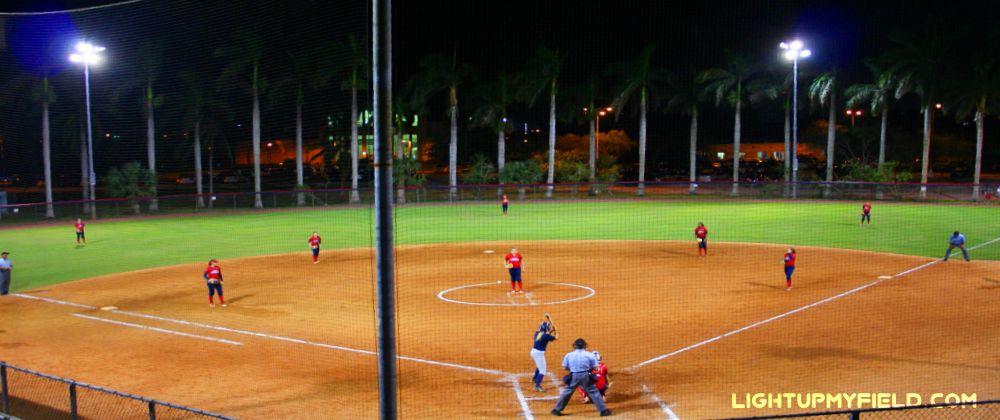
Brightness alone doesn’t guarantee good visibility — uniformity does. Imagine playing shortstop where one side of the infield is bright and the other side’s in shadow; that’s not fun and definitely not safe. A well-designed lighting plan spreads illumination evenly across the field so every area — from home plate to deep left field — is consistently visible.
Uniformity is measured by the ratio of minimum to average illuminance. For softball fields, that ratio should ideally be 0.6 or higher, meaning the darkest part of the field is still at least 60% as bright as the average. Professional designers often use specialized software (like Dialux or AGi32) to simulate the lighting layout and check that the field doesn’t have “hot spots” or dark patches.
Uniform lighting also reduces player fatigue. When your eyes don’t have to constantly adjust between bright and dim areas, you react faster and see the ball more clearly — especially those fast pitches and pop flies under the lights.
Lighting Direction
How the lights are aimed is just as crucial as how bright they are. The direction of the lighting affects how well players and spectators can track the ball in motion. For example, a badly aimed light could blind the batter or outfielder just as they’re trying to make a play.
Most field lights are tilted downward between 20° and 35°, which gives wide, even coverage while minimizing direct glare. The infield and outfield usually need slightly different angles — the infield needs more focused lighting to highlight bases, home plate, and the pitcher’s mound, while the outfield needs broader coverage for high fly balls.
Another small detail that matters is cross-aiming. Instead of all lights pointing straight ahead, some are angled diagonally to fill in darker zones and give more depth. When done right, this creates a seamless visual field — no harsh shadows, no blinding spots, just smooth, balanced brightness across the whole diamond.
Color Temperature
The color temperature of the lights changes the feel of the game. Measured in Kelvin (K), this number describes whether the light looks warm (yellowish) or cool (bluish-white). For softball fields, most designers aim for a cool white light between 5000K and 6000K. That’s roughly the same tone as daylight on a clear afternoon.
This daylight-style lighting helps players see the ball clearly against the background, and it keeps the colors of the uniforms, bases, and field markings looking natural. If you’ve ever seen an old field lit by orange-tinted lamps, you know how much harder it is to spot a fast-moving ball. With the right color temperature, everything just looks sharper — and for televised games, it makes the broadcast footage pop with clarity.
Some newer LED fixtures even offer tunable color temperatures, allowing fields to adjust the lighting tone for different conditions. For example, cooler light for gameplay and slightly warmer tones for post-game ceremonies or concerts.
Glare Control
Finally, let’s talk about glare — that annoying, sometimes dangerous issue when light beams hit your eyes directly. Too much glare can completely throw off a player’s focus, especially for batters and outfielders looking up for a high ball. Good lighting design is all about managing glare so that the field is bright without being blinding.
Modern LED sports lights use precision optics and anti-glare visors that direct light exactly where it’s needed. Instead of scattering brightness in all directions, these optics focus it onto the field, reducing spill light and keeping the surrounding area darker. Proper mounting height and angle adjustment also play a huge role. The lights should never point horizontally or directly toward the stands — that’s the fastest way to create eye-level glare.
A well-controlled system will have a glare rating (GR) below 50 for recreational play and below 40 for professional games. That might sound technical, but it simply means that even under intense brightness, the light feels comfortable to the eyes. Players can look up, track the ball, and make plays without squinting or losing sight.
Designing for Both Players and Spectators
At the end of the day, softball lighting design isn’t only for the athletes — it’s also about the fans. A field that’s evenly lit, with just the right brightness and color tone, makes the whole atmosphere more exciting. Spectators can see every play clearly, and the field takes on that crisp, professional “under the lights” vibe that makes night games so memorable.
With today’s LED technology, hitting the perfect balance between illumination, comfort, and efficiency is easier than ever. The key is thoughtful design — making sure the lights don’t just shine bright, but shine right.
| Aspect | Measurement | Typical Value |
|---|---|---|
| Brightness (Lux) | Recreational | 200–300 lux |
| Amateur/Semi-Pro | 500 lux | |
| Professional/TV | 700–1000 lux | |
| Uniformity Ratio | Minimum to Average | ≥ 0.6 |
| Lighting Angle | Infield | 20°–35° |
| Outfield | 20°–35° | |
| Color Temperature | Kelvin (K) | 5000K–6000K |
| Glare Rating (GR) | Recreational | < 50 |
| Professional | < 40 |
Lighting Layout Guide
Alright, now let’s get into the fun part — the actual layout. Once you know what kind of lights to use and how bright they need to be, the next question is all about placement: where do the poles go, how tall should they stand, how far apart do you space them, and how many lights do you really need to get that smooth, even glow across the entire field?
Good layout design is what separates a professional-looking softball field from one that feels patchy or uneven. Every foot of the field — from home plate to deep right field — needs balanced light coverage without shadows or hot spots.
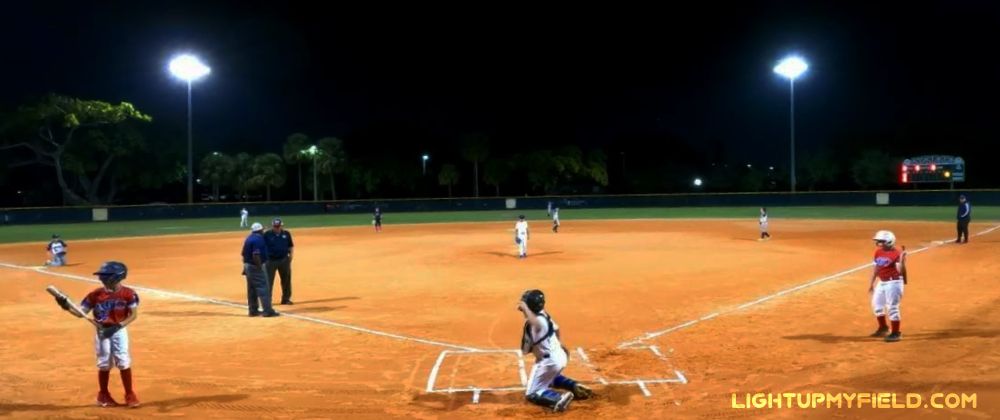
Light Pole Position
Most softball fields follow a 4- to 6-pole configuration, depending on size and competition level. Smaller community parks or youth fields can get by with four poles, usually two along each foul line. This layout provides decent coverage for the infield and part of the outfield.
But for larger or professional fields, designers almost always go with six poles. The extra two poles are positioned behind the outfield fence, spaced evenly to light the far corners and eliminate those dim zones near the warning track. This setup ensures that every part of the field — infield, outfield, bases, and pitcher’s mound — gets consistent illumination.
Pole placement is crucial for both performance and safety. Poles are normally installed just outside the field boundary, about 10 to 15 feet beyond the foul lines and around 20 to 30 feet behind the outfield fence. That spacing keeps the lights far enough from players while still providing optimal coverage.
The exact layout can vary based on field orientation (north-south vs. east-west), because you want to avoid light shining directly into players’ or spectators’ eyes. A well-planned setup directs light toward the playing surface and away from surrounding roads or neighborhoods, reducing light spill and glare.
Pole Height and Spacing
Pole height is another huge factor in creating even lighting. For softball fields, pole heights typically range from 40 to 70 feet, with 50–60 feet being the most common for standard adult fields. Shorter poles tend to create stronger glare and uneven brightness, while taller poles help spread the light more evenly across the diamond and outfield.
Think of it this way — the higher the lights, the softer the shadows. Taller poles help smooth out the lighting, so the players don’t see sudden dark zones or bright patches while tracking a fly ball. Of course, higher poles cost more to install and maintain, but they usually pay off in better visibility and longer-term performance.
Spacing between poles depends on the size of your field. For a regulation field with an outfield fence about 200 to 250 feet from home plate, poles are generally spaced 90 to 120 feet apart along the foul lines. The key is for the light beams to overlap slightly, which helps achieve that balanced, “no-shadow” effect across the entire field.
Designers often use computer simulations to test pole height and spacing before installation. These simulations predict how the lights will perform under real conditions, making it easier to fine-tune angles and coverage before any concrete is poured.
Number of Lights and Wattage
So, how many lights does a softball field actually need? There’s no one-size-fits-all answer — it depends on the field dimensions, brightness target (lux or footcandles), and the efficiency of your fixtures. But we can work with some typical numbers.
A standard recreational softball field (with an outfield fence around 200 feet) usually needs about 30 to 40 LED floodlights in total. Each of those lights typically draws between 600 and 1000 watts, which together can deliver around 300–500 lux of average brightness — perfect for local leagues or school competitions.
For semi-pro or professional fields, expect to use closer to 50 to 70 fixtures, often mounted on taller poles and producing 700 lux or more. Those setups often feature 1000W LED fixtures that generate about 130,000 lumens per light, bright enough for high-speed gameplay and TV broadcasting.
Of course, LED efficiency varies. Some high-end models deliver over 160 lumens per watt, which means you can hit your target lux level with fewer fixtures and save on both energy and maintenance. On the flip side, if you’re using slightly lower-wattage fixtures, you’ll simply need more of them to reach the same lighting standards.
It’s also a good idea to mix different beam angles — narrow beams to reach deeper parts of the field and wider ones for closer zones like the infield. This layering of light creates that smooth transition between areas, so the field feels evenly lit without harsh contrast.
Example Layout for a Standard Field
To give you a clearer idea, here’s what a well-balanced lighting setup might look like for a full-size field:
Imagine a softball diamond roughly 200 feet to the outfield fence, with 6 poles standing about 60 feet tall each. You’d mount around 8 to 10 LED floodlights per pole, each rated at roughly 800 watts.
The lights would be aimed downward at angles between 20° and 35°, allowing the beams to overlap and eliminate shadows. The resulting uniformity ratio — the balance between the darkest and average areas — should hit 0.6 or higher, which is ideal for competitive-level play.
With this kind of design, you’d typically get an average brightness of around 700 lux (70 fc) across the field. That’s enough for fast-paced night games with great visibility for both players and fans, without creating glare or uneven lighting.
A setup like this also offers good flexibility. With smart controls or dimming functions, you can reduce brightness for practice sessions or community events, saving even more on energy. And because LEDs turn on instantly (no warm-up time like metal halide lamps), switching between light levels is quick and easy.
| Aspect | Specification | Typical Value |
|---|---|---|
| Pole Configuration | Small Fields (e.g., youth, community) | 4 poles |
| Larger or Professional Fields | 6 poles | |
| Pole Placement | Distance from Foul Line | 10–15 feet |
| Distance behind Outfield Fence | 20–30 feet | |
| Pole Height | Standard Field (adult) | 40–70 feet |
| Pole Spacing | Between poles | 90–120 feet |
| Number of Lights (Rec) | Total Fixtures | 30–40 lights |
| Number of Lights (Pro) | Total Fixtures | 50–70 lights |
Special Softball Field Lighting Design
Not every softball field has the luxury of traditional grid power, and not every community wants to deal with high electricity costs or long wiring installations. That’s where flexible lighting solutions come in — smart, portable, and sustainable options that make night games possible just about anywhere. Whether you’re lighting a remote practice field or hosting a tournament in a temporary space, alternative lighting setups like solar systems and mobile light towers can make a huge difference.
Solar Panel Lighting Systems
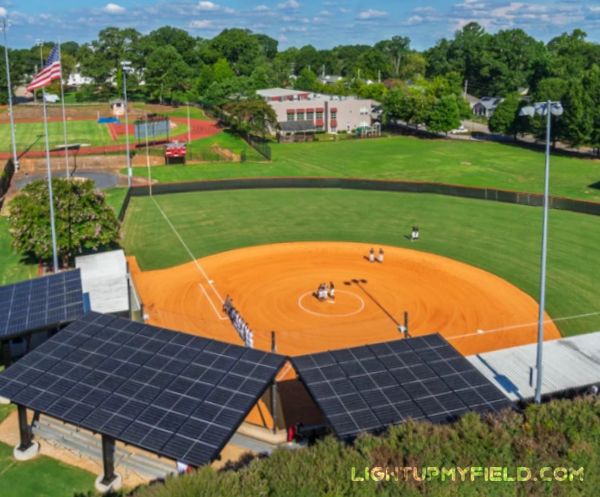 In the last few years, solar-powered softball field lighting has gone from a niche option to a seriously practical one. With the combination of solar panels, deep-cycle or lithium batteries, and high-efficiency LED floodlights, it’s now entirely possible to power a regulation-size field without being tied to the grid.
A well-designed solar lighting system can easily run for 8 to 10 hours per night on a single day’s charge — long enough to cover evening games, extended practices, or even late-night community events. The setup usually includes monocrystalline solar panels (which are more efficient than polycrystalline ones), MPPT charge controllers to manage energy flow, and LED luminaires optimized for outdoor sports lighting.
For example, a solar array with a total capacity of 20 to 25 kW can power around 40 to 50 LED floodlights, each rated at about 600–800 watts, depending on efficiency and brightness requirements. That’s enough to achieve around 400–500 lux across a standard softball field — perfect for recreational or semi-pro play.
Of course, the upfront investment for solar systems can be higher — sometimes 20–30% more than traditional wired setups. But the long-term savings are hard to ignore. With no monthly electricity bills and minimal maintenance (since LEDs and solar panels both last 20+ years), the return on investment often shows up within 5 to 7 years.
And beyond the financial benefits, going solar has its environmental perks. It helps cut carbon emissions, reduces dependence on the grid, and often qualifies for green energy incentives, sponsorships, or grants from local governments. Many parks and municipalities even use solar-powered lighting as a way to promote sustainability and community pride.
Another great thing about solar setups is their independence. Fields in rural or developing areas that lack reliable power can still host night games. You don’t need to dig trenches for wiring or wait for utility connections — just install the solar poles, hook up the batteries, and you’re ready to go.
Mobile Light Towers
Now, for fields that need something temporary or portable, mobile light towers are the go-to choice. You’ve probably seen these at outdoor events or construction sites, but newer versions are designed specifically for sports use — more compact, quieter, and equipped with high-performance LED lamps.
These portable towers come with telescopic poles, usually extendable up to 25 to 35 feet, and are mounted on wheeled trailers for easy movement. They can be powered by diesel generators, hybrid systems, or lithium battery packs, depending on the model. Setting one up typically takes less than an hour — you tow it into position, raise the mast, angle the lights, and you’re good to go.
A single mobile tower can illuminate an area of around 1,500 to 2,000 square meters (roughly one-third of a standard softball field). That makes them perfect for warm-up zones, practice areas, parking lots, or temporary game setups. For a full field, you’d usually use three to six towers, depending on brightness needs and the fixture power.
What’s really appealing about modern mobile towers is their flexibility. Need to move them between fields? No problem. Hosting a weekend tournament in a park with no permanent lighting? Just bring in a few mobile towers, and you’ve got a playable setup in an afternoon. Many professional training facilities also use them as supplemental lighting for drills, because you can position them anywhere you need extra visibility.
The latest designs are going green, too. Hybrid and solar-powered mobile towers combine renewable energy with battery storage, drastically cutting down on fuel use and noise. They can run silently for 8 to 12 hours on stored energy alone, making them ideal for residential or school environments where you don’t want generator noise interrupting the game.
And unlike old halogen or metal halide versions that took several minutes to warm up, LED-equipped light towers turn on instantly, reach full brightness immediately, and allow quick repositioning without waiting for a cool-down period. This makes them super convenient for tournaments, events, or training sessions that move locations throughout the day.
Choosing Between Solar and Mobile Options
So how do you decide which flexible setup fits your field best? It mostly depends on how often the field is used and where it’s located.
If your field is used regularly and gets good sunlight exposure year-round, a permanent solar-powered system is an excellent choice. It offers consistent, automated lighting with little upkeep and major energy savings over time.
But if you’re running temporary events, multi-purpose fields, or rotating training locations, then mobile towers are the better call. They don’t require foundations or wiring, and you can transport them from one site to another whenever needed.
In fact, many facilities use a hybrid approach — solar-powered main lighting for regular games, with mobile towers as backups or supplements during special events. This gives you the flexibility to adapt to different lighting needs without overcommitting to one system.
Tips to Have a Successful Lighting Design
Designing a great softball field lighting setup isn’t just about picking bright lights — it’s about combining smart planning, the right equipment, and long-term thinking. A few thoughtful choices at the start can save a ton of money, time, and frustration down the road.
Start with a Lighting Simulation
Before you even pour the concrete for your poles, it’s a smart move to run a lighting simulation. Tools like Dialux, AGi32, or Relux can create a 3D model of your field and help predict exactly how your lighting layout will perform in real life. You’ll see things like brightness distribution, shadow areas, and light spill before you buy a single fixture.
This step is more than just a technical exercise — it’s a money-saver. Adjusting a lighting angle in software costs nothing, but moving a 60-foot steel pole after installation can easily cost thousands. With simulation, you can tweak pole height, aiming angles, beam spread, and wattage until you hit that sweet spot of uniform, balanced lighting.
For example, simulations can show whether your layout achieves a uniformity ratio of 0.6 or higher, meaning there’s no harsh contrast between bright and dark zones. It’s the kind of detail that separates a well-lit, professional-looking field from one that just feels “off.”
Pick LEDs with High Color Quality
Not all LED floodlights are created equal. When comparing fixtures, look beyond wattage and lumens — check the Color Rendering Index (CRI). A CRI of 80 or above ensures the light shows colors accurately, so the ball, uniforms, and field lines look natural instead of dull or washed out.
If you’ve ever watched a night game under old metal halide lamps, you’ve probably noticed how the light can look yellowish or uneven. High-CRI LEDs fix that problem. They also make a big difference for spectators and photographers — everything looks sharper and more vivid, especially on camera.
And don’t forget longevity. Quality LEDs can last 50,000 to 100,000 hours, depending on the brand and cooling design. That’s roughly 10 to 15 years of regular use, which means fewer replacements and lower maintenance costs.
Follow Local Lighting Regulations
Every region has its own rules about outdoor lighting, and sports fields are no exception. Some local codes limit light spill, glare, or upward illumination to prevent light pollution and protect nearby homes or wildlife areas.
To stay compliant, choose fixtures with precision optics or visors, and aim them carefully so the light stays focused on the field — not into the sky or nearby neighborhoods. If your field is near residential zones, it’s also a good idea to install cutoff shields to keep the lighting comfortable for everyone.
Getting the permits right the first time can also help avoid costly rework later. Some cities even require a photometric report showing your lighting plan meets local standards, so that simulation we mentioned earlier will come in handy again.
Plan for Maintenance and Accessibility
Even though LEDs are low-maintenance, they’re not maintenance-free. Dust, dirt, and weather can gradually reduce brightness, so routine cleaning and inspection are still needed. The trick is to make maintenance easy from the start.
Poles with tilt-down mechanisms or removable fixtures save a ton of effort when it’s time for cleaning or replacements. Instead of renting a lift or calling a maintenance crew every time, you can just lower the fixtures to ground level.
Also think about the location of control boxes and power panels — keeping them accessible and weatherproof will make troubleshooting much simpler down the line. Spending a little more for high-quality connectors and surge protection can prevent bigger issues later.
Focus on Energy Efficiency and Smart Controls
If you’re upgrading from older metal halide lights, switching to LEDs can reduce energy use by 60–70% right off the bat. That’s a huge cut in operational costs, especially if your field runs several nights a week.
But you can take it a step further with smart lighting controls. Systems with timers, dimming functions, or even remote monitoring via smartphone apps can automatically adjust brightness based on the schedule or weather. Some setups include motion sensors for practice fields or smaller zones — lights brighten when players are active and dim when idle, saving even more energy.
Imagine this: a standard 50,000W setup could drop to 15,000–20,000W of actual usage after applying smart dimming and scheduling. Over a season, that’s hundreds of dollars (and plenty of carbon) saved.
Keep the Spectator Experience in Mind
Softball under the lights isn’t just about visibility — it’s about atmosphere. That feeling when the field glows under bright white lights and the crowd buzzes with energy? That’s part of what makes night games special.
A well-balanced lighting design helps players perform at their best and makes the field look sharp, even from the stands. When the lighting is smooth, glare-free, and evenly distributed, it’s easier for fans to follow the ball and enjoy the action.
That’s why professional venues invest so much in lighting aesthetics — it’s not only functional, it’s part of the experience. Even community fields can capture a bit of that magic with a thoughtful design that blends brightness, comfort, and visibility.
A Bright Future for Softball Fields
Designing the right lighting system for a softball field isn’t as simple as flipping a switch — it’s about balancing technology, layout, and a bit of creative thinking. From lux levels and pole positions to solar systems and smart controls, every detail adds up to better play and a safer, more enjoyable experience for everyone on the field.
As LED and solar technology continue to advance, lighting design is getting smarter, more efficient, and more adaptable. Whether you’re lighting up a small local park or a professional stadium, the goal is always the same: keep the field shining bright, game after game, night after night.