
When it comes to softball, the game isn’t just played by daylight. Evening practices, weekend tournaments, and nighttime league games all rely on good field lighting. But even the brightest lights won’t help much if the illumination is uneven. Shadows, hot spots, or dim corners can make it tough for players to track the ball and affect overall gameplay.
Creating even lighting coverage is about more than just putting up high-wattage lights. It’s about smart design, proper placement, and knowing how to measure and adjust the system.
Why Do We Need to Have Even Lighting Coverage in Softball Fields
When it comes to softball, lighting isn’t just about making the field look nice after sunset. Even coverage has a direct impact on player performance, safety, and the overall game experience. A poorly lit field can be more than annoying—it can actually affect the outcome of plays.
Player Safety and Reaction
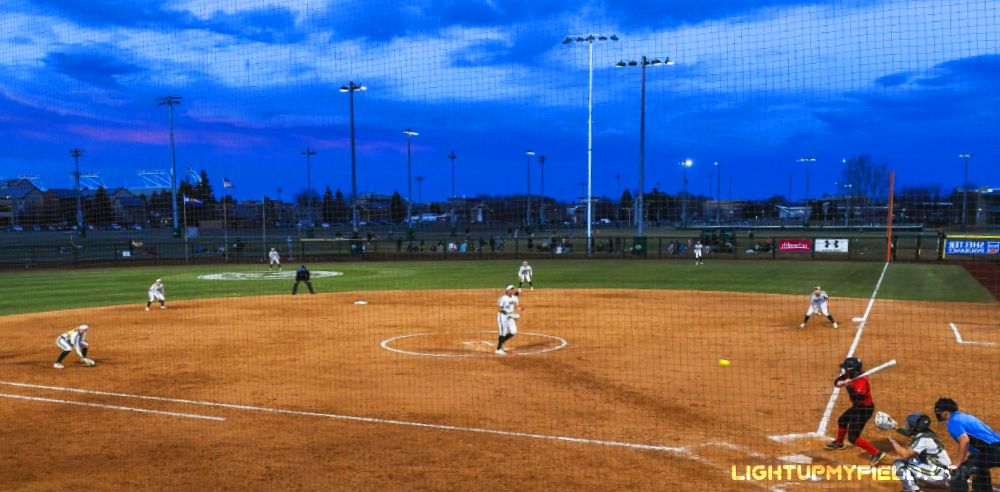
Uneven lighting creates pockets of shadows that make it harder for players to track the ball. Imagine a line drive heading to deep center field on a field with a 250 lux average but areas dropping below 150 lux in corners. That shadowed area can make the ball almost disappear, forcing fielders to guess its trajectory. Even small differences in brightness can slow reaction times by 0.2–0.3 seconds, which in softball is enough for a misplayed catch or a collision between players.
Areas like the pitcher’s mound, the infield dirt around bases, or foul territory near the dugouts are especially sensitive. Dim patches in these zones increase the risk of trips, slips, or awkward slides. Maintaining at least 60% uniformity across the field ensures the darkest areas still provide sufficient visibility.
Consistent Performance
Even coverage isn’t just about safety—it affects player performance. Batters need consistent light to pick up the rotation of the ball, fielders need it to judge depth and speed, and catchers need it to track high pop flies. A variation in brightness from 250 lux in the infield to 100 lux in the outfield corners can cause mistakes that wouldn’t happen under uniform lighting.
Professional and college-level fields aim for 700–1000 lux with a uniformity ratio of 0.7 or higher. At this level, players and coaches notice the difference immediately—balls are easier to track, and there’s less visual fatigue over the course of a game. Even recreational fields benefit when dim areas are minimized, helping young players learn proper tracking and reaction skills.
Visual Comfort and Glare Reduction
Uneven lighting doesn’t just create dark spots; it can also produce glare in areas that are over-illuminated. For example, if infield lights are significantly brighter than the outfield, batters looking up can experience temporary blindness, and fielders transitioning from shadow to bright light can be momentarily disoriented.
Maintaining smooth transitions with overlapping beams and well-aimed fixtures ensures the brightness doesn’t jump drastically from one area to another. Many designers target infield to outfield lux variation of less than 20–30%, which keeps the field visually comfortable for everyone.
Spectator Experience
Even lighting coverage isn’t just about the players—it also enhances the experience for spectators. Fans in the stands need to see the ball clearly, follow the movement of players, and enjoy the game without squinting into overly bright or dim areas. For televised or streamed games, uniform lighting across the diamond ensures cameras capture accurate colors and consistent contrast, preventing flickering or washed-out images.
In recreational parks, good uniformity allows parents and local fans to follow the action clearly, even in areas like outfield bleachers or along the baselines, where shadows often form if lights aren’t properly positioned.
How to Achieve High Lighting Uniformity in Softball Fields
Uniform lighting doesn’t happen by accident. It’s a careful balance of pole placement, fixture selection, aiming angles, and beam overlap. Getting these elements right ensures every part of the field—from the pitcher’s mound to deep center field—is consistently lit, reducing shadows, glare, and visual strain.
Light Pole Placement
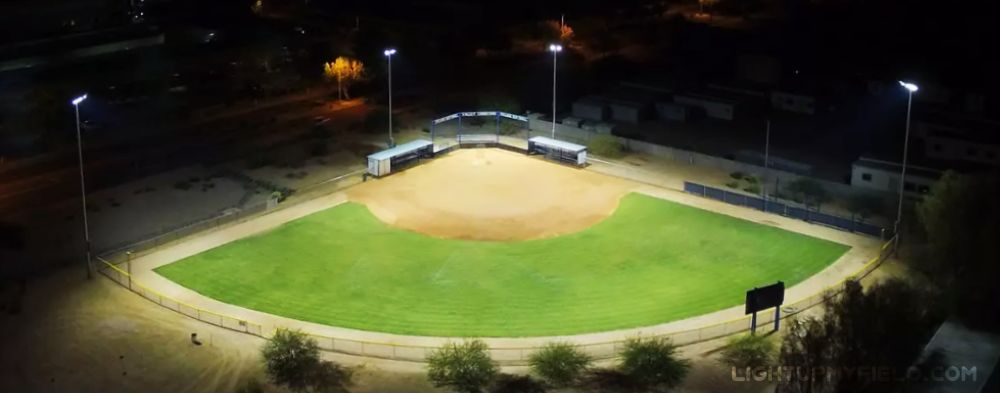
Pole placement is one of the biggest factors influencing uniformity. For a standard adult softball field, four to six poles are typically used. Smaller community fields can often get by with four poles, positioned along the foul lines, while college, semi-pro, or professional fields usually use six, with two poles located behind the outfield fence to cover deep zones.
Poles should be set outside the playing area—generally 10–15 feet behind the foul lines and 20–30 feet from the outfield fence. Pole height plays a major role as well. Taller poles (50–70 ft) help spread light evenly and reduce sharp shadows, but if they’re too tall or poorly aimed, you can get light spill, glare, or uneven brightness in key areas.
Spacing between poles also affects how evenly light spreads. On a typical 200–250 ft softball field, poles along the sidelines are often 90–120 feet apart. Slight beam overlap is crucial to avoid dark spots in corners or along the infield, which can make catching pop flies or tracking grounders much harder.
Choosing the Right Fixtures
Not all lights behave the same way. Modern LED floodlights are now standard for softball fields because they produce more lumens per watt, maintain consistent brightness over time, and allow for precise aiming.
The beam angle of each fixture is particularly important. Narrow beams concentrate light in a small area, which works well for the infield or around bases, but too narrow a beam can create hot spots. Wider beams cover larger areas but may reduce intensity. Many designers use a mix: narrow beams for the infield and wider beams for outfield coverage, which helps maintain both brightness and uniformity.
Fixture optics also play a big role. Lenses that focus or diffuse light can help minimize glare and direct illumination where it’s needed, reducing waste and preventing uneven lighting. The goal is for both the infield and outfield to receive similar lux levels, creating a smooth, consistent field of light.
Optimal Light Aiming and Beam Angle Selection
Even with the best poles and fixtures, improper aiming can ruin uniformity. Lights are usually tilted between 20°–35°, depending on pole height and field dimensions. The objective is to overlap beams just enough to eliminate shadows without producing overly bright areas.
Many fields now use lighting design software like Dialux or AGi32 to simulate the layout and check how beams interact with the field surface. This allows designers to adjust angles before installation, ensuring each zone—from the pitcher’s mound to the far outfield—is evenly illuminated.
For example, slightly angling infield lights toward the bases and the mound can provide balanced illumination across the diamond, while the outfield receives consistent coverage. Proper overlap and aiming help maintain a uniformity ratio of 0.6–0.8, meaning the dimmest areas are still at least 60–80% as bright as the average lux level on the field.
How to Measure the Lighting Uniformity in Softball Fields
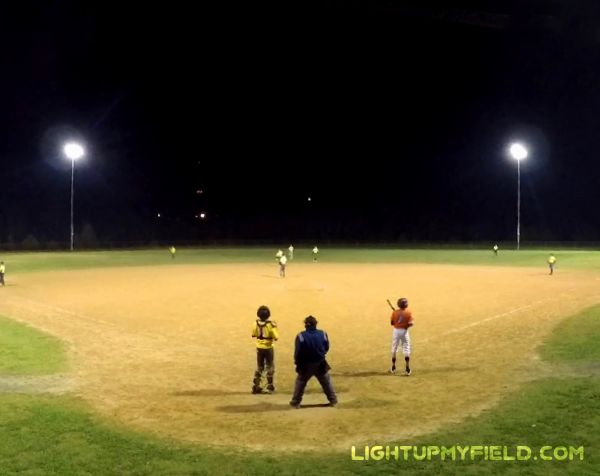 Even the most carefully designed lighting system can only be trusted once it’s tested and measured on the field. Achieving even coverage isn’t just about theory; it requires quantifying how bright each area is and confirming that the infield, outfield, bases, and foul lines all meet the intended lux levels.
Grid Sampling
One of the most common methods for measuring field uniformity is grid sampling. Essentially, you divide the field into a series of equal squares, often 5–10 feet per square, and take lux readings at the center of each square using a reliable light meter.
For example, on a standard 200-foot softball field, you might have a grid of 20×20 points, covering every zone from the pitcher’s mound to deep center field. Each reading gives you a snapshot of the brightness at that spot, and when combined, these readings provide a full picture of field illumination.
The results are often summarized using the uniformity ratio, which is the ratio of the minimum lux to the average lux. A ratio of 0.6 or higher is typically targeted for recreational and high school fields, meaning the dimmest spot still receives at least 60% of the average field brightness. For professional or televised games, the ratio is usually 0.7–0.8, ensuring even the darkest areas are nearly as bright as the average, which is especially important for high-speed ball tracking and HD broadcast standards.
Analyzing Results
Once you’ve collected your readings, it’s helpful to plot the data on a heat map or spreadsheet. Darker areas indicate under-illuminated zones, while very bright spots highlight potential glare or hotspots.
If you find uneven coverage, several adjustments can help: re-aiming fixtures, slightly changing beam angles, repositioning poles, or adding a few extra lights in dim areas. For instance, a pop fly to left field might be lost in shadow if one outfield corner is only 50% as bright as the rest of the field. Adding a light or adjusting angles can bring that zone up to 90–100% of average lux, dramatically improving visibility.
Maintenance and Long-Term Checks
Uniformity isn’t a one-time concern. Even LED fixtures gradually lose brightness, often 2–3% per year, and dust, dirt, or weathering on lenses can further reduce output. For example, a 600W LED fixture producing 60,000 lumens initially might drop to 57,000 lumens after two years of outdoor use if not cleaned.
Regular re-measuring—ideally every 1–2 years—helps maintain uniform coverage. This is particularly important for fields hosting tournaments or night leagues, where consistent illumination affects both safety and player performance. Small adjustments, like cleaning lenses or tweaking aiming angles, can restore uniformity without major upgrades.
Benefits of Measuring Uniformity
Taking the time to measure and adjust lighting uniformity ensures the field performs as designed, enhances player safety, improves the spectator experience, and keeps the field ready for higher-level competition or broadcasts. A uniform field also reduces eye strain for players, helps umpires make fair calls, and prevents the uneven shadows that often lead to misplays.
By combining grid sampling, heat map analysis, and routine maintenance, softball fields of any level can maintain smooth, even illumination that supports safe, competitive, and enjoyable nighttime play.
Conclusion
Even lighting coverage isn’t just a “nice-to-have.” It influences player performance, safety, and the overall game experience. By carefully planning pole placement, fixture selection, and aiming angles, and verifying coverage through grid sampling and uniformity measurements, you can create a field that performs well for casual games, tournaments, or professional matches.
With the right design, a softball field can have smooth, consistent brightness across the infield and outfield, letting players focus on the game instead of struggling with shadows or glare. And when the lights are balanced and even, nighttime softball finally feels as good as daytime play.